

T-Mobile's latest earnings report shows a troubling trend: its postpaid phone churn, the percentage of customers who cancel service, climbed to 0.9% in 2025. That's up from 0.84% in 2024. For a company built on aggressive customer acquisition, this rise in defections is a direct threat to its growth engine. The company itself points to the cause: T-Mobile raised prices for some of its legacy phone plans earlier last year and later made other plan changes that irritated some customers.
This isn't just a numbers game; it's a behavioral finance problem. The data reveals a deep-seated price sensitivity. A recent survey found that about 58% of U.S. consumers said that a bill increase triggers them to reevaluate their phone plan. In other words, the mere prospect of higher costs is enough to spark a search for alternatives. This aligns with the broader economic pressure consumers feel, making them more open to change. As one survey noted, "In 2026, that openness became action. Consumers are not passively renewing mobile plans. They are actively evaluating them."
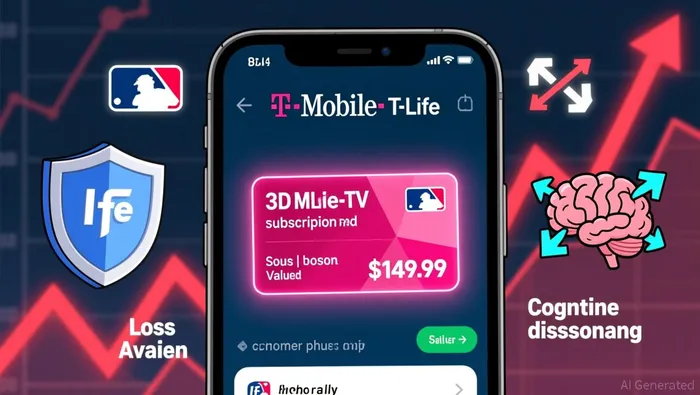
The company's response is a classic psychological play. By flooding its T-Life app with free perks-like a free, full regular-season subscription to the MLB.TV app valued at $149.99-T-Mobile is directly targeting two powerful cognitive biases. First, it leverages loss aversion: customers are more motivated to avoid losing a valuable freebie than to gain a similar benefit. Second, it exploits cognitive dissonance. After receiving a $150 perk, a customer who then switches carriers would have to justify abandoning a tangible, recent benefit, creating internal discomfort. This surge in freebies is T-Mobile's attempt to make the cost of leaving feel psychologically heavier than the cost of staying.
The Perk Arsenal: Designing for Behavioral Triggers
T-Mobile isn't just offering free stuff; it's engineering a psychological environment designed to make leaving feel like a loss. The company's arsenal of perks is meticulously crafted to exploit specific cognitive biases, turning everyday rewards into powerful retention tools.
The cornerstone of this strategy is T-Mobile Tuesdays, a monthly ritual that creates a habitual reward system. By guaranteeing a free Slurpee or movie ticket every week, T-Mobile is actively cultivating the endowment effect. This bias makes people value something more highly simply because they possess it. After receiving a freebie for months, a customer begins to feel a sense of ownership over that benefit. The prospect of losing it-a tangible, recurring perk-becomes psychologically heavier than the abstract benefit of switching to a competitor's plan. This transforms a simple discount into a perceived asset, raising the emotional cost of departure.
Then there are the exclusive experiences, like the Magenta Pass. This perk isn't about saving money; it's about access and belonging. By offering exclusive entrances and experiences at major venues, T-Mobile taps into social proof and herd behavior. Customers aren't just getting a ticket; they're gaining entry to a perceived in-group, a community of T-Mobile loyalists enjoying unique events. The desire to be part of this exclusive circle, to avoid missing out on a shared social experience, creates a powerful social anchor that can outweigh the appeal of a cheaper plan.
Finally, the company is testing a new layer of targeted offers for at-risk customers. As reported, T-Mobile is beginning to offer two new plan types for existing customers, specifically for "segmented" accounts. This is a direct application of the status quo bias-the human tendency to stick with the current situation, even when alternatives exist. By proactively presenting these customized "retention" plans, T-Mobile is lowering the perceived friction of staying put. The offer is framed as a special appreciation, not a negotiation. For a customer already feeling the sting of a price hike, this targeted gesture can make the status quo feel like the safer, more rewarding choice, effectively countering the natural inertia that often leads to churn.
Together, these tactics form a multi-pronged attack on the psychology of departure. From the habitual endowment of monthly freebies to the social pull of exclusive access and the strategic nudge of targeted offers, T-Mobile is using behavioral insights to build a moat around its customer base. The goal is clear: make the cost of staying feel minimal, while making the cost of leaving feel substantial.
Financial Impact and Competitive Context
T-Mobile's perk strategy operates against a backdrop of robust financial strength, which provides the necessary cushion to fund its aggressive retention play. The company's 2025 results were stellar, posting net income of $11.0 billion and generating $18.0 billion in Adjusted Free Cash Flow. This financial muscle is the bedrock that allows T-Mobile to offer a flood of freebies without immediately threatening its bottom line. The strategy's partial success is evident in the customer numbers: despite rising churn, T-Mobile posted industry-leading customer growth of 7.8 million postpaid customers in 2025. This net gain shows the perks are helping to offset defections and fuel expansion, even as the company navigates price sensitivity.
Yet, this financial buffer comes with a behavioral trade-off. The very strength that funds the perk arsenal also creates a risk of complacency. When a company is generating massive cash flows, there's a psychological tendency to view current profitability as a permanent state. This can lead to margin pressure over time, as the cost of these free benefits-while small per customer-adds up across millions. The strategy is a bet that the long-term value of a retained customer, who stays longer and spends more, outweighs the immediate cost of the perk. The risk is that this cost could erode the already-high industry-leading margins if not managed carefully.
The competitive landscape further complicates the calculus. T-Mobile isn't fighting a passive battle; it's in a race with rivals who are also innovating. The broader telecom sector is fiercely competitive, with Verizon and AT&T also handily outperforming the S&P 500 Index early in 2026. Verizon, in particular, has been a standout, delivering massive beats on subscriber growth. This environment forces T-Mobile to continuously refine its behavioral playbook. It can't afford to rest on its laurels. The perk strategy must evolve to stay ahead, countering not just its own churn but also the aggressive moves of competitors who are also targeting customer loyalty. In this context, the perks are less a one-time fix and more a critical, ongoing investment in the company's competitive moat.
Catalysts and Risks: The Behavioral Tipping Point
The success of T-Mobile's perk strategy now hinges on a series of future events that will test the limits of its behavioral playbook. The company is walking a tightrope between funding customer loyalty and preserving its financial edge. The key thresholds to watch are clear.
First, the most direct signal of failure would be a sustained deterioration in customer retention metrics. The company's own data shows churn rising to 0.9% in 2025. If this trend continues and churn climbs above 1.0%, or if its industry-leading postpaid customer additions begin to shrink, it would signal the perks are insufficient to counteract price sensitivity and competitive pressure. This would force a painful recalibration of the strategy, potentially requiring even more expensive incentives.
Second, the risk of a competitive arms race looms large. T-Mobile is not alone in its pursuit of loyalty. The broader telecom sector is fiercely competitive, with rivals who are also innovating. As the evidence shows, Verizon and AT&T are also offering tiered plans with varying perks and prices. If competitors match or exceed T-Mobile's freebie offerings, it could trigger a costly and margin-squeezing price war. The current financial strength provides a buffer, but the behavioral trade-off is real: the cost of these free benefits, while small per customer, adds up across millions and could erode the already-high industry-leading margins if not managed carefully.
Ultimately, the strategy's success depends on a psychological tipping point. It must convince customers that the perceived value of freebies like a free MLB.TV subscription outweighs the actual cost to T-Mobile's earnings. The company's 2025 results show it can afford this play, posting net income of $11.0 billion and generating massive cash flow. Yet the strategy is a bet that the long-term value of a retained customer, who stays longer and spends more, outweighs the immediate cost of the perk. The risk is that this cost could become a material drag on earnings per share if the perk arsenal expands unchecked while customer loyalty fails to keep pace. For now, the behavioral moat holds, but the next quarter's churn and competitor moves will reveal if the freebies are truly a moat or just a costly distraction.