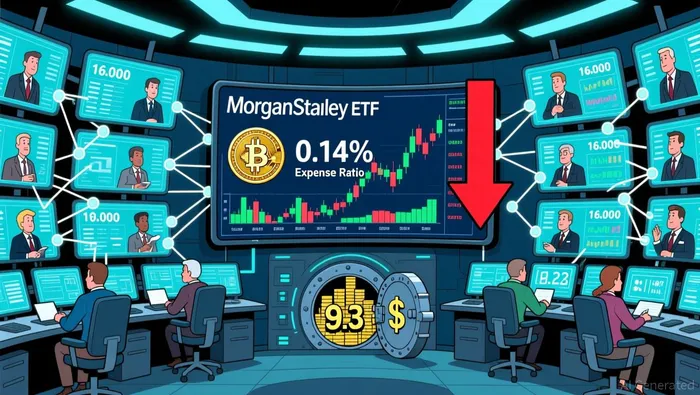
Morgan Stanley's spot Bitcoin ETF, MSBT, began trading on April 8th with a powerful debut. The fund logged roughly $34 million in inflows on its first day, a figure that places it among the top 1% of all ETF launches in the past year. This opening surge, which saw over 1.6 million shares change hands, established MSBT as a significant new player in a market dominated by giants like BlackRock.
The fund's competitive edge was immediate, anchored by its 0.14% expense ratio. This fee makes MSBT the cheapest spot Bitcoin ETF on the market, undercutting BlackRock's IBIT at 0.25%. For a product launching into a crowded field, this pricing strategy was a direct assault on the incumbent's cost advantage.
Crucially, MSBT is the first major U.S. bank to issue a spot Bitcoin ETF under its own name. This gives it a unique distribution advantage, as it can now leverage Morgan Stanley's network of approximately 16,000 wealth management advisors overseeing $9.3 trillion in client assets. That direct channel to institutional and retail clients is a structural shift in the ETF landscape.
Competitive Landscape: Sustaining the Momentum
The broader Bitcoin ETF sector faced a headwind on April 13, recording a $291.11 million net outflow. This reversal, following two days of gains, was led by Fidelity's FBTC, which saw $229.22 million in outflows. This choppiness highlights the volatility and investor caution that MSBT must navigate, even as it launches.
MSBT's primary weapon is its fee advantage. With a sponsor fee of 0.14%, it is the cheapest spot Bitcoin ETF. This pricing gives Morgan Stanley's 16,000 financial advisors a clear, conflict-minimized reason to recommend it over higher-cost competitors like BlackRock's IBIT at 0.25%. The bank's direct channel to its 16,000 advisors overseeing $9.3 trillion in client assets is a structural shift that could steadily draw assets from the crowded field.
Yet breaking into that field remains a challenge. MSBT's $34 million debut inflow was strong for a first-day launch, but it pales against the $237.9 million debut of Bitwise's BITB in January 2024. That earlier launch occurred during a period of heightened market enthusiasm. MSBT's path now depends on converting its fee and distribution edge into sustained flows, especially as the sector itself shows signs of fatigue.
Catalysts and Risks: The Flow-Driven Path Forward
The primary catalyst for MSBT is the conversion of Morgan Stanley's vast client base. With 16,000 financial advisors now able to recommend a product under the bank's own name, the potential flow is enormous. Analysts project that the first day's $34 million in inflows could represent a pace of $7 billion piling into bitcoin in just the first year. This direct channel to a $9.3 trillion client base is a structural shift that could steadily draw assets from the crowded field.
Yet the key risk is the sector's recent outflow trend. On April 13, Bitcoin ETFs saw $291.11 million in net outflows, a reversal that highlights investor caution. This choppiness suggests the market may not be ready to absorb new capital at the same pace as the launch. MSBT's ability to attract new money will be tested against this backdrop of volatility and sector fatigue.
The ultimate success metric is consistent inflows, not just a strong debut. To challenge IBIT's dominance in assets and liquidity, MSBT must generate sustained flows that outpace the sector's recent outflows. Its 0.14% expense ratio gives advisors a clear, conflict-minimized reason to recommend it. The path forward depends on whether that fee advantage and distribution power can translate into a steady stream of assets, overcoming the headwinds of a cautious market.