

Morgan Stanley's latest S&P 500 call changes the market argument more than the headline target suggests. The firm raised its 2026 year-end target to 8,000 from 7,800, saying the index still has room to rise after closing Tuesday at 7,400.96.
Not a simple liquidity call, the upgrade ties a stronger earnings environment to AI efficiency gains and improved pricing power, while noting that valuations could compress modestly as near-term rate-cut hopes fade. Profits are now being asked to do work that lower discount rates used to do.
Wall Street is moving the rally from multiples to earnings
Earlier phases of the bull market could lean on a cleaner story: falling inflation, eventual Fed relief and investors willing to pay more for long-duration growth. That framework is harder to defend when inflation data remain uncomfortable and the S&P 500 is already near a record.
Morgan Stanley's wording is important because it shifts the burden. The firm said its bullish index view is an earnings story rather than a multiple-expansion story, and set 2026 S&P 500 EPS at $339, 23% above the prior year. A target of 8,000 on that estimate implies investors are still paying a rich price for earnings, but not necessarily assuming a fresh valuation breakout.
Using Wednesday's 7,444.25 S&P 500 close, the new year-end target leaves about 7.5% upside. That is a demanding but not euphoric setup. The difference between a credible 8,000 call and a fragile one is whether the earnings line keeps moving up.
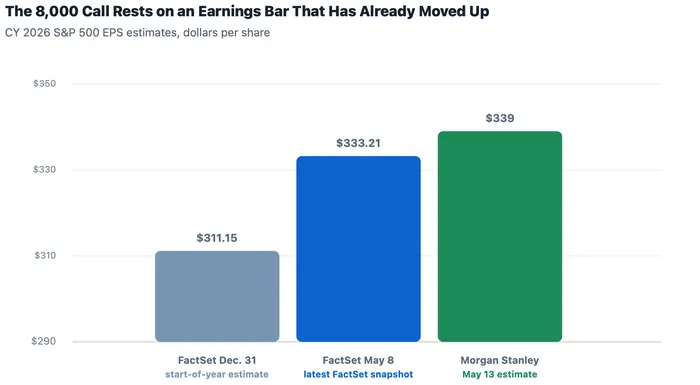
Sources: First Trust Portfolios summary of FactSet CY 2026 EPS estimates and Reuters report on Morgan Stanley's $339 EPS estimate. Basis: stitched S&P 500 calendar-year EPS comparison across source windows; FactSet snapshots from Dec. 31, 2025 and May 8, 2026; Morgan Stanley estimate reported May 13, 2026.
Q1 earnings give the upgrade a real evidence base
A strategist's target alone would not be enough. FactSet's May 8 Earnings Insight showed that, with 89% of S&P 500 companies reported, 84% had delivered positive EPS surprises and Q1 blended earnings growth was 27.7% year over year.
Index strength raises the evidence bar. If earnings were only meeting estimates, a 21x forward multiple would look more like valuation risk than profit confirmation. Companies are beating estimates at an above-average rate, while calendar-year 2026 EPS expectations have been revised higher.
FactSet data summarized by First Trust show 2026 calendar-year S&P 500 earnings estimates rising from 311.15 at the end of 2025 to 333.21 on May 8. Morgan Stanley's $339 forecast sits above that latest bottom-up number, but it is not detached from the direction of revisions.
AI now has to prove operating leverage
AI's role in the new target is narrower than the usual mega-cap enthusiasm. Morgan Stanley is not only saying that AI demand exists. It is saying broader AI adoption can improve efficiency and support pricing power across the index.
For investors, that distinction matters. Chip and cloud stocks can rally on capacity demand, but an S&P 500 target needs a broader profit mechanism. AI has to lower unit costs, improve sales productivity, reduce support expenses, speed software development or help companies protect margins in a slower-growth economy.
FactSet's sector data still show concentration. Information Technology had the strongest Q1 earnings growth among S&P 500 sectors at 50.7%, followed by Communication Services at 48.8%. Durability improves if those gains spread into industrial, financial and consumer businesses rather than remaining mostly a mega-cap technology story.
Rate cuts are no longer the center of the bull case
Rate pressure makes the Morgan Stanley call more interesting. AP reported that technology led Wall Street to fresh records Wednesday even though most U.S. stocks fell after another discouraging wholesale-inflation update. Investors usually expect a different tape when the rally depends mainly on Fed relief.
FactSet put the S&P 500's forward 12-month P/E at 21.0, above both its five-year and 10-year averages. A multiple that elevated leaves less room for disappointment if inflation keeps yields high or if the Fed stays cautious.
For that reason, the new target is not a free pass for risk assets. It is a more disciplined version of bullishness: earnings growth has to offset the possibility that investors pay a slightly lower multiple for those earnings.
Breadth is the next credibility test
Index-level strength can still look healthier than the average stock. Charles Schwab's Q1 earnings review noted that Technology, Communication Services and select Consumer Discretionary drivers accounted for a disproportionate share of earnings upside, while the Magnificent 7 continued to outgrow the other 493 S&P 500 companies.
Two versions of the 8,000 trade follow. In the stronger version, earnings revisions broaden, equal-weight performance improves and AI productivity shows up outside the obvious winners. In the weaker version, the index reaches higher levels because a small set of companies keeps carrying the load while the rest of the market offers little confirmation.
Portfolio construction changes under that distinction. SPY, VOO and IVV capture the index target directly. QQQ remains tied to the AI and mega-cap profit engine. Equal-weight exposure becomes the cleaner test of whether the earnings story is becoming broad enough to support a less fragile market.
The 8,000 call needs earnings proof, not a softer story
The next checkpoints are straightforward. Investors need more upward EPS revisions, stable or improving margins, positive guidance for the second half of 2026 and evidence that AI spending is starting to improve productivity rather than only lifting capital intensity.

Morgan Stanley's 8,000 target is useful because it makes the bull case more accountable. A market that once needed easier money now has to show that AI-driven productivity and pricing power can turn into actual EPS. If that keeps happening, 8,000 is an earnings destination. If it does not, the target becomes a valuation problem with a better headline.