

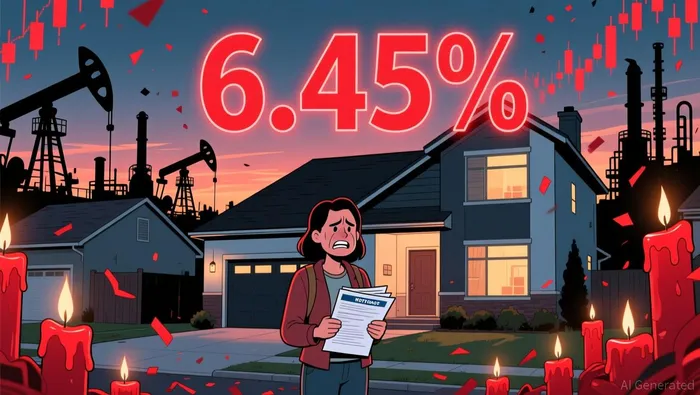
The average 30-year fixed mortgage rate has climbed to 6.45%, marking its highest level in a month and significantly straining housing affordability for prospective buyers. The primary catalyst for this upward spike is escalating geopolitical tension in the Persian Gulf, which has driven oil prices higher and reignited fears of persistent inflation. Consequently, the 10-year Treasury yield has jumped, directly pressuring long-term mortgage rates as investors demand higher returns to offset geopolitical and inflationary risks. Mortgage application volumes have contracted sharply, with purchase activity falling 4% as lower-income and first-time buyers are increasingly priced out of the market.
The American housing market is grappling with a sudden and severe shift in borrowing costs, driven almost entirely by external macroeconomic shocks rather than domestic economic overheating. As of early May 2026, the benchmark 30-year fixed mortgage rate has surged to 6.45%, erasing the modest optimism that briefly took hold earlier in the spring season. This rapid uptick is not a reflection of a booming domestic economy, but rather a direct transmission of geopolitical instability in the Middle East into the U.S. financial system. Investors and homebuyers alike are now navigating a landscape where foreign conflict dictates domestic borrowing costs, creating a volatile environment that is rapidly sidelining average-income shoppers.
To understand why your mortgage rate is climbing, it is essential to look beyond the Federal Reserve's immediate actions and examine the broader bond market mechanics. Mortgage rates are benchmarked primarily to the 10-year Treasury note, which serves as the baseline for long-term lending. When geopolitical tensions flare, as they currently are with the ongoing conflict involving Iran, oil prices typically spike due to fears of disrupted supply chains in the Strait of Hormuz. This surge in energy costs feeds directly into inflation expectations. As inflation fears rise, investors sell off fixed-income bonds, causing their prices to fall and their yields to rise. Since mortgage rates track the 10-year Treasury, they inevitably follow the bond market higher. The current 10-year yield, which recently climbed to 4.37% from late February levels, is the direct mathematical driver of the 6.45% mortgage rate we are seeing today.
How Does Geopolitical Conflict Impact Mortgage Rates Today?
The transmission mechanism from Persian Gulf tensions to your local mortgage rate is both swift and unforgiving. The ongoing conflict has acted as a massive wildcard, injecting extreme volatility into the bond market and making the path to lower rates incredibly narrow. While there have been fleeting moments of optimism regarding potential ceasefire proposals—which briefly pushed rates down toward 6.18%— any renewed hostilities or escalations in the region instantly reverse those gains. This whipsaw effect has left the housing market in a state of suspended animation, where daily rate movements are dictated by overnight news cycles rather than fundamental housing data.
Compounding this external pressure is the Federal Reserve's own cautious stance on domestic inflation. Although the Fed recently held its benchmark interest rate steady, the meeting was marked by significant internal dissent, with three governors objecting to any language suggesting an "easing bias." Core inflation remains stubbornly elevated at 3.2%, well above the Fed's 2% target, and the labor market continues to show resilience. This structural backdrop means the Fed is under no immediate pressure to cut rates, leaving mortgage rates to float entirely on the winds of geopolitical risk and bond market volatility. The combination of an inflation-phobic central bank and a war-driven bond market has created a perfect storm for elevated borrowing costs.
Why Are Homebuyers Dropping Out of the Market?
The human cost of these elevated rates is already becoming starkly visible in housing transaction data. The Mortgage Bankers Association reported a 4.4% week-over-week decline in total mortgage application volume, with purchase applications falling by 4% and refinance demand dropping by 5%. This contraction is not uniform across the market; it is heavily concentrated among first-time buyers and those seeking lower-priced entry-level homes. The average loan size on purchase applications has hit a record high of $467,300, signaling that the market is now dominated by high-net-worth individuals or investors who can absorb the higher costs, while average-income shoppers are forced to retreat.
Refinance activity has also collapsed, accounting for only 42% of total applications, the lowest share since August 2025. Lenders are adding more points to loans to offset the risk, with the average rising to 0.66 points for conventional loans, further increasing the upfront cost of borrowing. For the broader housing ecosystem, this drop in demand is a double-edged sword. On one hand, it provides relief to an overheated market by cooling buyer frenzies. On the other hand, it threatens to stall economic activity in the construction and real estate sectors. The spring homebuying season, traditionally the most active period of the year, has been significantly dampened, with existing home sales down year-over-year for the first three months of 2026.
What Should Investors Watch for in the Coming Months?
Looking ahead, the path for mortgage rates remains deeply uncertain and highly sensitive to two main variables: geopolitical developments and upcoming U.S. labor data. Industry forecasts from major institutions like Fannie Mae and the Mortgage Bankers Association suggest that rates will hover in the low-6% range through 2026 and early 2027, with little hope of a sharp, structural decline. The consensus is that rates will remain "higher for longer," not because the domestic economy demands it, but because the geopolitical risk premium embedded in bond yields will not easily dissipate.
The immediate trigger for any rate movement will likely be the monthly employment report. A weaker-than-expected jobs report could ease inflation fears and push Treasury yields—and subsequently mortgage rates—lower. Conversely, a strong labor market would reinforce the Fed's hawkish stance and keep borrowing costs elevated. For investors and homeowners, the bottom line is that the era of near-zero borrowing costs is structurally over. The housing market must now adjust to a new equilibrium characterized by mid-6% mortgage rates, constrained affordability, and a market that is as reactive to foreign wars as it is to domestic economic policy.