

U.S. stocks fell sharply early Friday as rising oil prices, increasing volatility and renewed concerns about stretched technology valuations pushed investors toward a more defensive posture after a powerful multiweek rally. The Dow Jones Industrial Average fell 415.79 points, or 0.83%, while the Nasdaq Composite dropped 439.68 points, or 1.65%, and the S&P 500 lost 87.63 points, or 1.17%, in early trading.
The selloff came as crude oil futures climbed back toward the psychologically important $100-a-barrel level amid continued uncertainty over the Iran war and concerns about global supply disruptions. June WTI crude futures rose $2.60, or 2.68%, to $99.52 early Friday after briefly trading above $100 overnight. At the same time, the CBOE Volatility Index, or VIX, surged 10.36% to 19.05, signaling a sharp increase in investor demand for downside protection.
Investors also appeared to be reassessing the durability of the AI-driven technology rally that has propelled the Nasdaq to repeated record highs in recent weeks. Yahoo Finance reported that U.S. equities are now trading at valuation levels not seen since the dot-com era, increasing sensitivity to any shift in macroeconomic or geopolitical conditions.
Technology and semiconductor shares were among the weakest performers despite another strong earnings report from Applied Materials. The company topped Wall Street expectations, but investors largely focused on profit-taking across high-multiple AI names after the recent run higher.
Markets were also digesting the conclusion of President Donald Trump’s China trip, which included renewed calls for economic stability and deeper engagement between Washington and Beijing. Investors initially viewed the diplomatic tone positively earlier this week, helping fuel gains in multinational industrial and semiconductor companies. Friday’s retreat suggested traders were rotating away from riskier assets as commodity prices and volatility accelerated.
Still, some macroeconomic signals remained constructive. Torsten Slok, chief economist at Apollo Global Management, highlighted improving household financial conditions, noting that the share of consumers expecting to miss a minimum debt payment over the next three months has fallen to its lowest level in several years.
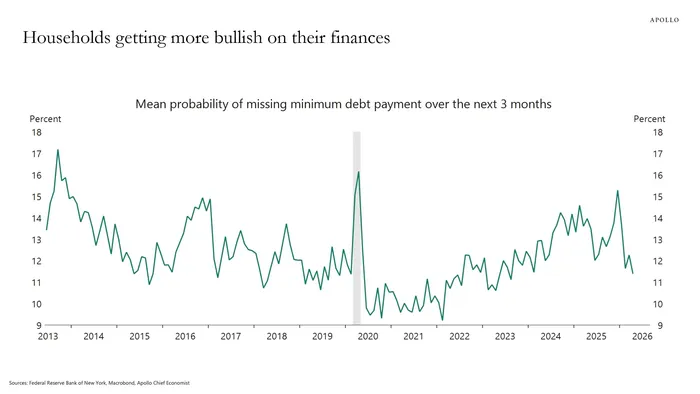
Apollo said the trend suggests financial stress is easing and households are becoming more optimistic about their finances.
The divergence between improving consumer balance sheets and rising market volatility underscored the current tension on Wall Street: investors remain optimistic about economic resilience and AI-driven earnings growth, but increasingly wary that elevated valuations, higher energy prices and geopolitical risks could trigger sharper market swings.