

Nebius Group is up more than 1% in overnight trading. The stock had just fallen 12% two days earlier after its CTO sold shares and macro headlines pushed the market lower. The move itself is routine noise for a $12 billion company that has rallied 492% over the past year.
The real story has nothing to do with overnight gaps. It's about what kind of business Nebius is building, and whether the market has fully priced the capital intensity - and leverage risk - underneath that 684% revenue growth number.
What Nebius Actually Is
Nebius is the international technology and cloud infrastructure business carved out of the former Yandex group. It reorganized around AI cloud services and now operates as an Amsterdam-headquartered infrastructure provider - essentially a GPU-powered data center company that rents compute capacity to AI developers and enterprises.
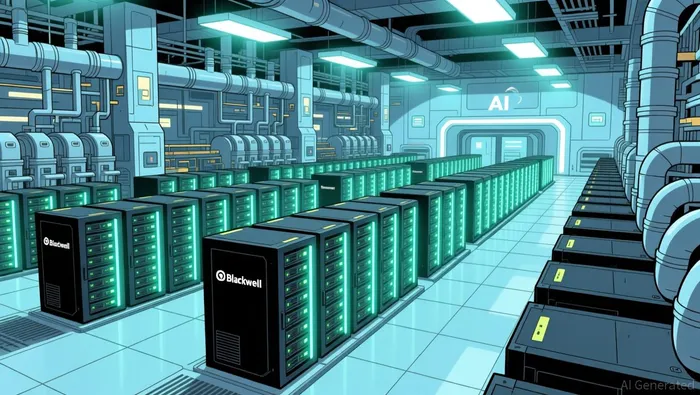
That matters because it determines the business model. Nebius doesn't design chips. It doesn't own a CUDA-equivalent software moat. It buys Nvidia's hardware - H100s, H200s, now Blackwell - builds the racks, powers the facilities, and rents the capacity. It's an AI factory that needs constant capital to expand.
That model works beautifully when demand outstrips supply and Nvidia is willing to fund part of the build. Nvidia invested $2 billion in Nebius in March 2026 as part of a strategic partnership to scale its full-stack AI cloud. The deal gave Nebius both financing and hardware access - two things it couldn't easily get elsewhere.
But it also created a structural dependency. If Nvidia controls the GPU supply chain and also owns a piece of Nebius, Nebius's margins and expansion timeline are ultimately a function of Nvidia's priorities, not its own.
The Demand Signal Is Real - and That's What Makes the Risk Harder to Ignore
Here's where the evidence stacks up in Nebius's favor:
- Q1 2026 revenue was $399 million, up from $51 million a year earlier.
- Full-year 2026 guidance is $3 billion to $3.4 billion. That's roughly six times last year's revenue.
- The company has guided to an annualized run-rate revenue of $7 billion to $9 billion by year-end 2026. ARR (annual recurring revenue) of that scale would make Nebius one of the fastest-growing AI infrastructure names on the market.
- Data center capacity is targeted at 800 megawatts to 1 gigawatt by year-end 2026 - up from a fraction of that a year ago.
Put plainly: the demand for GPU compute capacity is not a problem. Nebius has effectively sold out its available capacity and is building to meet orders that already exist. Companies are willing to commit to Nebius because it offers Blackwell access with bare-metal performance - something the hyperscalers haven't always been able to provide as flexibly to mid-market AI teams.
This is what separates Nebius from a generic cloud story. It's positioning itself as the AI-native alternative for teams that don't want to navigate Azure, AWS, or GCP bureaucracy - a bottoms-up demand pattern driven by developers, not enterprise procurement cycles.
However.
The Capital Burn Question
Revenue growth of 684% is compelling. What it doesn't show is how much capital each dollar of that revenue costs to generate.
Nebius's full-year 2024 operating cash outflow was $319.6 million. The company burned through more than $300 million in operating cash last year while only generating $117.5 million in revenue. The net loss widened to $249.6 million from $133.2 million a year earlier. Analyst models project negative cash flows bottoming out near $7.4 billion in 2026 - a figure that reflects the enormous capex required to build gigawatt-scale GPU facilities.
This is not a software company scaling cheaply. This is a capital-intensive infrastructure play. Every megawatt of data center capacity requires billions in hardware purchases, power infrastructure, and facility construction. Nebius is depending on debt and equity raises - plus that $2 billion from Nvidia - to fund a build-out that will dwarf its current revenue base.
Demand is not the issue. The issue is whether the supply commitments, the capital burn, and the debt dependence still justify the allocation the stock price implies.
DA Davidson flagged exactly this when it initiated coverage in May with a Neutral rating - citing high dependence on debt financing. The stock fell 9% on that call. Then it fell another 12% on June 5th when insider selling by the CTO (15,678 shares in a planned transaction) and macro headwinds from a hot jobs report hit at the same time.
Where the Stock Stands
At roughly $221 per share, Nebius carries a market cap around $12 billion. Against FY2026 guidance of $3–3.4 billion in revenue, that's roughly 3.5–4x forward sales. Analyst consensus sits around $197, with Goldman Sachs at $205 and Citigroup as high as $287.
Those numbers look attractive if you believe the $7–9 billion ARR run rate materializes. They look dangerous if the capex timeline slips, GPU supply tightens, or the debt load becomes a constraint.
I believe the long-term structural case for Nebius is intact. The shift from hyperscaler-dominated AI cloud to specialized AI-native infrastructure is real. Nebius is positioned on the right side of that transition, with Nvidia's endorsement as both strategic investor and primary hardware supplier. If the company hits its capacity targets, the revenue trajectory is explosive.
But the return profile is front-loaded into the stock already. A 492% annual gain means the market has priced in successful execution, on-time build-outs, and continued demand. The margin for error is narrow.
What Changes the Thesis
Three things would weaken my view:
Three things would strengthen it:
The Allocation Question
The debate is not whether Nebius remains important in the AI infrastructure build-out. It is whether a stock that has returned nearly five times its value in a year - with massive negative cash flows, heavy debt dependence, and a 12% pullback that hasn't fully stabilized - deserves a large allocation right now.
In my opinion, the setup is better suited to a small position than a core holding. The thesis is sound, but the timing is crowded. The stock has absorbed most of the upside from the earnings shock and the Nvidia partnership. What's left is execution risk on the build-out, and the market doesn't pay you well for carrying that when the stock has already run this far.
If the June pullback extends and the stock approaches the $180–$190 zone, the risk-reward becomes more interesting. At that level, the forward P/S compresses to closer to 5–6x - more room for error, more asymmetry. That's where the opportunity cost shifts back in Nebius's favor relative to alternatives in the AI infrastructure trade.
Until then, I'd rather watch from the sidelines. The AI infrastructure cycle isn't slowing down. But not every stock in it offers the best deployment of capital at the current price.