

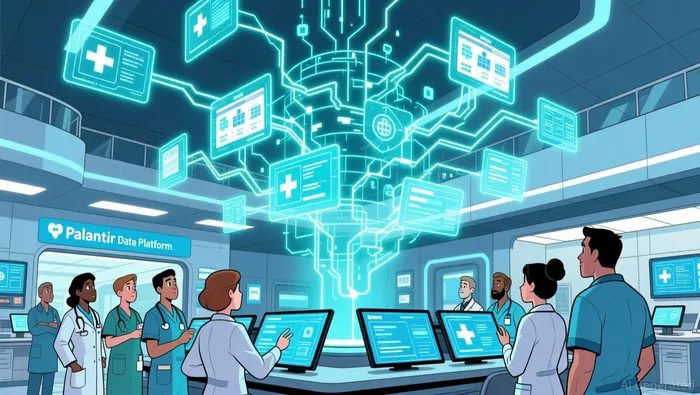
The £330 million seven-year contract signed in 2023 isn't just another government software deal-it's infrastructure play of the highest order. Palantir's Federated Data Platform (FDP) is being positioned as the central nervous system for England's fragmented NHS, connecting over 200 silos of antiquated medical data into a single operational layer. That's the S-curve play: become the indispensable rails for a system that desperately needs to integrate.
The early metrics justify the hype. By December 2025, the FDP had enabled 110,000 extra patients to undergo procedures-a measurable throughput gain that signals real adoption, not just pilot curiosity. The Chelsea and Westminster Hospital Trust pilot delivered a 28% reduction in inpatient waiting lists, the kind of operational leverage that makes health economics look attractive to cost-strapped public systems. These aren't theoretical benefits; they're the kind of numbers that create switching costs.
But here's the strategic tension: Palantir's infrastructure play works too well. The same qualities that make the FDP valuable-deep integration into clinical workflows, proprietary data structuring, operational dependency-also create the vendor lock-in that's now triggering political pushback. The government is exploring a break clause, and the science, innovation and technology select committee chair rejected Palantir's characterization of campaign concerns as "ideologically motivated," framing them instead as substantive issues around contract transparency, vendor lock-in, value for money and data security.
From an infrastructure layer perspective, this is actually confirmation of success. The most successful platform plays-think AWS in cloud or Snowflake in data warehousing-eventually face exactly this kind of institutional pushback as dependencies deepen. The question isn't whether Palantir has achieved critical mass in the NHS (the 110,000 procedures suggest it has), but whether the political system can tolerate the dependency or must sever it.
The UK's lack of a meaningful domestic alternative-many potential Palantir alternatives, like Microsoft, are U.S. companies too-suggests the government may well soldier on despite the political noise. That would cement Palantir's position as the de facto data infrastructure layer for one of the world's largest healthcare systems.
Infrastructure Play: Why This Matters for the S-Curve Thesis
The NHS contract isn't just another government deal-it's a textbook infrastructure layer play, and the metrics suggest Palantir has crossed the chasm.
The Federated Data Platform connects 200-plus silos of antiquated medical data-exactly the kind of fragmented, legacy data problem that Foundry was built to solve. Palantir's winning pitch was that its software could integrate disparate datasets better than anyone else, turning chaotic medical records into a digestible whole that AI can actually consume. That's the S-curve adoption story in a nutshell: a platform becoming indispensable to a massive, fragmented system by solving the integration problem that others can't touch.
The early adoption metrics justify the infrastructure thesis. By December 2025, the FDP had enabled 110,000 extra patients to undergo procedures-a measurable throughput gain that signals real operational dependency, not pilot curiosity. The Chelsea and Westminster Hospital Trust pilot delivered a 28% reduction in inpatient waiting lists. These aren't theoretical benefits; they're the kind of numbers that create switching costs and position Palantir as the de facto rails for healthcare AI at scale.
What reinforces the infrastructure play is the pattern across government. Beyond the NHS, Palantir has secured a contract with the UK Ministry of Defence worth up to £750 million over five years using the same data integration solutions. Add in police forces and the financial watchdog, and you see a deliberate strategy: capturing the "hard tech" government infrastructure roles that competitors avoid or can't deliver. This isn't about point solutions-it's about becoming the operating system for national-scale data operations.
The question for investors is whether this unlocks the exponential healthcare AI pipeline or whether reputational concerns create a ceiling. The infrastructure layer is built-the 200+ connections, the operational dependency, the measurable outcomes all confirm that. The wildcard is political: whether the UK government can tolerate the vendor lock-in or must sever it, and whether similar pushback emerges in other markets.
But here's the strategic reality: the UK lacks a meaningful domestic alternative, and many potential alternatives like Microsoft are also U.S. companies. France's domestic intelligence service recently renewed its Palantir contract despite searching for a domestic option. The infrastructure is too deeply embedded to abandon easily.
For the S-curve thesis, this is the inflection point. The platform has achieved critical mass in one of the world's largest healthcare systems. The question is no longer whether Palantir can integrate healthcare data-it's whether the political system can tolerate the dependency it has created. If the government soldier on (and all signs suggest it will), Palantir's position as the indispensable rails for healthcare AI becomes cemented. That's the exponential upside. The reputational risk is real, but it's a political problem, not a technological one-and the infrastructure is already laid.
Valuation and Scenario Risk: The Break Clause Wildcard
The market is sending a clear signal: Palantir's valuation now embeds the NHS infrastructure play as done, but hasn't fully priced the political risk scenario.
PLTR trades at EV/EBITDA of 159.7x and PS of 63.2x-extreme multiples that assume successful S-curve adoption across government healthcare systems. Yet the stock is down 22.48% YTD, suggesting investors are discounting something. The gap between where the stock trades and where it could end up depends entirely on how the NHS break clause plays out.
The 2027 break clause is the binary event. Exercising it would represent a significant revenue headwind-the £330 million contract spans seven years, and losing it would signal to other governments that Palantir's infrastructure plays are reversible. Preserving it, however, locks in the contract through at least 2030 and cement's Palantir's position as the indispensable rails for healthcare AI at scale. The question isn't whether the government wants to walk away-it's whether it can.
Here's where the deep tech thesis meets political reality. Committee chair Chi Onwurah rejected Palantir's characterization of campaign concerns as "ideologically motivated", framing them instead as substantive issues around contract transparency, vendor lock-in, value for money and data security. This is not a death sentence. Ministers are seeking guidance on triggering the break clause, not announcing termination. The UK lacks a meaningful domestic alternative-many potential alternatives, like Microsoft, are U.S. companies too.
For the S-curve investor, the real question is whether NHS data access unlocks a broader healthcare AI pipeline or whether reputational concerns around Palantir's military and police contracts create a ceiling on government adoption. The infrastructure is built-the 200+ data connections, the 110,000 extra procedures, the measurable operational gains all confirm the platform works. The wildcard is political: whether the system can tolerate the dependency it has created.
If the government preserves the contract (and all signs suggest it will), Palantir's valuation has room to run-the exponential healthcare AI pipeline is just beginning. If it exercises the break clause, the multiple contracts back to reality. The market is pricing in the former; the political risk premium is embedded in the YTD underperformance. The inflection point is coming.