

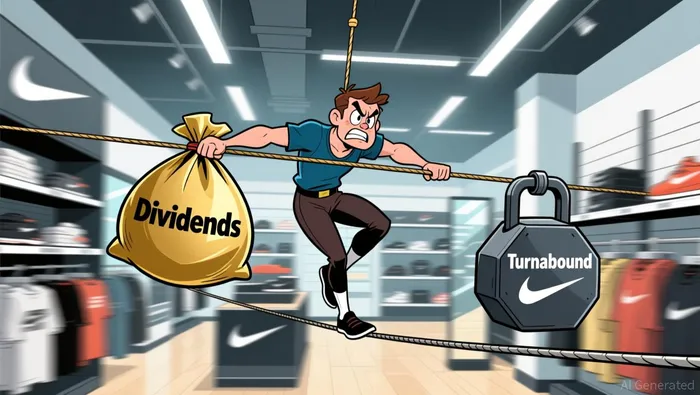
The recent declaration of a $0.41 quarterly dividend presents a classic test of financial discipline. For years, Nike has maintained a steady policy of annual increases between 5% and 20%, a hallmark of a company confident in its cash flow. Yet this commitment to returning capital to shareholders comes at a time when the company is in the midst of a multi-year, capital-intensive turnaround. The tension is clear: how much can be paid out in dividends while funding the deep operational reset required to restore the business?
That reset is the Win Now action plan, launched under new CEO Elliott Hill in 2024. The strategy aims to repair relationships with partners, refocus on core product innovation, and stabilize a business that had suffered from strategic missteps. Evidence suggests the immediate pressure has eased, with sales stabilizing and inventory improving. But as one analyst noted, "If you're 62 years old and you break your leg... it takes a much longer time before you can walk without a limp." The company is in the "final stretch" of its operational overhaul, a phase that demands continued investment in supply chain optimization, technology, and team upskilling.
The central dilemma for investors is this: maintaining a growing dividend requires strong, predictable earnings, but a successful turnaround often requires spending that pressures near-term margins. Nike's historical model of high operating margins fueled both growth and generous shareholder returns. The challenge now is to prove that margins can recover and that the recovery is sustainable. If the company must choose between funding its turnaround and sustaining its dividend growth, the path to long-term intrinsic value may require a temporary pause in the payout. The dividend policy is a sign of a durable compounder only if the underlying business can generate the cash to support both its reinvestment needs and its shareholder commitments.
The Foundation of a Durable Compounder: Margin Recovery
The recent revenue growth is a relief, but it is not the story that determines intrinsic value. The real test for Nike's ability to fund both its turnaround and its dividend lies in the recovery of its margins. The company reported a 1% increase in first-quarter revenue, a modest step from the declines of previous years. Yet this stability is overshadowed by a significant contraction in profitability. Gross margin fell 320 basis points to 42.2%, a clear sign that the business model is under pressure.
This decline is the flip side of the operational reset. The company has been forced to lean on promotions and a less favorable channel mix to clear inventory, a necessary but costly move. The result is a loss of pricing power that has eroded the premium brand identity. For a durable compounder, this is the central vulnerability. Historically, Nike's operating leverage-its ability to grow earnings faster than sales-was anchored in operating margins in the mid-to-high teens. That structure allowed earnings per share to accelerate, fueling both reinvestment and generous shareholder returns. The recent margin compression means that leverage has slipped, and the path to EPS growth is now blocked.
The central thesis for 2026 is straightforward: margin recovery is the key near-term test for available cash flow. Without it, even modest revenue growth will generate muted earnings, limiting the capital available for the Win Now plan and for sustaining the dividend. The company must demonstrate that full-price sell-through is strengthening, that gross margin can trend upward consistently, and that operating expenses are being disciplined. These are the signals that will rebuild investor confidence in the premium business model. Until then, the dividend policy remains a promise that must be funded by a recovery that is not yet in sight.
Evaluating the Payout: A High Ratio and Insider Confidence
The dividend's sustainability now hinges on a critical question: can Nike afford to pay it while it still needs to invest? The numbers tell a story of a company operating at a high level of financial commitment. For the fiscal year ending in August 2025, Nike's dividend payout ratio stood at 82%. This is a stark figure, especially when compared to the industry median of 42%. Even within its own history, this ratio is extreme, matching the highest level recorded over the past 13 years. A payout ratio this elevated leaves little room for error; it means nearly all of the company's net income was used to fund shareholder returns, a level of distribution that is difficult to maintain if earnings falter.
This context makes the recent insider buying all the more telling. In late 2025, despite the stock having fallen 56% over the last five years, Nike's leadership and board made a concerted move to acquire shares. The total purchases by CEO Elliott Hill, Tim Cook, and other directors exceeded $5.4 million. This is a powerful signal of internal confidence. As the adage goes, insiders buy when they believe the price will rise. Their actions suggest they see value in the current price and are betting on the Win Now plan's success. It is a vote of confidence in the long-term trajectory, even as the near-term financial math is tight.
The key signal for investors, therefore, is not the current payout ratio, but what management does next. The dividend policy will be the ultimate test of financial discipline during the margin recovery phase. If Nike maintains or increases its quarterly dividend of $0.41 while facing ongoing pressure on gross margins, it would demonstrate a profound belief in the durability of its cash flows. It would signal that the operational reset is working and that the premium business model is being restored. Conversely, any pause or reduction would be a clear admission that the turnaround is consuming more capital than anticipated, forcing a difficult choice between shareholder returns and reinvestment. For now, the high payout ratio is a risk, but the insider purchases suggest management is willing to live with that risk in pursuit of a higher intrinsic value.
Catalysts and Risks: The Path to Compounding
The investment thesis for Nike now hinges on a few clear milestones. The primary indicator is sequential improvement in gross margin and operating leverage in the quarters ahead. Management has stated that stabilization is underway, but as one analyst put it, the company is in the "final stretch" of a multi-year reset. The recent 1% increase in first-quarter revenue is a start, but it was accompanied by a 320 basis point drop in gross margin. The path to compounding requires reversing that trend. Investors must watch for signs that inventory is fully normalized, that promotional pressure is easing, and that full-price sell-through is strengthening. Only then can the company demonstrate that its premium business model is being restored, allowing earnings per share to grow faster than sales once again.
Management commentary on the dividend policy during upcoming earnings calls will be a critical signal of changing priorities. The company currently maintains a $0.41 quarterly dividend with a payout ratio near 82%, a level that leaves little room for error. If Nike continues to report margin pressure while reaffirming its commitment to dividend growth, it would signal deep confidence in its cash flow recovery. However, any hint that the dividend may be under scrutiny or that capital needs are taking precedence would be a major shift in narrative. The recent insider buying suggests leadership believes the stock is undervalued, but their words on the call will reveal whether they see the dividend as a core pillar of shareholder value or a potential lever to pull if the turnaround proves more costly than expected.
The ultimate risk is that the capital required to complete the Win Now turnaround exceeds cash flow after sustaining the dividend. The company has already shown it can stabilize sales and improve inventory, but the more difficult work of margin recovery is just beginning. If gross margin continues to compress or if unexpected costs arise in supply chain or technology, the high payout ratio could force a difficult choice. For a durable compounder, the goal is to fund reinvestment and shareholder returns from the same pool of cash. The current setup tests that balance. The path to long-term intrinsic value will be validated only if Nike can prove it can do both.