

The story behind the Nikkei's latest record isn't about Japan finally catching up in semiconductors. It's about Japan already owning the one layer of the AI buildout that no one can skip.
Tokyo Electron - Japan's largest chip equipment maker - guided for net sales of around JPY 1,570 billion for just the first half of fiscal 2027. Annualized, that implies roughly ¥3.1–3.2 trillion for the full year, a step up of 25–30% on top of a record ¥2.44 trillion fiscal 2026. The stock jumped 8.6% on the guidance alone. This is the signal the Nikkei rally is really pricing in.
The equipment layer is Japan's actual AI thesis
While most of the market fixates on chip designers - Nvidia, AMD, custom silicon from hyperscalers - the equipment makers are the ones who profit regardless of who wins the design wars. Every fab that Nvidia's Blackwell chips get manufactured in, every advanced node that TSMC ramps, every new AI accelerator that Amazon or Microsoft builds in-house requires the same set of deposition, etching, and inspection tools. Tokyo Electron, Advantest, and Screen make those tools.
Advantest, the testing equipment leader, has surged from a 52-week low of ¥7,010 to trading near ¥28,000 - nearly a four-fold move - as the global capex cycle validates its backlog. Tokyo Electron's field solutions division (maintenance, spare parts, upgrades) already generated ¥626 billion in fiscal 2026, up 16.3% year over year, creating a recurring-revenue floor beneath the cyclical equipment sales.
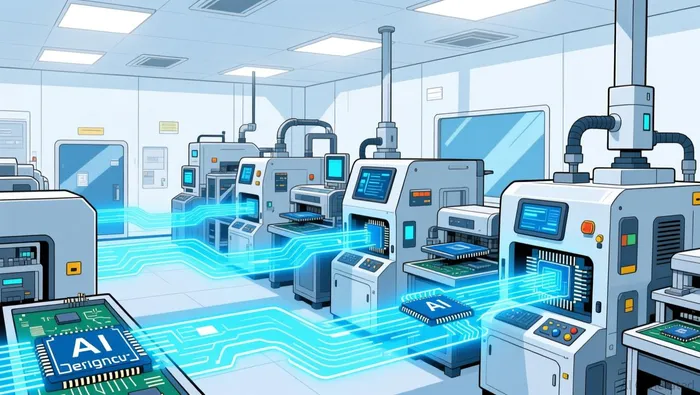
Put plainly: Japan's chip equipment names are the pick-and-shovel play on the AI infrastructure build. They don't need to design winning chips. They just need the buildout to continue.
The foundry story is still aspirational
Here's where the narrative gets stretched. Japan has spent years building two foundry stories: TSMC's Kumamoto operations and the state-backed Rapidus project aimed at 2-nanometer production by 2027.
TSMC's first Kumamoto fab entered mass production in late 2024, and the Taiwan government has approved a 3nm upgrade for the second facility. That's real, and it creates domestic equipment demand. But this is TSMC's capacity, not Japan's - the intellectual property, the process recipes, and the revenue all flow back to Taiwan.
Rapidus is more ambitious but further from revenue. The company raised $1.7 billion in strategic funding in February 2026 and is planning to begin 1.4nm development this year, targeting a six-month gap behind TSMC's roadmap. It powered up a pilot line for 2nm in April 2025. The timeline is aggressive, the backing is genuine, and the ambition is national - but mass production in 2027 remains a projection, not a commitment backed by tape-outs or yield data.
This is what separates Japan's equipment layer from its foundry layer. One is generating record revenue today. The other is a 12-to-24-month story that needs execution to matter.
SoftBank's pivot tells you where the capital is actually going
SoftBank's stock has been one of the primary Nikkei engines, surging on Nvidia's $81.6 billion Q1 fiscal 2027 revenue - Data Center alone at $75.2 billion, up 92% year over year. But the more interesting move happened months ago.
SoftBank sold its Nvidia stake in November 2025 for $5.8 billion - booking a massive gain - and redirected that capital into OpenAI, including a $40 billion commitment and the $500 billion Stargate infrastructure joint venture. The Vision Fund booked a $46 billion annual gain in fiscal 2025, driven largely by the rise in OpenAI's valuation.
This isn't random. Masayoshi Son is rotating from AI hardware equity to AI platform equity. He recognized that while Nvidia's run is extraordinary, the value migration from infrastructure to applications is already underway - and he positioned Vision Fund to capture the next phase.
Demand is not the issue for Nvidia or for the equipment layer. The issue is which layer captures the disproportionate returns as the buildout matures.
Where the allocation should go
The Nikkei's record high is telling you something specific: Japan's semiconductor equipment names are trading on real revenue acceleration, not speculation. Tokyo Electron's H1 FY2027 guidance implies 25–30% growth on a record base. Advantest's forecast calls for ¥1,420 billion in net sales. These are companies whose order books are being filled by the same AI capex that is printing Nvidia's results.
However, the question isn't whether these companies will keep growing. It's whether the return profile is still as compelling as direct exposure to Nvidia, or to the next bottleneck that emerges when the training cycle transitions toward inference dominance.
Japan's equipment layer gives you geographic diversification and currency hedging on the yen - and the pick-and-shovel durability of a business model that doesn't depend on any single chip winner. But the multiples are rising, and the 13% CAGR projection for Japan's domestic semiconductor equipment market through 2033 is strong, not explosive.
I believe the equipment layer deserves allocation - but as a core holding that absorbs volatility, not as the highest-conviction entry in the AI trade. The foundry story needs another 18 months of execution before it changes the calculus. And SoftBank's pivot from Nvidia to OpenAI suggests that even the most aggressive AI bulls are already looking past the infrastructure phase.
The debate is not whether Japan's chip stocks deserve their rally. It is whether the equipment layer's return curve is front-loaded enough to justify its current premium - or whether the next generation of returns is already migrating elsewhere in the stack.