

The headline numbers were spectacular-a 132.1% year-over-year revenue surge to 572.3 billion yen and operating profit up 4.4% to 56.9 billion yen. But here's the question that matters: what was the market actually pricing in? The Switch 2 launch was a known catalyst, and the consensus had already baked in strong unit sales. What Nintendo delivered was largely what sophisticated investors expected from a next-gen console ramp.
The real story isn't the beat-it's the margin compression. Operating profit margin dropped 12.2 points to 9.9%, a significant contraction that signals the cost structure of a hardware launch. Yes, Switch 2 moved 5.82 million units in the quarter with Mario Kart World selling 5.63 million copies-but hardware sells at thinner margins, and the mix shift dragged on profitability. This is the classic launch curve: top-line explosion, margin pressure.
Net profit included a 32.3 billion yen gain on sale of investment securities-a one-time item that further muddies the operational picture. The market isn't fooled by headline earnings; it's looking through to the underlying business quality.
So why did the stock react the way it did? Because the guidance reset mattered more than the earnings beat. The full-year forecast stayed flat at 1,900 billion yen in net sales with operating profit at 320 billion yen-no upgrade despite the spectacular quarter. That's the signal: management is not raising the bar, even as Switch 2 momentum builds. The expectation arbitrage here isn't about beating numbers-it's about whether the market underappreciated the margin headwinds that came with the hardware ramp.
Guidance Reset: The Real Surprise
The earnings beat grabbed headlines, but the guidance reset is what the market is actually pricing today. Nintendo slashed its full-year net profit forecast by 26.9% to 310 billion yen-a material downgrade that reveals a softer narrative than the quarter's top-line explosion suggested.
Here's the gap: prior expectations had the company targeting 2,050 billion yen in net sales and 370 billion yen in operating profit. The new outlook trims net sales to 1,900.0 bn yen and operating profit to 320.0 bn yen. That's a 7.3% reduction in the sales target and a 13.5% cut to operating profit from prior consensus. The market now prices in a year where profit growth stalls despite the Switch 2 ramp.
What's driving the reset? Management pointed to rising chip prices and higher U.S. tariffs-structural headwinds that compress margins at exactly the wrong time. But the more telling signal is in the mix: digital sales fell 13.5% year-over-year to 69.8 bn yen, now representing just 59.3% of total software sales. That's a meaningful contraction in the higher-margin revenue stream, offsetting the hardware momentum.
This is the expectation arbitrage in action. The earnings beat was priced in-the market expected strong Switch 2 numbers. What wasn't fully priced in was the guidance cut, the margin pressure from chip costs, and the digital sales weakness. The stock reaction isn't about what happened yesterday; it's about what the market now expects for the next twelve months. And the outlook says: growth yes, but profitability under pressure.
Switch 2 Price Increase: Priced In or Catalyst?
Nintendo just announced a 20% price hike for Switch 2-¥49,980 to ¥59,980 in Japan effective May 25, and $449.99 to $499.99 in the U.S. effective September 1. The question for investors isn't whether this boosts revenue per unit (it clearly does), but whether the market has fully priced in the demand elasticity risk that comes with a near-$500 console.
The competitive context matters here. Sony and Microsoft already raised PlayStation 5 and Xbox Series X prices due to tariff costs, and Nintendo had resisted following suit. Now it's caught up-but the timing is telling. The price hike arrives alongside guidance that forecasts just 16.5 million Switch 2 units in the next fiscal year, well below the 20-plus million some analysts had expected. Management is essentially signaling that even with the price increase, volume growth is decelerating.
This is where the expectation arbitrage gets interesting. The market has likely priced in the revenue tailwind from higher MSRP-but has it priced in the demand destruction? A $500 console represents a meaningful step up from the original Switch's $299 launch price, and Nintendo's own guidance suggests they're bracing for softer demand. The nearly four-month window before the U.S. price take-effect creates a "buy now at old price" rush that could artificially boost near-term unit sales before the hike kicks in.
The double-edged sword is clear: higher prices improve per-unit economics at a time when rising memory and storage costs are compressing margins. But the demand curve is not infinitely inelastic. The market's reaction will depend on whether investors believe Nintendo's 16.5 million unit forecast is achievable at the new price point-or whether the guidance itself is already a ceiling that the price hike will push against.
The key insight: the price increase is not a pure catalyst. It's a hedge against cost inflation that comes with its own execution risk. The market hasn't fully priced that tension yet.
Valuation and Scenario Implications
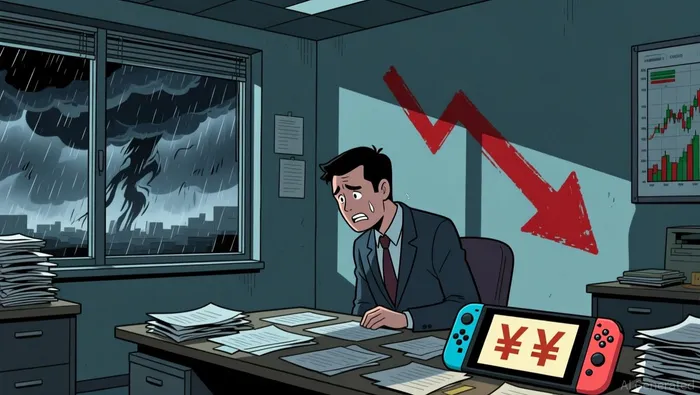
At 21.05x PE with a 2.86% dividend yield, Nintendo is pricing in a steady-state Switch 2 trajectory-but the guidance cut and price hike create asymmetric risk that the current valuation may not fully capture.
The stock trades at 7,664 yen, sitting near the bottom of its 52-week range of 7,361–14,795. That's a meaningful drop from the highs, yet the PE multiple hasn't compressed proportionally with the guidance reset. A 26.9% profit cut should logically compress multiples, but the market is holding steady-suggesting investors are looking through near-term noise or betting on the Switch 2 ramp to deliver.
Here's the tension: the 2.86% dividend yield is attractive and signals management confidence in cash generation, but it also reflects a stock that has underperformed. The 1-year target estimate of 11,218 yen implies roughly 47% upside from current levels-yet that target predates the price hike announcement and may not fully account for demand elasticity at the new ¥59,980/$499.99 price point.
Upside scenario: The price hike sticks without meaningful demand destruction. Nintendo's 16.5 million unit forecast proves conservative, and the company beats guidance as higher MSRP improves per-unit economics at a time when chip costs are stabilizing. Digital sales stabilize (the 13.5% YoY decline reverses), and the market re-rates the stock toward the 1-year target as profitability holds.
Downside scenario: The price hike accelerates demand destruction just as chip costs keep rising. The 16.5 million unit forecast proves optimistic, and Nintendo is forced to cut guidance again. The PE compresses toward the low end of its historical range as profit growth stalls-the stock tests the 7,361 floor or breaks below it.
The asymmetry is clear: upside requires the price hike to work perfectly while headwinds fade. Downside only requires the price hike to cause meaningful demand erosion-or for chip costs to keep climbing faster than Nintendo can pass through. At current valuation, the market is betting on the former. That's a bet worth questioning.