

NIO's CEO William Li recently compared the appeal of Firefly, NIO's budget sub-brand, to Apple's iPhone. The analogy is supposed to comfort investors. It should do the opposite.
The way to compete like Apple is not to sell a $17,000 car. It's to charge enough that people feel they owe you something for owning it.
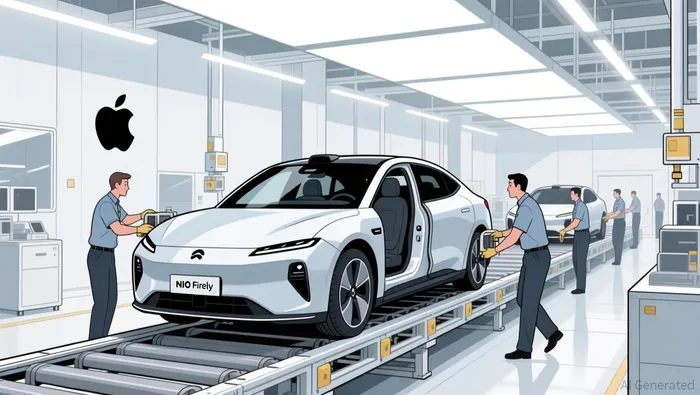
Firefly launched in April 2025 at RMB 119,800 - roughly $16,800. It's a small rear-wheel-drive hatchback with a 141-horsepower motor. By design, it's meant to sell in volume. In the first quarter of 2026, Firefly delivered 11,583 units. By April, the sub-brand had passed 50,000 cumulative deliveries. Those are decent numbers. They're also exactly the kind of numbers that don't print profits at that price point.
Li seems to think the brand story matters more than the unit economics. He told a recent conference that Firefly holds a 70 percent market share in what he calls the "high-end small car" segment. That definition does a lot of work. A $17,000 car is high-end only in a market where BYD sells a fully equipped hatchback for about $10,000.
Here's the thing about Apple that the comparison gets backwards. Apple doesn't win because its products are accessible. It wins because it charges more than the competition and customers accept it. The iPhone is a premium product with premium margins. Apple's gross margin runs above 40 percent. NIO's overall gross margin was 13.6 percent for full-year 2025, up from single digits a year earlier but still the kind of number that requires relentless volume to justify.
That's the hidden contradiction in NIO's strategy. The company finally achieved its first-ever quarterly operating profit in Q4 2025 - RMB 1.25 billion on a non-GAAP basis - after 11 years of losses. The market should be celebrating. Instead, the stock has been sliding. It closed around $6.11 on May 15, down from recent highs above $6.50.
The reason the market isn't buying the story is probably structural, not emotional. Firefly is selling more cars, but each one contributes very little to covering NIO's fixed costs. The company is running three brands now - the premium NIO line, the mid-tier ONVO, and the budget Firefly - and managing three cost structures is harder than managing one. Firefly costs nearly 70 percent more than the BYD Seagull while trying to win the same buyers. BYD builds its own batteries and has scale that NIO doesn't. In the cheapest segment of the Chinese EV market, BYD isn't a competitor. It's gravity.
NIO's cash position - $1.6 billion against $1.2 billion in long-term debt as of Q4 2025 - gives the company runway. But runway is not a business model. Total deliveries for the first four months of 2026 reached 112,821, up 71 percent year-over-year. Growth is real. The question is whether it's profitable growth or just more efficient bleeding.
I suspect Li understands the margin math better than the Apple comparison suggests. The iPhone analogy is a story for Wall Street, not a strategy. The real strategy is volume: Flood the budget segment with Firefly, use NIO's battery-swapping network as a differentiator that cheaper brands can't replicate, and hope that scale eventually compresses costs enough to make the margins work.
That's not impossible. It's just not what Apple does. And it's not what NIO told investors it was going to do a decade ago, when the pitch was premium vehicles and premium brand.
NIO reports earnings on May 21. The number worth watching isn't total revenue or even adjusted operating profit. It's the vehicle gross margin. If it stays above 14 percent, the multi-brand strategy is working. If Firefly drags it below 12 percent, the company is buying market share with its own future. In a segment where BYD starts at $10,000, margins on a $17,000 car have a natural tendency to fall.
The test for the next quarter is simple: can NIO sell more Firefly cars without the per-unit economics collapsing further. If the answer is no, the stock's slide isn't a rout. It's the market doing arithmetic that the Apple comparison was trying to distract from.