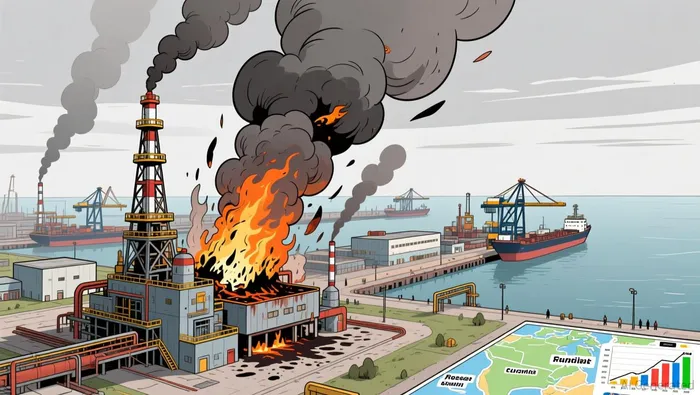
Every time a Ukrainian drone hits a Russian oil terminal, the headlines run the same script: supply crisis, price spike, global disruption. This time it's the Grushovaya oil terminal at Russia's Novorossiysk port, struck on May 22 by falling drone debris that sparked a fire and injured two people. NASA satellite imagery confirmed the blaze the next day.
The problem is the script is wrong - and it has been wrong every single time before.
Novorossiysk's Sheskharis Transshipment Complex, which includes the Grushovaya depot, is one of Russia's largest oil export hubs. It handles roughly 75 million tons of annual throughput - about 1.5 million barrels per day - and historically accounts for more than 30% of Russia's crude exports. That's big enough to matter. What the headlines don't tell you is that this terminal has been hit by drones at least five times since November 2025.
Let's walk through the record. In November 2025, a drone strike halted 2.2 million barrels per day of exports. Loadings resumed three days later. In early March 2026, another attack sparked fires and suspended loading operations. Terminal operations were back by March 11. In mid-April, drones damaged two berths and forced Rosneft to divert cargoes. Partial loading resumed by April 10. And now, May 22.
The pattern is clear: the terminal goes dark for a few days, repairs are made, oil flows again. Ukraine's stated goal is to force Russia to pump less and cut state revenue, but the cumulative disruption has never been structural. By mid-May - before this latest attack - Bloomberg reported Russian oil exports had rebounded to 3.61 million barrels per day, essentially unchanged from the prior week.
Now, here's what actually matters for oil and gas investors. The fear premium the market is supposed to price in never showed up in crude prices. Brent was already falling into the May 22 attack, sliding from roughly $116 per barrel at the start of the month to around $101 on the day of the strike. It kept falling after, settling near $98-$100 by the weekend. If Novorossiysk really represented a binding constraint on supply, Brent would be spiking. It's not.
The broader context explains why. Brent surged past $126 per barrel in early May due to the Iran conflict. As that risk premium unraveled, prices came off. The drone fire at a Russian terminal is a footnote in that larger move. The market isn't pricing a supply crisis from Ukrainian drones - because it isn't one.
From a cash-flow perspective, this matters for how you think about oil company revenues. If you're invested in Western E&Ps - the Permian operators, the Guyana names, the North Sea producers - your revenue is tied to where Brent actually trades, not to headline events that fizzle. The repeated cycle of "terminal on fire → brief disruption → back to normal" means the cash-flow impact for non-Russian producers is transient at best. Prices don't sustainably spike from these events, so the revenue uplift doesn't last.
For midstream investors, the story is even more straightforward. Fee-based pipeline and terminal operators in North America aren't exposed to Black Sea export bottlenecks. Their cash flows are determined by contracted volumes and throughput fees, not by whether a Russian port is temporarily unavailable. The more fee-based the revenue stream, the less any single geopolitical event moves the needle.
While it's true that a prolonged and sustained shutdown of Novorossiysk would tighten Asian crude supplies and support prices, that has not happened and the track record suggests it won't. The terminal has proven remarkably resilient. Russia has also demonstrated the ability to reroute cargoes to Baltic ports like Primorsk and Ust-Luga, though at higher cost and with some capacity constraint.
Even if Ukraine escalates further and keeps Novorossiysk at reduced capacity for weeks, the global surplus conditions and falling demand outlook from OPEC+ production growth would likely offset any supply tightness. Brent's move from $116 to $98 in the same week as this attack tells you where the market's real focus lies: away from Russian supply risk and toward the unwinding of the Iran premium.
All things considered, the drone fire at Novorossiysk is a headline event, not a supply event. The terminal has been hit repeatedly, the disruptions have been temporary, and oil prices have been falling, not rising. For oil and gas investors, the investable takeaway is this: don't chase geopolitical headlines when the price data tells a different story. The real drivers of energy company cash flows in the current environment are the trajectory of Brent itself, the durability of OPEC+ discipline, and whether demand growth in Asia can absorb the flood of non-OPEC supply. A burning terminal in Russia is background noise against that backdrop - noisy, dramatic, and ultimately irrelevant to where your energy portfolio's value comes from.