

Oklo Inc., a nuclear reactor startup, held an earnings call this week. That is weird. The company has no revenue and reported a $33.1 million net loss for the first quarter. Its stock fell 5.76% to $73.63 after the announcement. The odd part is not that a pre-revenue company is losing money. The odd part is that everyone - the company, analysts, investors - is going through the motions of a quarterly earnings ritual for something that looks more like a multi-decade infrastructure project than a traditional business.
Oklo is developing small modular nuclear reactors. It is targeting first commercial operations in 2028. It has $2.5 billion in cash and marketable securities. It expects to use $80 million to $100 million in operating activities and $350 million to $450 million in investing activities this year. At that burn rate, it has roughly three to four years of runway before it needs more capital or starts generating revenue from its reactors. The company has a market capitalization of about $12.8 billion.
So the financial model here is: raise a bunch of money, spend it over several years building reactors, hope they work and get regulatory approval, then maybe start making money sometime after 2028. That is basically venture capital, but done in public markets with quarterly reporting. The "earnings call" is not really about earnings; it is a progress report on a long-term capital project.
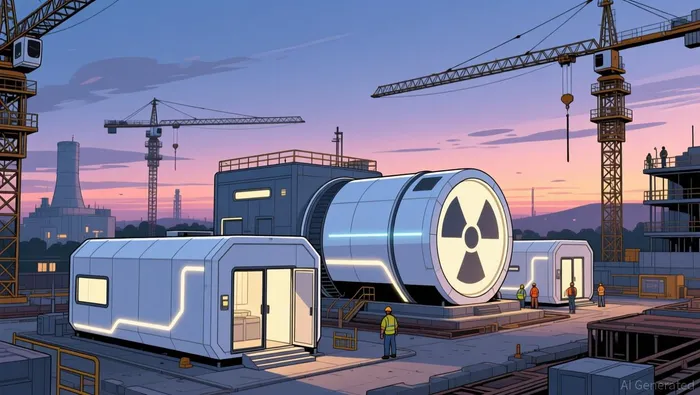
The interesting tension is between the quarterly rhythm of public markets and the multi-year timeline of nuclear development. Public companies are supposed to report earnings every quarter. Investors are supposed to react to those earnings. Analysts are supposed to have expectations that companies can beat or miss. But when the company has no earnings, what are they reacting to? The answer seems to be: they react to the cash burn, the regulatory progress, and the timeline updates. Which are all important! But they are not earnings.
You can imagine a tiny dialogue:
Analyst: Did you beat earnings expectations? Oklo: We have no earnings. Analyst: Right, but did you lose less money than expected? Oklo: We lost exactly $0.19 per share, which was what you expected. Analyst: So you met expectations. Oklo: For losing money, yes. Analyst: And the stock is down 6%. Oklo: Apparently meeting expectations for losing money is not good enough.
The ritual persists because it is how public markets process information. Companies report quarterly. Investors trade on the news. The format is familiar, even when the underlying business does not fit the format particularly well.
There is a sort of old-finance analogy here. What Oklo is doing looks less like a traditional public company and more like a closed-end fund that invests in a single, long-term infrastructure project. The $2.5 billion cash balance is the fund's assets. The cash burn is the fund's expenses. The eventual reactor operations are the hoped-for return. The market cap of $12.8 billion is what investors are willing to pay today for that future return.
The difference is that a closed-end fund would trade at a discount or premium to net asset value. Oklo trades at a massive premium to its cash balance - the $12.8 billion market cap is about five times the $2.5 billion cash. That premium represents the option value on the nuclear technology working out. Which is fine! That is how venture capital works. But it is funny to see it wrapped in the quarterly earnings call format.
Anyway, the economic point is: public markets are funding a long-term, capital-intensive, regulatory-dependent technology development project. They are doing it through the usual machinery - quarterly reports, earnings calls, analyst expectations, stock price reactions. The machinery is a bit awkward for the job, but it is the machinery we have. The $2.5 billion cash gives Oklo a few years to build before it needs more money. The market is betting that by then, the reactors will be closer to reality, and the story will have become the business.