

Nvidia Is Turning CPU Ambition Into a Real Competitive Threat
Nvidia is no longer treating CPUs as a side project. It is now targeting about $20 billion this year from agentic-AI CPUs, while Jensen Huang has described the opportunity as a much larger market. That is why the setup matters now: investors are no longer looking at a distant roadmap, but at a revenue claim large enough to reshape how the market sizes Nvidia's next growth layer.
Why CPUs are becoming more important in AI
AI is shifting from model training and chatbots toward deployment and agentic workflows, and that changes where bottlenecks show up. Nvidia says CPUs are becoming the bottleneck as systems orchestrate more tasks, move more data, and run more tools in parallel. If that trend holds, the host processor stops being background hardware and becomes a more important control point for spending.
Why the market is split on the threat
Bulls see a new profit engine inside a growing bottleneck market. Bears have a credible counterargument: Nvidia has entered a field that Intel and AMD have dominated for decades, and their installed base plus ecosystem depth should slow rapid conversion. That suggests early share gains may look modest even if the long-term opportunity is real.
The key point is timing. If Nvidia is early to the CPU layer, waiting for full proof could mean paying up after the first market repricing.
Nvidia's Stack, Not Just Its Chips, Is the Competitive Edge
The product is the full system
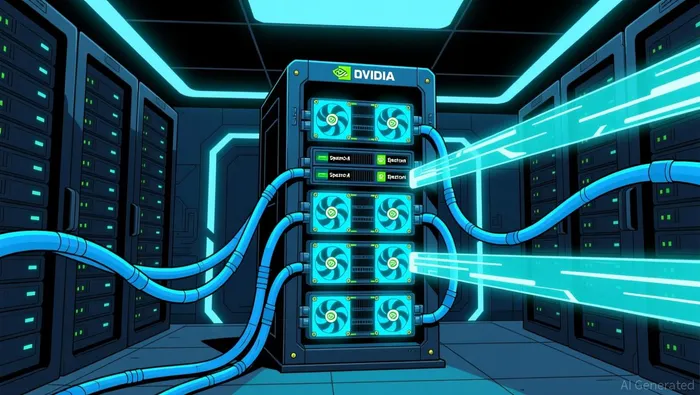
Nvidia's threat is not a standalone CPU spec sheet. It is the ability to sell CPUs as part of a system that already includes Grace CPUs and Spectrum-X networking technology alongside its GPUs. Partner details also show Meta is Nvidia's first large-scale Nvidia Grace-only deployment, with codesign and software optimization aimed at improving performance per watt over time. That changes the sale from a component swap to a full-system design.
That system-level approach matters because customers are not just buying a processor in isolation. They are buying a tighter mix of compute, memory, and interconnect. That is how Nvidia can become more than an accelerator vendor and position itself as a broader infrastructure provider.
Customer proof changes the sales story
This is no longer just a roadmap narrative. Meta gives Nvidia a live hyperscaler proof point inside real AI infrastructure, while management has said its server CPU business is expected to take off this year. That combination is what investors should focus on. A benchmark can be debated; a deployed system addressing real workload pressure is harder to dismiss.
That proof point also improves Nvidia's ability to capture more spending per AI build. Once a customer trusts one vendor across GPUs, CPUs, and networking, the next design win can expand beyond the original scope. That is how a side category becomes strategically important.
Why Intel and AMD still have an advantage
The incumbent base remains huge. Reuters noted that 90% of computing once sat on CPUs, and that category is regaining strategic importance as AI shifts toward deployment. Even so, Nvidia does not need to win the entire market at once. It only needs to win a meaningful share of the newest, most efficiency-sensitive AI server builds where end-to-end system performance matters most.
That is the real debate now: can Nvidia move fast enough in the newest AI architectures to make its CPU push matter before Intel and AMD adapt?
What Investors Should Watch First
The setup is no longer theoretical. Nvidia just delivered Q1 fiscal 2027 adjusted earnings and revenue ahead of Wall Street estimates and provided a current-quarter revenue outlook well above analyst expectations. At the same time, the semiconductor complex is already riding strong momentum: the SOX is up 80% since March 30. That means investors do not need to wait for a perfect CPU story to form in order to pay attention.
What matters most from here
Nvidia remains the clearest beneficiary if CPUs become a more meaningful part of the AI build cycle, because the market already trusts its execution after the recent earnings beat. If standalone CPU shipments and broader customer traction start to show up, Nvidia could add another revenue layer on top of its existing platform strength.
What would weaken the thesis
If Nvidia's CPUs remain mostly complementary to GPUs rather than becoming a standalone revenue layer, the urgency around this thesis should cool quickly. For now, the more constructive view is to treat CPU demand as upside optionality on an already proven platform, not as the sole reason to watch the stock.