

Nvidia's growth engine is still firing on all cylinders, but the fuel is starting to run thin. The company's dominance is undeniable, with datacenter revenue hitting $68.13 billion in the fourth quarter of fiscal 2026. That figure sets a staggering baseline for the current quarter, where Wall Street is looking for revenue of $78.8 billion, implying an annualized growth rate of nearly 79%. This isn't just expansion; it's a market-scale ramp-up that has defined the AI boom.
Yet the critical growth question now is sustainability. The market is maturing from a period of desperate hardware scarcity into one of fierce architectural competition. The arrival of AMD's Instinct MI350 series has created the first genuine duopoly in the AI accelerator market. This isn't a minor challenger. The MI350 series, built on a cutting-edge 3nm architecture, offers raw hardware specs-particularly in High Bandwidth Memory capacity-that directly challenge Nvidia's traditional software moat. By offering mathematically more efficient hardware for running massive trillion-parameter models, AMD has effectively lowered the switching cost for developers.
The bottom line is that Nvidia's path to maintaining its lead is no longer about simply out-innovating. It's about out-executing in a duopoly. The competition has shifted from capability to total cost of ownership, forcing a strategic realignment where Nvidia must sell entire "AI Factories" rather than just GPUs. The growth engine remains powerful, but its next phase will be defined by how well it navigates this new, crowded landscape.
Scalability Drivers: The Stack, Supply, and the AI Bottleneck
The growth trajectory for Nvidia hinges on its ability to scale not just its chip sales, but its entire technological ecosystem. The fundamental bottleneck has shifted from raw compute power to memory bandwidth and power efficiency, making High Bandwidth Memory (HBM) capacity the new battlefield. As AI models grow to trillions of parameters, training them demands over 3 TB/s of memory bandwidth per accelerator. This places HBM at the heart of performance, accounting for a massive 30–40% of the total cost in next-generation systems. Nvidia's strategy is to control this critical supply chain, not by relying solely on TSMC for logic chips, but by securing its memory partners. The company's visible push to strengthen ties with SK hynix, including Jensen Huang personally hosting frontline engineers, is a direct move to lock in HBM4 supply and maintain its performance lead.
This supply-chain focus is part of a broader, integrated moat. Nvidia's real advantage has always been its "stack"-the seamless orchestration of hardware, software (CUDA), networking, and advanced packaging like CoWoS. This system-level integration has been its fortress. Yet, that fortress is being tested. Competitors like AMD are now offering hardware specs that match or threaten Nvidia's lead, particularly in HBM density and power efficiency. The arrival of AMD's Instinct MI350 series, with its 288GB of HBM3e, has forced a strategic realignment. The competition is no longer just about peak performance; it's about total cost of ownership and the ability to scale entire AI factories.
The interplay of these factors determines scalability. Control over HBM supply secures performance leadership, which is essential for maintaining the stack's premium value. But if competitors can match hardware specs, the stack's software and ecosystem advantages become the primary differentiator. The risk is that as hardware parity increases, the switching cost for customers-previously locked in by CUDA-continues to fall. Nvidia's challenge is to scale its stack advantage fast enough to offset this erosion, ensuring that its integrated solution remains the most efficient and cost-effective path for customers building massive AI infrastructure. The company's future growth depends on its ability to execute this dual mandate: dominate the supply chain for the new bottleneck while defending its software moat in a duopoly.
Financial Implications and Valuation Scenarios
The financial outlook for Nvidia is a direct function of its ability to maintain its market share and stack advantage in a maturing landscape. The consensus view, as reflected in an average 12-month price target of $273.57 per share, implies significant upside of 37.9%. This bullish projection assumes the company captures a dominant portion of the projected $483.95 billion in next-year sales for the AI chip market. In other words, the valuation is a bet on Nvidia's continued scalability and pricing power.
The key risk to this scenario is the erosion of its high-margin model. Increased competition, particularly from AMD's Instinct MI350 series, introduces the threat of margin compression or even a price war. While Nvidia's integrated stack and software moat provide a formidable defense, hardware parity in specs like HBM capacity could force the company to offer deeper discounts or invest more heavily in R&D to maintain its lead. This would directly pressure the operating margins that have fueled its growth and justified its premium valuation.
The upcoming earnings season is the critical test of this thesis. The company must meet or exceed the high bar set by Wall Street, which is looking for revenue of $78.8 billion this quarter. A miss would not only disappoint near-term expectations but could also signal that the growth engine is slowing or that competitive pressures are already impacting sales. Conversely, a strong beat would reinforce the narrative of an "AI castle on a hill" and likely validate the current price target.
Valuation, in this context, is a forward-looking wager. Nvidia trades at just 17 times its 2027 earnings forecast, a discount to the sector average. This suggests the market is pricing in some risk, perhaps a slowdown in growth or margin pressure. The stock's recent underperformance relative to CPU rivals like AMD and Intel, despite their own gains, indicates that analysts are looking past short-term hype to assess the structural durability of Nvidia's lead. The bottom line is that the current price offers a margin of safety only if the company can successfully navigate the competitive duopoly and continue to scale its stack advantage without sacrificing profitability.
Catalysts and Risks to the Growth Thesis
The investment case for Nvidia now hinges on a handful of specific milestones that will validate its path to sustained dominance or expose its vulnerabilities. The near-term catalysts are less about quarterly earnings and more about the technical and market forces that will determine the durability of its lead.
First is the pace of adoption for next-generation HBM4 and the success of competing architectures like AMD's MI350. This is the most immediate signal of competitive erosion. Nvidia's strategy is to control the memory supply chain, but its advantage is only as strong as its ability to deliver superior performance. The MI350 series has already forced a direct confrontation over memory density and inference throughput, creating a duopoly where hardware specs are now parity. The key test will be whether customers, particularly major cloud providers, continue to diversify their silicon portfolios or begin to favor AMD's mathematically more efficient hardware for trillion-parameter models. A rapid, widespread shift toward AMD's architecture would signal that Nvidia's software moat is weakening and that the race is truly on for total cost of ownership.
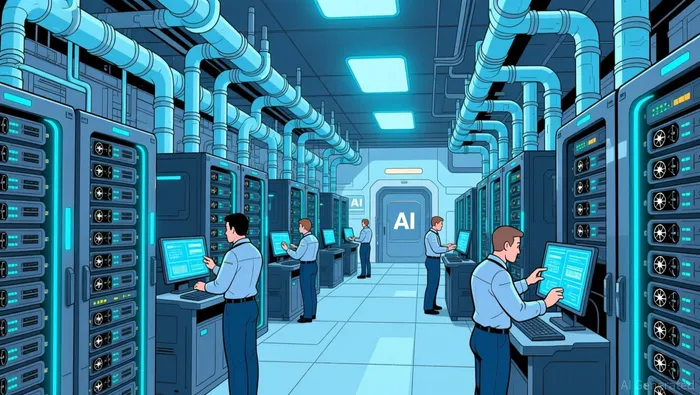
Second is the evolution of data center power density and cooling. This is a major structural catalyst that could favor chips with superior performance-per-watt. As AI models grow, the physical constraints of electricity and heat become paramount. Nvidia's Blackwell Ultra racks are explicitly designed to address this, using advanced liquid cooling to reduce electricity costs by up to 40%. The success of this platform will be measured by how quickly it is deployed and whether it sets a new industry standard for efficiency. If power and cooling constraints accelerate, Nvidia's integrated stack advantage-its ability to deliver a complete, efficient AI factory-will become a decisive selling point. Conversely, if competitors can match or exceed its power efficiency, the competitive landscape will shift further toward price and total cost of ownership.
Finally, the broader market's reaction to Nvidia's stock performance relative to its competitors serves as a key sentiment indicator. Despite its massive technological lead, Nvidia's stock has underperformed the recent CPU rally, with analysts noting that the market is looking past short-term hype to assess structural durability. The recent surge in AMD and Intel shares, while driven by their own news, provides a benchmark. If Nvidia's stock continues to lag its peers despite strong fundamentals, it could signal investor skepticism about its growth trajectory or margin protection. Conversely, a sustained outperformance would reinforce the "AI castle on a hill" narrative and validate the current price target.
The bottom line is that the growth thesis is being stress-tested on three fronts: competitive hardware parity, physical infrastructure constraints, and market sentiment. The coming quarters will provide clear signals on which of these catalysts is gaining momentum.