

The design cycle has collapsed
Nvidia told investors at GTC in April that AI has reduced a GPU design task that used to require eight engineers over ten months - roughly 80 person-months - to something an AI agent can complete overnight on a single GPU.
That is not a marginal productivity improvement. It is a compression of the entire design-to-tape-out cycle from a year to a day. Put plainly: if the cadence at which Nvidia can ship the next generation of accelerators is no longer bottlenecked by human engineering time, the competitive dynamic changes. It means product iteration moves from generational to continuous.
The tool doing the heavy lifting is called ChipNeMo, backed by layout optimization from PrefixRL - which Nvidia says finds chip floorplan options that improve key performance metrics by 20–30%. The company was careful to say it is "still a long way" from fully autonomous chip design. Human oversight remains. But the point is not that AI will replace engineers. The point is that the constraint on how fast Nvidia can move from architecture concept to physical chip has been removed.
That is the supply chain signal that matters more than any revenue number.
TSMC is building the wall the other side can't climb
On the manufacturing side, TSMC has been deploying hundreds of AI models across its fabs since 2023, focusing on autonomous agents for yield optimization, defect classification, and supply chain orchestration. The result on paper is stark: TSMC is running five 2nm fabs right now, selling every wafer through 2026. Meanwhile, Samsung's foundry market share has fallen to 7.7% and Intel isn't even in the top ten pure-play foundries.
The number that carries the whole argument is TSMC's yield rate on CoWoS packaging - the advanced chiplet technology that holds Nvidia's GPUs together. TSMC is manufacturing the world's largest 5.5-reticle CoWoS configurations with yields above 98% in 2026. For context, CoWoS yield at that scale was the industry bottleneck for the entire Blackwell ramp. A 98% yield on the most complex packaging in existence means TSMC has solved the margin problem at leading edge while competitors are still stuck trying to make the chips work at all.
Industry projections put AI-driven fab optimization at 15–25% cost reduction within the first 18 months of deployment. Applied to TSMC's $56 billion capex cycle, that is a margin cushion no competitor can replicate. Samsung and Intel are not just losing on capacity - they are losing on the economics of the chips they can produce.
The loop that makes the moat self-reinforcing
Here is the structure nobody is framing correctly. Nvidia uses AI to design chips faster, which demands more advanced manufacturing from TSMC sooner than the old cycle would allow. TSMC uses AI to achieve yields that no one else can match, which means Nvidia has nowhere else to go. Each company's AI investment makes the other's position more untouchable. It is not two independent stories. It is a closed loop.
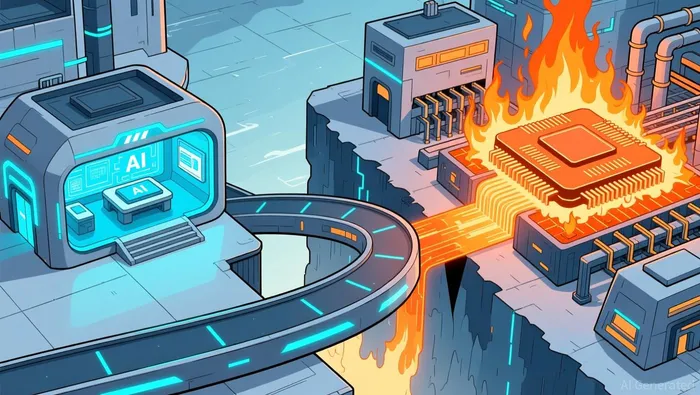
The numbers lock it in. Nvidia has reserved over 60% of TSMC's advanced CoWoS packaging capacity. CoWoS is sold out through 2025 and into 2026 - TSMC's own CEO said so publicly. Nvidia's FY2026 data center revenue was $194 billion, up 68% year-over-year, and the company has now pointed toward a $1 trillion AI revenue target. TSMC's 2026 revenue growth guidance sits at 25–30%, with AI accelerator revenue expected to grow at least 50% annually through 2029.
TSMC now commands roughly 71% of the pure-play foundry market, up from 66% a year ago. Samsung continues to slide. The gap is widening, not narrowing.
Demand is robust, but the concentration risk is real
This is where the frame flips. The Nvidia-TSMC loop is a moat for both companies - and simultaneously a leverage risk that neither can fully manage on its own.
Nvidia's entire supply chain for advanced nodes is TSMC. There is no alternative at 2nm or 3nm that can produce at volume with acceptable yield. That is great for Nvidia today. It is fragile if TSMC faces a demand spike from competitors that displaces Nvidia's reservation - or if geopolitical risk, capacity constraints, or a yield stumble at a new node creates a bottleneck Nvidia can't work around.
For TSMC, the risk is the inverse: Nvidia is not just a customer, it is the anchor tenant. Over 60% of advanced packaging capacity booked to one client creates concentration risk of the highest order. If Nvidia's growth slows, or if hyperscalers shift more volume to custom silicon that TSMC also manufactures but at lower margins, the revenue trajectory changes.
TSMC's $56 billion capex to double CoWoS capacity is a bet that Nvidia's demand justifies it. It probably does - the demand signal is undeniable. But capital commitments of that scale, tied to a single customer's product roadmap, are the definition of leverage risk even when the thesis is intact.
So where does capital go?
The debate is not whether Nvidia and TSMC are important. They are irreplaceable, at least through the Rubin and Blackwell Ultra cycles. The debate is whether the loop itself - the mutual dependency that makes the moat deeper - is worth the concentration risk.
I believe the answer depends on time horizon. For the next two years, through the Rubin ramp and the CoWoS expansion, the loop is working exactly as it should for both companies. Nvidia ships faster, TSMC yields higher, and neither has a credible alternative to pivot to. That is the sweet spot for a large allocation.
After that, the question becomes whether custom silicon growth - now projected at 45% annually versus 16% for standard GPUs - begins to divert demand away from the Nvidia-TSMC channel at TSMC's other customers, or whether AMD and cloud builders find enough design talent to compress their own cycles and demand TSMC capacity outside Nvidia's reservation. If that happens, the loop doesn't break - but the concentration shifts.
The signal to watch is TSMC's CoWoS utilization rate outside of Nvidia's reservation. If it stays below 40%, the concentration risk is structural, not cyclical. If it starts climbing as other customers scale, TSMC's risk diversifies and Nvidia's supply chain monopoly becomes a negotiation advantage rather than a dependency.
For now, the AI loop is a force multiplier. The risk is in the tail, not the trend. I would not exit either position - but I would not overweight them assuming the loop has no expiration date either.