

The Department of Justice and the Commodity Futures Trading Commission are investigating $2.6 billion in suspiciously timed oil trades placed minutes before President Trump's announcements on Iran policy. At least four of those trades generated billions of dollars in profits. The headline version - someone front-ran the White House - is the kind of story that moves from the financial press to the Senate floor to 60 Minutes without missing a beat.
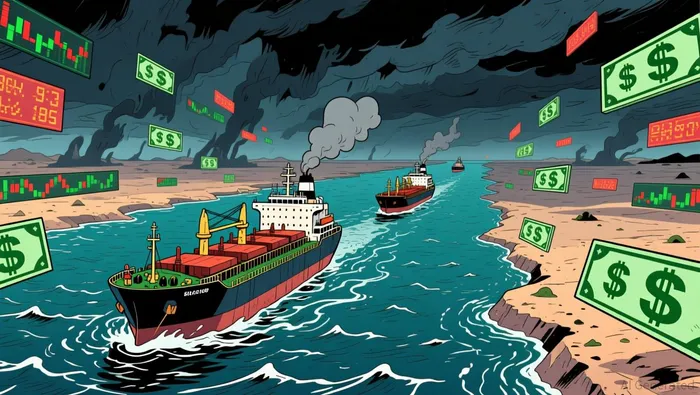
But if you invest in oil and gas companies, the trading investigation is not your problem. Your problem is a far more consequential reality: crude oil has been sitting well above $100 per barrel for months now, and the cash-flow regime it creates for E&P and midstream operators is unlike anything in the past decade. The real story is not who profited from knowing policy before it was public. The real story is which energy companies are collecting windfalls from a supply disruption that may not unwind anytime soon.
Let me start with the supply shock, because that is the number that actually matters. The Strait of Hormuz - the narrow waterway through which roughly a fifth of global oil consumption flows - was effectively closed starting March 4. Gulf energy exports fell by 60 percent. The supply shortfall worked out to approximately 11.1 million barrels per day. Brent crude surged past $120 per barrel and has remained in the $109 to $111 range as of this week. WTI crude is holding around $104.
This is not a headline. It is a structural change in the revenue environment for every company that produces or transports oil. For an E&P operator producing 200,000 barrels a day, the move from a $60 barrel to a $105 barrel adds roughly $9 million in daily gross revenue before operating costs. That is $3.3 billion a year of incremental top-line. Even after lifting costs, lease operating expenses, and taxes, the free cash flow difference is transformative.
Now let's talk about the investigation itself, because its credibility is worth examining alongside its subject matter. The CFTC chair, Michael Selig, is a Trump appointee. Four of the commission's five seats are vacant. A regulatory body with a single member on the bench is conducting a probe into trades that profited from news closely held by the administration that appointed its only sitting chair. That is not an argument that the trades were innocent. It is an argument about what to trust in the enforcement timeline. The Senate Banking Committee's Warren and Whitehouse have pushed for the investigation, and Representative Ritchie Torres demanded action before Bloomberg even reported the probe. Political pressure has created movement, but the institutional capacity to follow through is an open question.
From a valuation perspective, this is the crack that matters. Oil at $110 is a regime shift, but the market has not yet decided how to price it. Some E&P names still trade at multiples that reflect a world where oil eventually returns to $60 or $70. Others that have strong balance sheets - manageable leverage, no covenant risk, fee-based midstream contracts that lock in throughput revenue regardless of commodity price - are getting only a modest predictability premium despite sitting on cash flows that should be commanding a premium in any environment.
While it's true that sustained $100-plus oil carries recession risk - higher energy costs depress consumer spending and can slow the economy enough to reduce demand - I would argue that the supply-driven nature of this price environment makes it stickier than a demand-driven rally. When prices rise because barrels are physically missing from the market, as they are now with the Hormuz disruption, they tend to stay elevated until supply is restored. A fragile US-Iran ceasefire holds as of early May, but analysts estimated that energy firms pulled 3.3 million barrels from storage during the week ended May 1, draining the cushion that normally absorbs shock.
Even if the Hormuz reopens and oil eventually retreats below $100, the damage has already been done to the bear case for companies with strong balance sheets. The cash generated during this period goes to debt reduction, shareholder returns, and reserves replacement. Those are permanent improvements to the financial profile that survive the next commodity cycle. Cheap companies that burn cash to survive do not benefit the same way. That is why balance-sheet quality is the gatekeeper, not headline valuation.
For midstream operators with fee-based revenue models - companies that charge for moving oil and gas regardless of where the price sits - the case is even cleaner. Higher oil prices stimulate production, which drives throughput volume, which flows directly into contracted cash revenue. The higher the fee-based share of earnings, the less commodity risk matters. That predictability deserves a premium whether the CFTC is investigating trading irregularities or not.
All things considered, the market is fixated on a story about market plumbing while sitting through one of the most favorable cash-flow environments for oil and gas companies in a generation. The investigation may uncover wrongdoing. It may not. The regulatory capacity to act is uncertain at best. What is certain is that oil remains above $100, supply remains constrained, and energy companies with fee-based contracts and clean balance sheets are sitting on cash flows the market has not fully priced. The upside for those names is not about geopolitics resolving or not resolving. It is about the market eventually catching up to what the numbers are already saying. For E&P and midstream investors, there is better work to do than watching regulators chase traders.