

The market is celebrating oil's first $5 pullback as signs of a U.S.-Iran deal emerge. Stock futures are up, headline writers are typing "relief rally," and energy investors are watching Brent retreat from $112 toward $97. It feels like the end of a stress episode.
It isn't. It's the beginning of a much larger unwind - one that nobody is pricing yet.
Let me start with the arithmetic. WTI crude rose from below $60 at the start of the year to nearly $100 by mid-May. Brent climbed above $105. That's roughly a $45 barrel gain in under four months, almost entirely triggered by Iran's closure of the Strait of Hormuz following U.S.-Israeli military action on February 28. The strait carries about 20 million barrels per day of crude and petroleum products - roughly a fifth of global trade. Block that choke point, and the market pays a geopolitical premium the way anyone pays for insurance they hope never gets called.
Now let's talk about what happens when the insurance policy expires.
The International Energy Agency released its May Oil Market Report on May 13. Before the war, its 2026 Brent forecast was $62 a barrel. The agency has since revised that higher to account for supply disruptions - estimating a 1.78 million barrel-per-day gap between supply and demand driven by the conflict. J.P. Morgan's pre-war consensus forecast was even lower, at $60. The World Bank's April commodity outlook called for $86, but explicitly assumed the "most acute" crisis would end. Strip away the Hormuz blockade, and you remove the single variable propping up every bullish oil price forecast this year.
Here's what the market is ignoring: global oil demand is shrinking. The IEA's May report projects world oil demand contracting by 420,000 barrels per day year-over-year in 2026. The EIA echoed the downgrade in its own May outlook, cutting its 2026 demand growth forecast from 600,000 to just 200,000 barrels per day. This isn't a war-induced demand shock. This is structural weakness showing up in the data.
So the headline tells us oil is falling because peace is coming. The fundamentals say oil should be falling because, once the geopolitical premium evaporates, you're left with a market where demand is declining, the pre-war supply surplus the IEA identified in January is back on the table, and no institutional forecast model sees $100 oil surviving past June without a supply disruption to justify it.
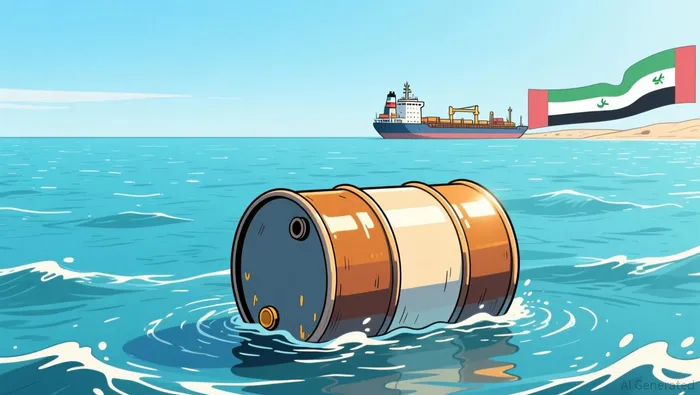
From a cash-flow perspective, this is where the energy investor's job gets real. If you're long an E&P operator that saw its quarterly cash flow balloon in April and May because oil was $100, you need to understand how much of that was real earnings power versus a geopolitical spike that's already starting to reverse. Even the Nikkei, citing deal negotiators, reports the Strait of Hormuz won't fully reopen until approximately 30 days after any agreement. That means the $5 drop we've seen is just the front edge of a much wider move. The full decompression hasn't happened yet.
While it's true that a deal might not restore every barrel of Hormuz capacity immediately - and that conflict-related supply losses could linger - the direction of travel is clear. Every day the negotiation advances, another fraction of the premium comes off. And it comes off a price level that was already unsustainably high relative to where the demand data wants the market to sit.
This is where fee-based midstream names separate themselves from commodity-exposed E&Ps. If you own pipeline and processing capacity with 85%+ fee-based revenue, your cash flows don't collapse when Brent falls from $105 to $75. Volume throughput might soften, but the per-barrel economics are contractually locked. That's the insulation the fee-based model was designed for. It's the exact scenario where the model pays for itself. For E&Ps, the same price move means operating cash flow gets sliced, discretionary capex gets questioned again, and the balance sheets that looked manageable at $95 oil start looking tight at $70.
The counterargument, worth acknowledging, is that a prolonged Hormuz reopening timeline and physical supply damage from the conflict could create a floor. The IEA's own model shows supply 1.78 million barrels below demand this year. Even after peace, reconstruction and logistics bottlenecks won't restore flows overnight. That floor, however, doesn't put us near $105. It puts us closer to the $70-80 range the pre-war models were already pointing to.
Even if oil holds above $80 in the second half, that's still 25-30% below where it was trading three weeks ago. For an E&P whose break-even is $55 and whose dividends and buybacks were calibrated to $80 oil, that's a different cash-flow world than the one the market priced in on May 19.
The bottom line for energy investors: the $5 drop is the easy move. The harder move - the return to fundamental pricing once the Strait opens - is what determines whether the names you're holding can survive the normalization. If your position relies on $100 oil staying the new normal, you've been selling duration, not value. If your position is in fee-based infrastructure with locked-in cash flows and a balance sheet that doesn't care whether Brent trades at $90 or $70, the sell-off is where the entry gets better, not worse.
The market is buying the peace headline. The data says the correction isn't over.