

The short version
- The Trump-Iran announcement is a 60-day ceasefire, not a peace deal. The Strait of Hormuz reopens temporarily, then the uncertainty comes back.
- Brent has fallen from $110.34 on May 20 to roughly $97.59 as of today. WTI dropped to $91.30 - a 5.5% single-session plunge. The market is pricing a structural problem into a temporary event.
- Canadian oil sands operators still carry the lowest cash costs in the world. Suncor's cash operating cost was $28.95 a barrel in Q1. CNRL's synthetic crude sat at $17.30. At $90 Brent, these companies are still generating enormous free cash flow.
- The IEA's real story - a 420,000 barrel-per-day demand contraction in 2026 - is the structural issue that matters. The ceasefire selloff is just noise layered on top.
The headline says oil is collapsing. The data says something messier, and if you're looking at it through a cash-flow lens rather than a headlines lens, the messiness is what matters.
Brent crude dropped from $111 on May 20 to $97.59 on Friday. WTI fell even harder, landing at $91.30, a 5.5% single-session move. The trigger: Donald Trump announced that a framework with Iran has been "largely negotiated," involving a 60-day ceasefire extension during which the Strait of Hormuz reopens and Iran clears the mines it deployed in the waterway. TSX energy names followed oil lower. Athabasca Oil was flagged by market watchers as one of the biggest losers.
Now, here is what the market is treating as a peace deal and what the reporting actually says. The New York Times was precise on Thursday: "The temporary agreement that the Trump administration announced with Iran this weekend isn't a peace deal. It isn't a nuclear deal." It is a 60-day window. Iran agrees to stop charging tolls and clear the mines. Shipping resumes. But nothing is resolved on the underlying conflict, Iran's uranium program, or the terms that would make this permanent. In sixty days, the geopolitical risk comes back unless something else happens. The market is selling as if it won't.
That is the first reason to pause. Geopolitical risk premiums are not permanent. BloombergNEF estimated in February that Iran-related risks padded oil prices by $4 to $10 per barrel. Those premiums inflate during crises and deflate when headlines ease - even temporarily. The unwind is mechanical, not fundamental. It strips the insurance surcharge off the price; it doesn't change the underlying cash cost of producing a barrel.
And that is where the cash-flow math separates the sellover from a genuine deterioration.
Let's look at the numbers that actually determine whether a Canadian E&P survives this move. Suncor reported oil sands cash operating costs of $28.95 per barrel in Q1 2026 - up slightly from $27.80 a year earlier, but still a fraction of the current market price. Canadian Natural Resources, which sits at the low end of the cost curve, reported synthetic crude operating costs of $17.30 per barrel. Cenovus beat Q1 EPS expectations at CA$0.83 versus CA$0.77 estimated, even as its stock fell nearly 5% on earnings day in early May because oil prices dropped. The earnings machine keeps running.
At $90 WTI or $97 Brent, these companies are not facing a margin crisis. They are facing a headline crisis. A roughly $70 spread between Brent and CNRL's cash cost means the business model is still generating substantial free cash flow per barrel. Distribution coverage, debt service, and growth capex are all funded from that spread. The spread narrows when oil falls, yes - but it doesn't collapse. Not for the low-cost tier.
From a valuation perspective, this is where the mispricing becomes visible. Cenovus trades at roughly 9.3 times EV/EBITDA as of late May. That is above its January level of roughly 5.5x - the stock has run on elevated prices through the crisis - but still reflects a discount to the broader industry average that sat near 7.7x in mid-May before this latest sellover. Suncor is at roughly 7.5 times EV/EBITDA. These are not distressed multiples. But they are also not pricing in any recovery scenario once the ceasefire window closes and supply risk re-enters the equation. The market is doing the equivalent of pricing a temporary rent reduction as a permanent property devaluation.
Having said that, there is a real structural issue beneath the ceasefire noise. The IEA's May Oil Market Report forecasts that world oil demand will contract by 420,000 barrels per day year-over-year in 2026, landing at 104 million barrels per day. That is the actual bear case, and it is worth taking seriously. Demand destruction from trade tensions, EV adoption, and economic slowdown is the structural headwind. The Iran ceasefire is not what drives that number. If you're selling Canadian E&Ps because of the IEA demand forecast, you're at least selling for the right structural reason - even if the timing coincides with a headline-driven dip.
Even if demand does contract and Brent settles lower through the second half of 2026, the question for the deep-value investor is not whether oil goes to $120 again. It is whether companies with $17 to $29 cash costs can still generate distributable cash flow at lower prices, carry manageable leverage, and compound value while higher-cost producers get squeezed. The answer for the Canadian sands majors is yes. The cost curve is their margin of safety. When prices fall, it is the marginal producer - not the mining operator at $17 a barrel - who bleeds.
This does not mean every energy name is a buy. It means the selloff is indiscriminate, and indiscriminate selloffs create mispricing. The companies that matter are the ones with the lowest cost position, the strongest balance sheets, and the dividend coverage to weather the noise. The rest are speculation dressed as value.
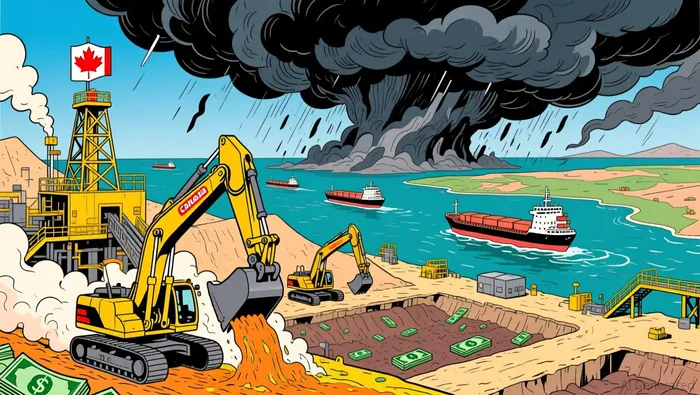
All things considered, the Iran ceasefire is a 60-day pause button, not an off switch. The geopolitical premium unwound is coming back when the window closes. Meanwhile, the low-cost Canadian E&Ps are still running cash-flow machines at $90 oil, and the market has already started pricing a recovery that hasn't happened yet. For investors who focus on cost position and cash generation rather than daily price action, this selloff creates entry points rather than reasons to flee. The structural demand question from the IEA is the one to watch. The ceasefire headline is just noise.