

Oil prices rebounded sharply on Monday, with Brent crude futures settling at $104.21 a barrel, up $2.92 or 2.88%, while U.S. WTI settled at $98.07, gaining $2.65 or 2.78% Brent crude futures settled at $104.21. The move erased much of last week's collapse after President Trump dismissed Iran's ceasefire response as "stupid" and declared the truce "on life support" Trump dismissed Iran's ceasefire response.
The reversal was stark. Just days earlier, oil had plunged 13% in a single session when Chinese Foreign Minister Wang Yi called for a comprehensive ceasefire, sending WTI down more than $13 to $88.88 per barrel oil had plunged 13% in a single session. Markets had rallied on hopes the 10-week conflict was nearing an end and the Strait of Hormuz would reopen. Those hopes collapsed over the weekend when Iran submitted a response to the U.S. peace proposal that included demands for sanctions relief, compensation for war damage, and recognition of its sovereignty over the strait Iran submitted a response. Trump's immediate rejection-calling the offer "totally unacceptable" on social media-shifted the narrative from de-escalation back to escalation in a matter of days Trump's immediate rejection.
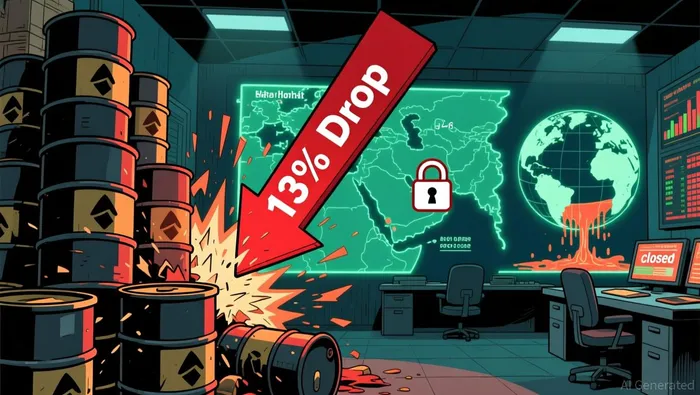
"What we're seeing is the market responding to a narrative that has changed again from de-escalatory to escalatory in a matter of a few days," said Rabobank energy strategist Florence Schmit Florence Schmit. The 2.8% move Monday was modest compared to the 13% swing earlier in the week, suggesting markets have begun to price in a prolonged period of geopolitical risk 13% swing earlier in the week. Yet the reversal confirms how tightly oil is tethered to diplomatic developments: when peace seemed possible, prices cratered; when that prospect vanished, they rallied back toward the $100+ zone.
Supply Disruption Reality Check
The market's 13% swing earlier this week and Monday's 2.8% rebound both rest on a simple supply reality: roughly 10.5 million barrels per day of Middle Eastern crude production remains shut in 10.5 million barrels per day. That's the assessment from the latest energy outlook, and it provides the fundamental floor under prices even as diplomatic headlines flip-flop.
The inventory math has tightened considerably. Because that disrupted production isn't coming back anytime soon, global oil stocks are now expected to shrink by 2.6 million b/d this year-up from the 0.3 million b/d draw forecast just last month 2.6 million b/d this year. In other words, the buffer that normally absorbs supply shocks is being drawn down at a rate eight times faster than anticipated. That limits how far prices can fall even when flows through the Strait of Hormuz begin to recover.
The timeline matters. The Strait remains effectively closed until late May, with shipping traffic expected to pick up in June but not reach pre-conflict levels until later this year Strait of Hormuz remains effectively closed. Some production disruption will persist well into the recovery period. That means the inventory draw continues through the second quarter, keeping Brent anchored around $106/b through May and June before gradual decline sets in as supply resumes Brent prices around $106/b.
For now, the geopolitical risk premium has real physical backing. The 10.5 million b/d shut-in isn't a narrative-it's a hard constraint on global supply that turns any ceasefire optimism into a short-term trade rather than a structural shift.
The China Factor and Macro Backdrop
The Trump-Xi summit scheduled for this week in Beijing adds a new layer to an already fragile price setup. President Trump is set to arrive in Beijing on Wednesday to meet with Chinese President Xi Jinping, with the Iran situation expected to feature prominently on the agenda. Markets are pricing a binary outcome: either the discussion produces meaningful pressure on Iran to reopen the Strait of Hormuz, or the geopolitical risk premium holds firm-or even expands.
The Asian reaction Monday offered a glimpse into how regional markets are weighing these stakes. Tokyo's Nikkei 225 fell 0.4% to 62,486.84 after briefly touching another record high, while South Korea's Kospi surged 4.1% to 7,804.71 on tech-led gains. The divergence is telling: Japan's export-sensitive economy faces headwinds from any sustained oil price elevation, whereas Korea's tech-heavy index is being lifted by AI enthusiasm that has overshadowed Middle East risks. For oil, the implication is straightforward-regional demand from China, the world's largest crude importer, remains a critical wildcard. If the summit yields even a tentative pathway to de-escalation, the 10.5 million b/d supply gap could start closing faster than expected. If not, the market's 2.8% Monday rebound is just the opening move in a higher-range trading band.
The broader macro backdrop provides a floor but also a ceiling. The dollar's strength against the yen-trading near 157.14-keeps dollar-denominated commodities relatively expensive for Asian buyers, potentially capping demand elasticity. Yet the inventory draw story remains intact: global stocks are now expected to shrink by 2.6 million barrels per day this year, a structural tightness that prevents prices from sustaining drops even when diplomatic winds shift. The result is a market caught between a hard supply floor and a soft demand ceiling, with the Trump-Xi outcome serving as the primary catalyst for breaking either direction.
Catalysts and Scenario Outlook
The market now faces a clear inflection point. With the Trump-Xi summit underway in Beijing, the coming days will test whether diplomatic momentum can translate into physical supply restoration-or whether the geopolitical risk premium becomes structural.
The price path hinges on two variables: the timing of Strait reopening and the durability of any ceasefire. If Chinese mediation yields tangible results and Iran agrees to reopen the Strait of Hormuz by late May, Brent could drift toward the $95-98 range as the 10.5 million b/d shut-in begins to close 10.5 million barrels per day of crude oil production. That scenario assumes shipping traffic picks up in June as currently forecast, allowing inventory draws to moderate.
But the baseline remains elevated. The latest outlook projects Brent averaging $106/b through May and June, with the Strait effectively closed until late May Strait of Hormuz remains effectively closed until late May. Even if flows resume, pre-conflict volumes won't return until later this year. That keeps the inventory draw story alive-global stocks shrinking by 2.6 million b/d annually-and puts a hard floor under prices. A failed summit or renewed Iranian intransigence keeps Brent in the $100+ zone, with $110 not out of reach if disruptions persist into summer.
The UAE's OPEC departure adds a structural layer to this setup. Effective May 1, the UAE's exit reduces OPEC's collective spare capacity to 2.5 million b/d by 2027, down from the 3.8 million b/d previously forecast OPEC's spare capacity to average 2.5 million b/d in 2027. That's a meaningful reduction in the buffer that normally absorbs supply shocks. Even if the Strait reopens, the market loses a key swing producer just as it faces its tightest supply-draw cycle in years.
Key watchpoints: The summit outcome (Wednesday-Thursday), any Iranian compliance signals on the Strait, and May inventory data (due early June) that will confirm or contradict the 2.6 million b/d draw forecast. The macro cycle says prices stay elevated until proven otherwise. The Trump-Xi meeting is the catalyst that could change that narrative-or confirm it.