

Oil prices pulled back sharply on Wednesday, with Brent crude losing 73 cents to settle at $107 a barrel and US West Texas Intermediate falling 62 cents to $101.60. This move followed three days of gains and is driven by technical profit-taking after the rally, combined with a diplomatic pause as President Trump heads to Beijing for a summit with President Xi Jinping.
The benchmarks have held above $100 since the US and Israel launched strikes on Iran in late February, which led to the effective closure of the Strait of Hormuz. This supply disruption has been the primary support for prices, pushing Brent from roughly $70 before the conflict began. The upcoming summit is critical because China is the world's largest buyer of Iranian oil, and any discussion about the strait's closure or Tehran's nuclear programme is likely to move markets significantly.
Markets are now looking for a concrete mechanism from the diplomatic talks, with the key prize being a joint signal to provide an "off-ramp" for the Iran conflict. Reopening the Strait of Hormuz could finally set crude oil prices on a sustainable path below $100 per barrel. For now, the pullback reflects a wait-and-see stance as investors weigh the potential for a diplomatic resolution against the persistent physical supply risk.
Supply Shock and Downstream Bleed
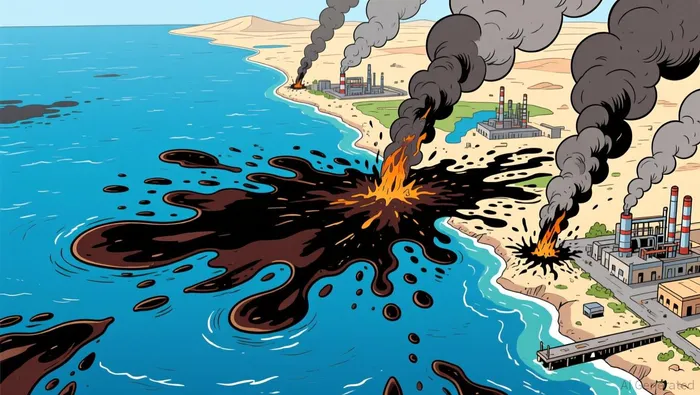
The closure of the Strait of Hormuz has created a massive physical shock, cutting off a critical waterway that handles about a fifth of global oil and liquefied natural gas flows. This disruption has already led to a marked increase in inflation and triggered a series of downstream crises, including extensive environmental damage. Satellite images show multiple oil spills spanning miles in the Persian Gulf, with experts warning of an impending ecological catastrophe that threatens marine life and coastal communities.
The economic bleed is now hitting the refining sector hard. Chinese independent refiners, known as "teapots," are cutting output to minimum levels as their margins collapse. They are facing estimated losses of 500 to 600 yuan per ton of crude processed, a dramatic shift from a profit of 269 yuan a year earlier. The mechanism is a squeeze from both sides: they have largely exhausted their stockpiles of cheap, discounted crude, while having to pay higher prices for new cargoes, all while battling weak domestic fuel demand and a glut caused by export curbs.
This forced reduction in Chinese refining runs is a direct economic consequence of the supply shock. It means a key buyer of sanctioned Iranian and Russian crude is pulling back, which will erode demand for those barrels. The situation underscores how a geopolitical event in the Middle East is now triggering a chain reaction of environmental damage and economic pain in Asia, with the teapots caught in the middle of a perfect storm of high input costs and weak output prices.
Demand Inelasticity and Flow Divergence
The market's focus on downstream distress is missing a critical upstream signal. Despite China's ethylene production falling 18% year-over-year and naphtha cracker utilization at just 62%, Brent crude holds above $98. This divergence reveals crude demand is far more inelastic than its derivatives, a structural reality that supports upstream economics while pressuring downstream players.
The data quantifies this inelasticity. Goldman Sachs estimates global crude demand elasticity at -0.12, meaning prices can spike before consumption falls. Petrochemical feedstock demand is nearly four times more responsive. This explains why Chinese crude imports only declined 3.2% in Q1 despite the petrochemical collapse. Core demand from transportation and industrial processes is proving resilient, underpinning crude's pricing power.
This resilience contrasts with broader economic weakness. Weak steel and cement output are driving a sharp decline in industrial emissions, signaling a slowdown in construction and manufacturing. In March, cement output fell 21% year-on-year, reaching its lowest level since 2020. The flow divergence is clear: while derivatives demand crumbles, the fundamental need for crude to fuel transport and basic industry remains intact, supporting a price floor.