

The market has been plunged into a crisis of historic proportions. In March, global oil supply collapsed by 10.1 mb/d, with OPEC+ production falling 9.4 mb/d month-on-month. This is the largest disruption in history, a violent reversal from the pre-war trend of oversupply. Just weeks before the conflict, J.P. Morgan was forecasting a market with Brent crude averaging around $60/bbl in 2026, underpinned by a supply-demand imbalance that pointed to persistent inventory builds. The war has erased that outlook in an instant.
The primary engine of this shock is the de facto closure of the Strait of Hormuz, a critical chokepoint through which nearly 20% of global oil supply flows. Since military action began in late February, the strait has been effectively shut to shipping, choking off the movement of crude and products. This is not a temporary blip; it is a fundamental, multi-front disruption. Attacks on energy infrastructure continue, and the resulting scarcity has forced Middle East and feedstock-constrained Asian refineries to slash crude runs by around 6 mb/d. The result is a global supply chain under severe strain, with inventories outside the Middle East Gulf drawn down by 205 mb in March alone.
The market's reaction has been extreme. Spot crude benchmarks and differentials soared, outpacing futures, as refiners scrambled for alternative cargoes. North Sea Dated crude traded around $130/bbl at the time of writing, a staggering $60/bbl above pre-conflict levels. This price surge is a direct signal of the new, fragile balance. The pre-war fundamentals of ample supply and building inventories have been replaced by a scenario where a single chokepoint can paralyze the system, and where the risk premium for such disruptions is now permanently baked into the price.
Demand Destruction and the New Reality
The initial price spike has given way to a more complex reality: a market where supply shocks are triggering their own demand destruction. The International Energy Agency now forecasts global oil demand will contract by 80,000 barrels per day in 2026, a sharp reversal from its previous projection of a 640 kb/d increase. This isn't just a statistical shift; it's the market's direct response to the new, scarcer reality. The IEA notes that the deepest cuts in oil use have come from the Middle East and Asia-Pacific so far, with consumption falling hardest for naphtha, LPG, and jet fuel.
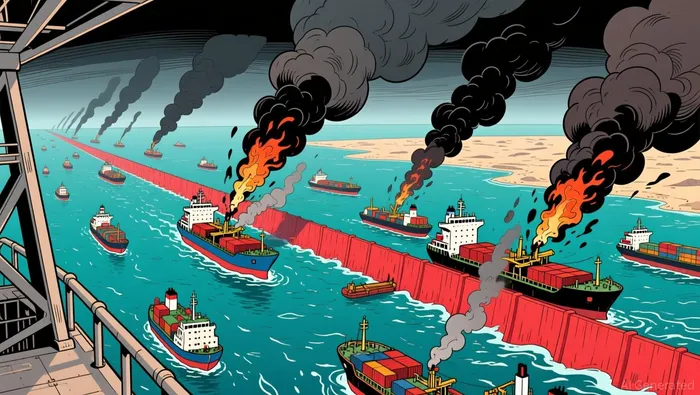
This demand destruction is already materializing. The closure of the Strait of Hormuz and attacks on infrastructure have forced Middle East and feedstock-constrained Asian refineries to slash crude runs by around 6 mb/d. When the supply chain breaks, the first casualty is often the most vulnerable demand. Refineries without alternative feedstocks are forced to idle, directly reducing crude consumption. This is the mechanism of "scarcity and higher prices persisting" that the IEA warned about.
Yet, this demand destruction is being counterbalanced by a persistent structural surplus. Even as the war disrupts flows, strong non-OPEC+ production and Russian flows continue to limit the price impact. The pre-war outlook of ample supply, which J.P. Morgan had anchored around a $60/bbl Brent average, is not entirely gone. It has been overlaid with a massive, temporary shock. This creates a tug-of-war: the supply shock pushes prices up, but the underlying surplus in global production acts as a ceiling, preventing a sustained, runaway rally.
The bottom line is a fragile, new equilibrium. The market is not simply returning to its old path. Instead, it is settling into a state where the price reflects a premium for the risk of chokepoint disruptions, while being held in check by the sheer volume of barrels that can still flow from other sources. The demand destruction in key regions is a critical part of that balance, absorbing some of the shock but not eliminating it. For now, the price is caught between the force of a historic supply crunch and the weight of a resilient global supply base.
Immediate Market Pressures and Volatility Drivers
The market's immediate pressures are now defined by a series of cascading rerouting attempts and escalating threats. The closure of the Strait of Hormuz forced producers to seek alternatives, with Saudi Aramco quickly pivoting to its east-to-west pipeline to the Red Sea. Daily loadings at the Yanbu terminal have more than doubled this month, a critical but narrow lifeline. Yet that route is now under direct threat. Iran has declared US naval facilities in the Red Sea as potential targets, a move that raises the stakes for any vessel using the Red Sea as a transit corridor. This creates a dangerous new dynamic: the primary alternative to the blocked strait is itself becoming a contested zone, amplifying the risk premium and volatility for every barrel shipped.
This tension is reflected in the brutal price action. Brent crude averaged $103 per barrel in March, a staggering $32/b increase from February. Daily prices have spiked even higher, reaching almost $128/b on April 2. These aren't just trading moves; they are the market's real-time assessment of a system under siege. The volatility stems from the constant calculation of rerouting costs, insurance premiums, and the ever-present fear of another attack that could sever the Red Sea link entirely. Traders are pricing in a premium for the sheer uncertainty of getting oil from point A to point B.
The impact is not confined to major trading hubs. For distant consumers, the crisis is already a tangible hardship. Pacific Island nations, already isolated and reliant on complex Asian supply chains, are facing higher fuel prices, electricity uncertainty, and fears of deeper economic insecurity. Their fragile shipping links mean that disruptions in the Middle East ripple across thousands of miles of ocean, driving up bunker costs and freight rates. As one UN official noted, they are "at the end of the supply chain", making them acutely vulnerable to any spike in global energy prices. This creates a secondary, humanitarian pressure point that adds to the geopolitical instability.
The bottom line for investors is a market caught in a high-risk, high-cost loop. The initial shock of the Strait's closure has been followed by a dangerous escalation in the Red Sea. Prices are volatile because the fundamental problem-getting oil around a major chokepoint-has no easy solution. Every rerouting attempt introduces new vulnerabilities, and every threat of an attack reinforces the risk premium. The market is not just reacting to a supply crunch; it is pricing in the immense logistical and security costs of navigating a broken system.
The Fragile Balance and Key Watchpoints
The market now exists in a precarious equilibrium, where the price of oil is a constant negotiation between a shattered supply chain and a resilient global production base. The immediate catalyst for any shift will be the resolution of the Middle East conflict and the pace at which supply can be restored. Until then, the system is held together by symbolic gestures and emergency measures, not by a return to normal.
OPEC+ is at the center of this symbolic dynamic. The group is scheduled to meet to discuss output quotas, but any increase approved will be largely academic. The war has effectively shut the Strait of Hormuz, cutting exports from its key members, while damage to infrastructure and existing production limits mean OPEC+ lacks spare capacity to increase production. A modest boost for May would signal readiness to raise output once the strait reopens, but it would have little immediate impact on the physical supply crunch. The group's recent decisions are less about managing supply and more about managing expectations, a gesture of unity in the face of a crisis it cannot control.
In response to the price surge, the International Energy Agency has taken direct action. It has launched its largest ever release of emergency oil stocks to help mitigate price pressures. This is a critical tool to provide a buffer, but it is a finite one. The IEA is also tracking a wide array of demand-side measures adopted by governments, from work-from-home mandates to fuel rationing, to shelter consumers and support energy security. These measures are designed to absorb some of the shock, but they are a response to the crisis, not a solution to the underlying supply disruption.
The primary watchpoints are now binary. First, the geopolitical timeline: how long will the conflict and the closure of the Strait of Hormuz persist? The market's forecast already assumes disruptions will continue through late 2026, but a swift resolution could begin to ease the pressure. Second, the pace of supply restoration. Even if the strait reopens, the damage to infrastructure and the backlog of tanker routes mean a full recovery will take months. As one consultancy noted, it would take months to resume normal operations and reach production targets even if the war stopped and Hormuz reopened immediately.
The bottom line is that the current balance is fragile and temporary. It is a standoff between a historic supply shock and the world's emergency response. The next phase will be determined by the conflict's endgame and the slow, costly process of getting oil flowing again. For now, the market is caught in a high-risk loop, where every day without a resolution reinforces the premium for risk and the vulnerability of the global system.