

OpenAI's IPO scale shifts the debate from promise to proof
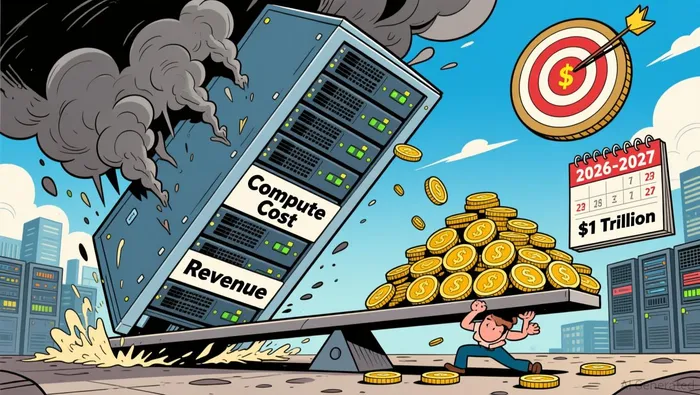
OpenAI is laying the groundwork for a potential up to $1 trillion valuation and a raise of as much as $60 billion, with timing pointing to late 2026 through a 2027 listing. That becomes more consequential if the company is also on track for an annualized revenue run rate of about $20 billion. The central question is no longer just whether OpenAI can keep pushing the frontier. It is whether revenue can scale quickly enough to support capital demands of this size.
Why the timing matters now
OpenAI's big restructure cleared the path for a public offering, and the company is expected to need public-market capital to keep funding the next stage of AI infrastructure buildout. With Anthropic and SpaceX also reportedly eyeing debuts, 2026–2027 could become the first major IPO wave centered on AI infrastructure. If OpenAI can debut with demand intact, investors will start pricing the category by revenue conversion, not just compute ambition. If not, the debate over AI valuations becomes much less theoretical.
OpenAI's lead is still distribution-first, not yet economics-first
Why being first still matters
ChatGPT launched in late 2022, giving OpenAI an early lead in adoption. That matters because early distribution can shorten the path to enterprise exposure, deepen brand familiarity, and make it easier to turn casual users into paid customers and workflow integrations.
But that lead is no longer self-evidently durable. Competition is intensifying, and OpenAI increasingly has to prove that usage can become monetization before parity narrows its advantage.
The moat now depends on enterprise conversion
A narrowing technical gap does not erase the value of being first, but it does raise the importance of the next step: turning usage into paid enterprise revenue, stronger pricing power, and more durable workflow dependency. The market is also looking at AI infrastructure earlier in the cycle because three major tech IPOs are shaping up, which could push investors to pick leaders before every business model is fully proven.
The real pressure point is whether revenue can outrun the compute bill
The harder question is not whether OpenAI can keep advancing the frontier. It is whether revenue can grow faster than the cost of training, inference, and infrastructure.
The burn rate is the pressure point
OpenAI had a reported cash burn of $9bn last year, and the same analysis points to roughly $17bn this year. Looking further ahead, OpenAI is projected to burn $57 billion annually by 2027, with profitability not expected until 2030. That is the real stress test. Much of the spending is tied to securing access to compute. If revenue does not steepen quickly, investors are more likely to see a business that needs repeated financing than a platform already generating durable returns.
Monetization is the test, not model prestige
That does not end the bull case. It changes what investors need to see. OpenAI does not need perfect economics today, but it does need evidence that usage can be converted into revenue, that pricing can be deepened, and that inference costs can fall fast enough to widen the gap between spend and return.
Bulls see a familiar pattern: early platform leaders sometimes subsidize access first, then later monetize through raised prices, added new revenue streams. OpenAI has already moved in that direction with new subscription tiers and in-platform ads.
Bears focus on the conversion gap. A huge user base only supports the capex story if a meaningful share moves into paid plans, enterprise contracts, or commercial inference volume. If most usage remains free or low-ARPU, the model starts to look more like a utility than a high-multiple infrastructure monopoly.
What investors should watch before the IPO window hardens
The next move is not about another round of faith. It is about whether OpenAI can show that its monetization curve is becoming more durable than its compute curve.
The near-term scorecard
This year is already being treated as a make or break year for AI model companies heading public, and OpenAI is seen as particularly extended. The most useful signals are straightforward:
- Enterprise monetization: Are enterprise contracts and paid workflows scaling fast enough to matter?
- Pricing power: Are subscription tiers, ads, and enterprise pricing extracting more value without hurting adoption?
- Cost discipline: Are inference costs falling quickly enough to narrow the gap between spending and revenue?
- IPO timing and market conditions: Can OpenAI enter public markets when investor scrutiny is already rising?
If those signals improve, the market may accept a longer road to profit. If they do not, the compute story will look less like infrastructure and more like a financing burden.
The IPO is a catalyst, not a validation
OpenAI is reportedly preparing for a filing as early as the second half of 2026, with advisers seeing a path to late 2026 or a 2027 listing. That would land in a crowded AI-era capital market: three major tech IPOs are already shaping up, which could either amplify demand for category leaders or expose the risks of paying up for scale too early.
The practical takeaway is simple: do not buy the story on capability alone. Wait for evidence that enterprise monetization, pricing power, and cheaper inference are improving together. If that still is not visible by the time the filing window opens, caution is the more disciplined stance.