

The institutional case for OpenAI hinges on a stark tension between its staggering private valuation and the material political overhang that threatens to discount or delay its public debut. The numbers alone are eye-popping. In November 2024, the company closed a deal that valued it at $80 billion or more. Just months later, in a separate funding round, it secured $122 billion at an $852 billion post-money valuation. This represents a valuation leap of over 1,000% in less than a year, a premium that assumes flawless execution and infinite growth runway.
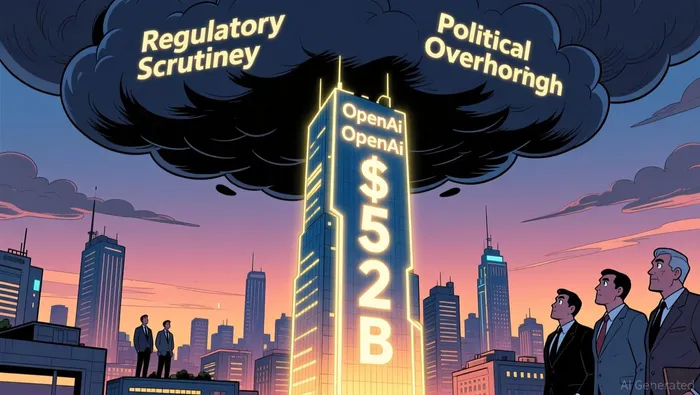
Against this backdrop, the company's stated ambition is to list in the fourth quarter of 2026. That target window is the focal point of institutional scrutiny. The political and governance scrutiny surrounding the company introduces a quantifiable risk premium that could materially impact that timeline and the ultimate price. The Securities and Exchange Commission is actively investigating internal communications from the period of Sam Altman's ouster and reinstatement, a move that is a predictable response to the board's public statements about his leadership. This regulatory probe, while not yet concluding, creates a cloud of uncertainty that public investors cannot ignore.
For institutional allocators, this is the core dilemma. The private market has priced OpenAI as a near-monopoly in generative AI, but the public market demands transparency and governance clarity. The SEC investigation introduces a tangible delay risk and a potential discount to the $852 billion private peak. Until that overhang clears, the IPO's success is not just about growth metrics-it's about navigating a complex regulatory and corporate governance minefield. The risk premium here is the gap between the private market's optimism and the public market's demand for a clean slate.
Governance and Capital Structure: The 'Cash Bonfire' Narrative
The transition from a non-profit to a for-profit entity has created a complex capital structure that is now under intense institutional scrutiny. The recent closed-door Capitol Hill meeting where lawmakers raised serious questions about OpenAI's Defense Department partnerships is a critical example. This scrutiny highlights the tension between the company's original mission and its current commercial and strategic alliances, a governance overhang that institutional investors must weigh against the promised returns.
This governance pressure coincides with a massive liquidity event that has already priced in near-perfect execution. The company's $122 billion funding round at an $852 billion valuation represents a "cash bonfire" of unprecedented scale. For institutional allocators, this is a double-edged sword. On one hand, it provides a massive war chest to fund growth and R&D. On the other, it leaves virtually no room for error. The valuation assumes flawless scaling and market dominance, compressing the risk premium into a narrow band. Any stumble in growth or margin expansion would be punished severely in the public markets.
Adding to the regulatory complexity is a separate antitrust review. The UK's Competition and Markets Authority is investigating the partnership between OpenAI and Microsoft, focusing on how this deep integration might affect competition. This review, distinct from the US SEC probe, signals a global regulatory pushback against the perceived duopoly in enterprise AI. For an IPO, this introduces another layer of uncertainty around the company's commercial freedom and long-term competitive positioning.
Together, these elements paint a picture of insider economics in flux. The massive funding round has concentrated wealth among early and late private investors, creating a large potential supply of shares upon an IPO. The governance and regulatory overhangs, from Capitol Hill to the UK, threaten to delay the liquidity event and could force a discount to the private market's lofty peak. The institutional case must therefore assess not just the business model, but the structural risks of unlocking that capital at a time when political and regulatory scrutiny is at its highest.
Sector Rotation and Portfolio Construction
The political overhang is forcing a critical re-evaluation of capital allocation within the AI ecosystem. For institutional investors, the scrutiny targeting the commercialization of AI in national security creates a clear bifurcation. Pure-play AI firms like OpenAI, which are directly engaged in high-value but politically sensitive Defense Department partnerships, now face a heightened risk premium. The closed-door Capitol Hill meeting where lawmakers raised serious questions about these ties signals a regulatory and reputational vulnerability that is not shared by companies focused solely on enterprise software or consumer applications. This niche but lucrative vertical introduces uncertainty that could delay funding rounds or dilute valuation multiples upon an IPO.
By contrast, the broader AI infrastructure sector-encompassing semiconductors, cloud computing, and foundational software-faces less direct political risk. These are the enablers of the AI boom, not the end-product developers in contested domains. This structural difference makes infrastructure plays a more defensive allocation within a tech portfolio. While they benefit from the overall AI investment surge, they are insulated from the specific governance and mission creep debates that plague pure-play firms. The institutional playbook may therefore shift toward overweighting these infrastructure components, seeking exposure to the AI growth story with a lower political beta.
This rotation dynamic is further complicated by a separate layer of regulatory uncertainty: the UK's antitrust review. The Competition and Markets Authority is investigating the partnership between OpenAI and Microsoft, a deep integration that could be scrutinized for anti-competitive effects. This global review adds another overhang, potentially constraining the commercial freedom and long-term competitive positioning of the leading AI stack. For portfolio construction, this means the "AI winner-take-most" thesis now carries an additional regulatory risk that is not uniformly distributed.
The bottom line for institutional allocators is a move toward structural diversification. The high-risk, high-reward pure-play AI bets are becoming more expensive to hold, not just on valuation but on governance risk. The path of least resistance may be to rotate capital toward the AI infrastructure layer, where the growth story is intact but the political and regulatory overhang is materially thinner. This is a classic sector rotation driven by a shift in the risk premium, where quality and defensive positioning trump pure exposure to the most hyped narrative.
Catalysts and Guardrails: The Path to Liquidity
For institutional investors, the path to liquidity is now defined by a series of forward-looking catalysts that will determine whether the political risk premium dissipates or crystallizes ahead of the IPO. The most immediate and consequential event is the outcome of the SEC investigation into internal communications from the period of Sam Altman's ouster and reinstatement. This probe, which subpoenaed emails and records in December, is a direct response to the board's public statements about Altman's leadership. Its resolution-whether through material disclosures, enforcement actions, or a quiet conclusion without accusations-will be the single largest signal for investor confidence. A finding of misleading statements would severely damage the company's credibility and likely force a significant discount to its private valuation. Even a clean conclusion may not fully erase the overhang, but it would remove a major source of uncertainty that currently clouds the IPO timeline.
A second critical catalyst is the finalization of any new Defense Department partnership guidelines. The closed-door Capitol Hill meeting where lawmakers raised serious questions about these ties highlights a persistent opacity that frustrates oversight. Clear, publicly available rules for AI in national security would reduce the regulatory and reputational risk that lawmakers perceive. It would signal a more transparent and governable model, potentially easing the political pressure that could otherwise delay funding rounds or dilute the IPO price. The absence of such guidelines, by contrast, leaves the door open for ongoing scrutiny and legislative action that could constrain commercial freedom.
Finally, the next major institutional signal will be the IPO pricing and allocation itself. This event will reveal whether the market is willing to pay a premium for OpenAI's growth story amid this new risk profile. The massive $122 billion funding round at an $852 billion valuation priced in near-perfect execution. The IPO will test if that premium can be sustained in a public market that demands greater transparency and governance clarity. A successful, well-priced deal would indicate that the risk premium has been adequately compensated. A delayed listing or a discount to the private peak would confirm that the political and regulatory overhangs are a material drag on value.
From a portfolio construction perspective, these catalysts define the guardrails for liquidity. The institutional view must weigh the potential for a "cash bonfire" of supply against the risk of a delayed or discounted exit. The SEC outcome and defense policy clarity are pre-IPO guardrails; the IPO pricing is the post-IPO test. Until these are resolved, the liquidity event remains a function of political and regulatory risk, not just business fundamentals.