

Sam Altman, the CEO of OpenAI - the company that built ChatGPT, not a car or a machine - posted a hiring call for robot engineers on Sunday. Full-stack hardware engineers, ML engineers, operations and systems engineers. The robotics group, led by Aditya Ramesh (the person behind Sora, OpenAI's video model), is looking to build robots. Not as a side project. Not as a research toy. As something they plan to manufacture and sell.
Tesla's stock dropped roughly 4% on Monday as a result.
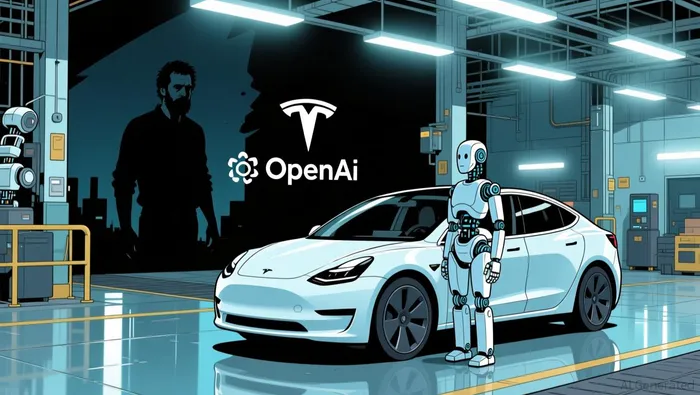
That was weird. Not because OpenAI is building robots - anyone who has followed the space knows the humanoid robot category is crowded. Boston Dynamics, Figure, Apptronik, Unitree in China selling a humanoid for $16,000, the list goes on. The odd thing is not that there's another competitor. The odd thing is that one specific competitor - OpenAI - moved Tesla's stock on the back of a hiring tweet.
That tells you what's actually happening. The market isn't pricing in a new robot company. The market is starting to question whether the robot story that Tesla's valuation runs on has the moat that Elon Musk has been selling.
Here's the plumbing. Musk has repeatedly said Optimus, Tesla's humanoid robot, could drive the company's market cap to $25 trillion. He has said 80% of Tesla's value will eventually come from robots. The stock, trading at $415 as of Monday's close, carries a valuation premium for AI and robotics that doesn't reflect any current robot revenue - because there is none. Optimus is still being tested inside Tesla's own factories. It doesn't have a launch date. It doesn't have customers. It doesn't even have a clear cost target.
An analyst last year assigned 6% of Tesla's market cap to Optimus. Musk says the number should be 80%. Both are speculation about a product that generates zero dollars. But in a stock like Tesla, the speculation is the product. The story is the valuation.
So when OpenAI - a company with deep AI capabilities, a war chest of cash, and no manufacturing legacy to defend - announces it's building robots too, the market has to ask a question Musk would rather it didn't: what was the moat?
Musk's answer has always been the same. Tesla's advantage is the combination of AI plus manufacturing scale. Nobody else can do both. You need the AI brain and the factory body.
Except OpenAI clearly thinks it can build the factory body, or at least figure out manufacturing the way every other robot startup is trying to. And the Chinese companies in this space seem to think manufacturing is the easy part - Unitree's $16,000 humanoid suggests the hardware race is already heading toward a commodity play.
That is a very different story from the one Tesla has been running.
There is also the matter of timing. Apptronik raised $935 million in Series A funding in February. Humanoid robot companies raised $1.61 billion in equity in the first four months of 2026 across 13 funding rounds. Goldman Sachs estimates the global humanoid robot market at $205 billion by 2035. Kalshi prediction markets give Optimus only a 21% chance of being available for purchase in 2026.
Meanwhile, Tesla just raised its own capex guidance for 2026, promising to spend even more on AI and robotics. That fell flat with investors back in April. The signal is clear: the market is getting skeptical of spending promises that don't have products attached.
The simplest model is this. Tesla is valued as a company with three engines: cars, energy, and robots/AI. Cars are mature and margin-squeezed. Energy is growing but small. Robots are the option premium - the part of the valuation that says this company has something no one else can replicate. OpenAI entering the space doesn't kill the robot market. It challenges the replication claim. If the AI brain can come from ChatGPT instead of FSD, and the body can be built by anyone with capital, then Tesla's robot story looks less like a monopoly and more like another crowded startup category with extra steps.
That doesn't mean Tesla is broken. It means the premium on the story just got a stress test. A 4% move on a hiring announcement is not a repricing. It's a signal that some portion of Tesla's market cap has been resting on an assumption that's starting to feel less unique than it did last quarter.
The structural question going forward isn't whether Optimus can compete. It's whether investors will keep paying for a robot valuation in a company that hasn't sold a robot, in a space that's no longer monopolized by a single narrative. If the answer is no, the gap between Musk's $25 trillion dream and Tesla's roughly $1.8 trillion reality is a lot harder to bridge.