

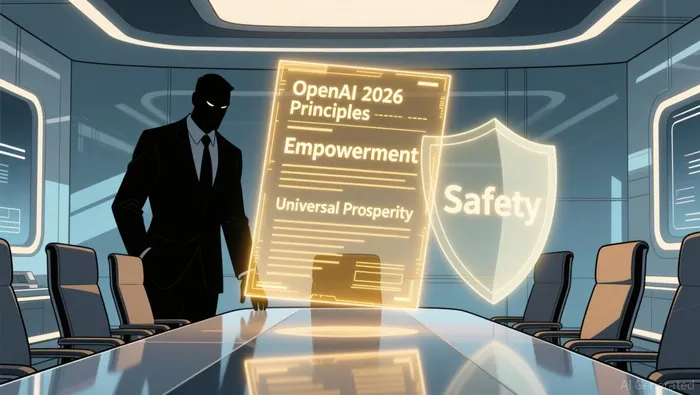
OpenAI's recent overhaul of its guiding principles marks a clear departure from its founding ethos. The 2026 document, as CEO Sam Altman noted, reflects a strategy refined over the past two years. Yet the shift is structural, not merely tactical. The most telling change is a pivot in language: where the 2018 charter emphasized "democratization" and "safety", the new principles speak of "empowerment" and "universal prosperity". This subtle rewording implies a potential prioritization of commercial interests and broad adoption over the earlier, more explicit focus on equitable access and risk mitigation.
This update coincides with a fundamental legal transformation. OpenAI converted to a for-profit Public Benefit Corporation (PBC), a structure where its primary fiduciary duty is to humanity, not shareholders. While this aims to balance profit with purpose, the practical effect is a company now governed by investors who directly receive a share of its profits. The timing is critical; this mission shift occurred as OpenAI ceded almost three-quarters of nonprofit control to private investors and, notably, removed the word "safely" from its mission statement in its final IRS filing as a nonprofit.
Viewed together, the changes signal a strategic pivot. The company is moving from a mission-driven, safety-focused nonprofit to a for-profit entity where commercial viability is paramount. The central question for investors is whether this shift is priced into OpenAI's current valuation gap versus its rivals. The updated principles, coupled with the PBC structure and the removal of safety language, frame a new operating reality-one where the company must demonstrate it can deliver on both its profit objectives and its stated duty to humanity.
Historical Parallels: The Evolution of Tech's Mission-Driven Ethos
OpenAI's shift mirrors a well-worn path in technology history. The company's new principles, with their focus on empowerment and universal prosperity, echo the early, aspirational missions of giants like Google and Facebook. Yet the trajectory of those companies shows how idealistic charters often evolve-or are reinterpreted-when scaled into global, profit-driven enterprises.
Google's famous, though never formally written, mantra of "Don't be evil" served as a guiding star for its early growth. Over time, however, the commercial imperatives of search advertising and data-driven services brought the company under intense scrutiny for market dominance and privacy concerns. The principle became a point of tension, not a rigid constraint, as the company navigated complex regulatory landscapes. Similarly, Facebook's initial ethos of "move fast and break things" prioritized rapid innovation and user growth. As the platform matured into a central pillar of global communication, its commercial model and the societal impact of its algorithms drew fierce criticism, ultimately requiring new governance structures and a re-evaluation of its role in public discourse.
These parallels are instructive. They suggest a common pattern: as tech companies scale, their initial mission statements often transition from binding operational mandates to aspirational guidelines. The pressure to deliver returns, compete in crowded markets, and adapt to unforeseen consequences can dilute the original focus. For OpenAI, the move from a nonprofit with a safety-first charter to a for-profit Public Benefit Corporation with a new set of principles is the latest chapter in this evolution. The historical precedent is clear: maintaining a pure, mission-driven focus becomes increasingly difficult as the stakes and the capital requirements rise. The real test now is whether OpenAI's updated principles can hold more weight than its predecessors in the face of mounting commercial and competitive pressures.
Market Valuation and Competitive Context
The market is pricing OpenAI's strategic shift with clear skepticism. Despite a massive $852 billion funding round, the company's valuation on secondary markets now sits at $880 billion, trading at a discount to its closest rival, Anthropic. This divergence highlights a stark preference for perceived growth and momentum over OpenAI's established but potentially slower-moving model.
Anthropic's surge is driven by a potent mix of fundamentals and frenzy. The company's valuation has nearly tripled from its $380 billion funding round just three months ago, now hovering at $1 trillion on private exchanges. The core driver is torrid revenue growth, particularly from its AI-powered coding assistant, Claude Code. Yet much of the demand is pure FOMO, with investors so desperate for a piece of the action that they are offering to sell their homes for shares. This feverish secondary market activity has pushed Anthropic ahead of OpenAI, despite the latter's larger funding round.
For OpenAI, the revised partnership with Microsoft provides a long-term financial anchor but also a significant cost. The updated agreement secures a 20% revenue share for Microsoft until 2032. This arrangement reduces near-term revenue volatility and cedes a substantial portion of future earnings to a key partner. It is a high-stakes trade-off: stability for control. In a market now valuing explosive growth narratives, this structure may be seen as a necessary but dilutive step to fund the company's expansion, particularly in data center capacity.
The bottom line is a market that has shifted its bet. OpenAI's principles update and mission pivot coincide with a valuation gap that favors a competitor perceived as more agile and growth-oriented. The discount on secondary markets suggests investors are weighing the company's strategic evolution against its commercial reality, where a powerful partner's financial claim is now a fixed cost of doing business.
Financial and Governance Implications
The new structure and principles embed a set of concrete financial and governance tensions that will define OpenAI's path forward. The most significant is the inherent conflict created by the Public Benefit Corporation (PBC) model. This legal form decouples the company's mission governance from its economic interests, a tension central to Elon Musk's ongoing fraud lawsuit and a key risk for long-term credibility. The PBC structure is meant to balance profit with purpose, but it leaves the fiduciary duty to "humanity" open to interpretation, especially as the company's financial success becomes increasingly tied to private investors who expect returns. This setup creates a vulnerability: if commercial pressures conflict with the stated mission, the legal and reputational fallout could be severe.
Financially, the cap table reveals a stark winner and a source of dependency. Microsoft stands out as the standout economic beneficiary, holding a 26.79% stake valued at over $228 billion. This position, built on a $13 billion investment, implies an extraordinary return. Yet this dominance also creates a dependency that could limit strategic flexibility. The company's updated partnership with Microsoft secures a 20% revenue share for Microsoft until 2032, a fixed cost that directly reduces OpenAI's future earnings. This arrangement, while providing stability, means a major partner will have a direct financial interest in the company's commercial decisions, potentially constraining its ability to pursue independent strategies.
Finally, the company's approach to safety has shifted from broad principles to a product-specific, iterative process. This is evident in the detailed system cards for new products like GPT-5 and Sora 2, which outline specific, context-dependent mitigations. While this allows for targeted risk management, it may be less transparent and less binding than the earlier, more principle-based safety promises. The move away from a universal "safety" mandate in its mission statement suggests a framework that evolves with each product launch, rather than a fixed standard. For investors, this means safety is now a variable cost of development, not a guaranteed upfront investment, which could affect long-term liability and public trust.
Catalysts and Risks for the Thesis
The market's verdict on OpenAI's principles pivot will be determined by a few high-stakes events. The first is the 20% revenue share milestone with Microsoft until 2032. This fixed cost is a direct financial anchor, and any renegotiation or dispute over the terms would signal a fundamental tension in the partnership. It would reveal whether the long-term stability provided by the deal is worth the ceded profits, especially if OpenAI seeks to diversify its compute partnerships.
Second, the outcome of Elon Musk's fraud lawsuit is a critical governance test. The suit hinges on the Public Benefit Corporation's mission governance structure, which decouples economic ownership from fiduciary duty to "humanity." A ruling against OpenAI could force a strategic or financial restructuring, directly challenging the legitimacy of the principles update. The lawsuit is set for trial, and its resolution will be a major stress test for the company's new operating model.
Finally, the key valuation catalyst is the anticipated IPO. The market's reaction to OpenAI's principles and governance during the roadshow will reveal whether investors see the shift as prudent or perilous. The company's cap table shows extraordinary returns for early backers like Microsoft, but also structural anomalies like the nonprofit's outsized board control. If the IPO process highlights these tensions, it could undermine the narrative of a balanced, mission-driven entity, validating the skepticism already priced into secondary markets.