

OpenAI's Spud is expected by the market to surface around April 14, although no formal release timing has been confirmed. What makes it important is not simply the possibility of a stronger new model, but the growing view that it could be a deeper base-layer upgrade with implications for reasoning, context retention, product integration, and enterprise delivery.
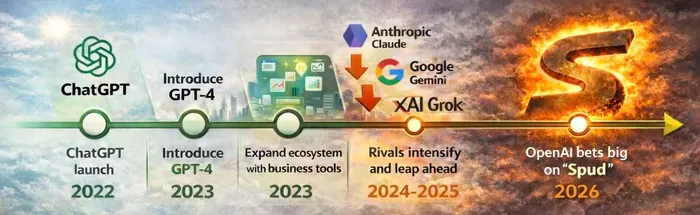
If Spud does appear soon, this update is unlikely to look like a routine version refresh. It looks far more like a flagship move with clear strategic intent. Over the past year, the AI industry has seen no shortage of new models and no shortage of short-lived hype cycles. What has become rare is the ability to turn stronger model capability into stronger products, smoother workflows, and firmer commercial control. Spud matters not because it is simply another codename, but because more and more public signals point in the same direction: OpenAI may be trying to accelerate not just the model itself, but the capability of its entire platform.
Based on what has surfaced publicly, Spud could mean much more than a standard upgrade. Greg Brockman recently described it as a "new base" and "new pre-train" built on roughly two years of research. Meanwhile, an internal memo reported by The Verge placed Spud inside a broader platform narrative—not as an isolated new model, but as a foundational capability layer that could make other OpenAI products significantly stronger. Taken together, those signals make Spud look less like a standard release and more like a coordinated attempt by OpenAI to widen the gap again.
More importantly, market discussion around Spud is no longer centered only on whether it will be stronger. The conversation is increasingly shifting toward whether it can push AI from something that answers prompts into something that completes tasks. For everyday users, that would mean less back-and-forth prompting, less manual context loading, and less correction. For enterprises, it would mean AI becoming less of a feature and more of a workable system. That is why Spud is being watched not merely as a launch event, but as a possible attempt by OpenAI to pull the center of competition back into a rhythm it defines.
Why the market does not see Spud as a routine upgrade
The language already in circulation does not sound like a patch. For a company that already has a mature flagship lineup, phrases like "new base" and "new pre-train" suggest something much closer to a generational shift than a normal optimization cycle. They imply not a light adjustment to an existing system, but a refresh of the structure underneath the product stack itself. If that underlying shift is real, the impact will not stay at the model layer. It will move upward through ChatGPT, the API, Codex, memory systems, and enterprise deployment.
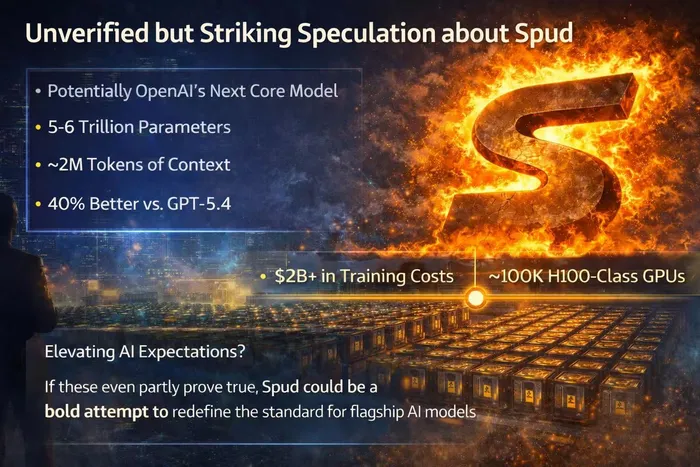
A number of striking claims about Spud have also circulated externally. These include suggestions that it could be OpenAI's next core foundation under an internal codename, that its scale may reach roughly 5 trillion to 6 trillion parameters, that it may support around 2 million tokens of context, that overall performance could improve by about 40% versus GPT-5.4, that training costs may have exceeded $2 billion, and that roughly 100,000 H100-class GPUs may have been involved. None of these figures has been officially confirmed by OpenAI, so they should not be treated as established fact. But the speed with which such claims spread says something important by itself: investors and industry observers are no longer treating Spud as a modest step forward. They are treating it as a possible flagship inflection point. A more disciplined way to frame this is simple: if even part of these rumors proves directionally true, Spud will be understood as an attempt by OpenAI to redefine the standard for flagship AI models.
Put differently, the most important thing about Spud may not be how high any single benchmark goes. It may be whether OpenAI is trying to prove something larger: that frontier models have not become fully commoditized, and that top-tier model capability can still translate into platform value, product value, and commercial defensibility. If Spud ultimately shows up as stronger unified orchestration, more mature agent execution, smoother tool use, and better memory handling, then the real upgrade will not just be smarter answers. It will be a system that feels more like a persistent digital worker capable of carrying work forward. That is what the market is really watching.
Compared with GPT-5.4, Spud may not widen the gap by a few points of performance, but by a full layer of user experience
The right comparison point for Spud is not GPT-4, but the already strong GPT-5.4. OpenAI introduced GPT-5.4 on March 5, 2026, as a frontier model for professional work, then expanded the family in mid-March with GPT-5.4 mini and nano to extend those capabilities across different cost and use-case tiers. In other words, GPT-5.4 is not a transitional release. It is already a fairly complete and usable system for real work.
That is exactly why Spud cannot win attention by being only a little faster or a little smoother. What it really has to prove is whether it can move the user experience from "the user still has to teach the model how to work" to "the system understands the task more naturally and carries it forward more reliably." That may not sound like the easiest headline sell, but it is often the upgrade users feel most directly. Today's strongest models often do not fail because they lack intelligence. They fail because users still have to keep supplying background, splitting the work, and correcting direction. If Spud can materially reduce that friction, then the improvement is not merely that it is smarter. It is that it begins to feel more like a system that can independently advance work.
That also means the difference between Spud and GPT-5.4 may not first appear in a single eye-catching benchmark chart. It may show up more clearly in the closed-loop quality of complete tasks. The model that can more reliably understand intent, call tools, preserve context, check its own output, and deliver a result is the one that comes closer to the next real competitive standard in AI products. For users, that shift would feel very concrete: not that the answers sound grander, but that the cost of using the system falls, the efficiency of completion rises, and real workflows start to get picked up by AI in a more serious way.
Why this release could hit other AI companies directly
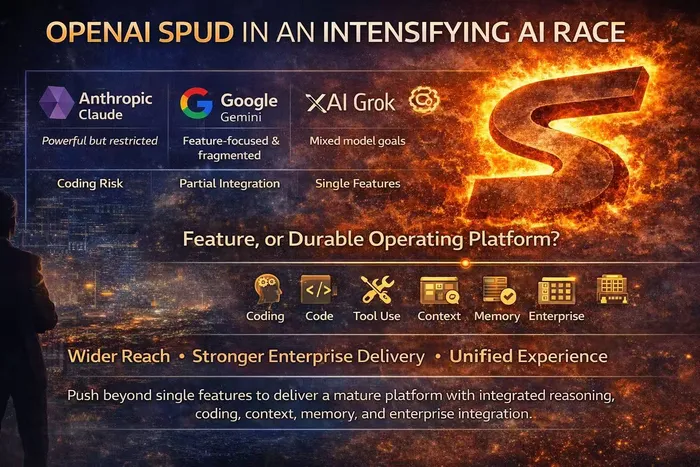
Spud's potential impact becomes clearer when placed inside the current competitive environment. Anthropic announced Claude Mythos Preview and Project Glasswing on April 7, but did not broadly release Mythos to the public. Subsequent reporting described Mythos as one of Anthropic's strongest models for coding and autonomous tasks, while also highlighting misuse concerns tied to its ability to discover and exploit vulnerabilities, which led to a more restricted deployment posture. In other words, Anthropic is currently telling a story of high capability paired with high constraint.
That creates a potential opening for OpenAI. If Spud can land quickly in a broader product form with wider user reach and stronger enterprise delivery, then OpenAI's story is no longer just "we also have a powerful model." It becomes "we are better at turning frontier model capability into a widely usable product and platform." At this stage of the AI race, that difference matters a great deal. Anthropic's narrative leans toward capability with caution. The direction suggested by OpenAI's internal memo leans more toward platform unification, enterprise deployment, lower switching costs, and stronger product coordination. If Spud makes that story concrete, the pressure it applies to competitors will not be only at the model layer. It will be at the platform layer too.
And that pressure would not stop with Anthropic. For Google, xAI, and other major players, the next phase of competition is no longer about one standout feature. A large context window alone is not enough. Real-time search alone is not enough. Multimodality alone is not enough. What becomes dangerous is a model that can reason, code, use tools, preserve context, coordinate memory, and already sit inside a mature product surface at the same time. Once OpenAI pushes that integration further, every rival faces the same uncomfortable question: are they selling a feature, or are they building a durable operating platform?
What OpenAI may really be trying to say is not just that the model is stronger, but that it wants the industry's tempo back
From a broader perspective, Spud's symbolic value may matter just as much as its technical details. For some time now, the industry has been asking whether frontier models are gradually becoming commoditized and whether leadership advantages will become harder to sustain. If Spud shows that a new foundation upgrade can still create a clear generational step—and that this step can quickly convert into product value, enterprise deployment, and user retention—then the market will have to revisit a deeper question: whether top-tier models can still define platform-level order.
That is why Spud does not look like a normal release cycle. It looks more like a tempo-recapture move. At a time when competitors are emphasizing safety, vertical strengths, and narrower differentiators, OpenAI appears to be trying to bind model capability, agent behavior, product entry points, and enterprise integration back into one unified narrative. If that narrative lands, OpenAI no longer looks like just a supplier of leading models. It starts to look like the company trying to redefine what the next major AI platform should be.
Seen from that angle, Spud's real mission may not be simply to prove that OpenAI can still build a stronger model. It may be to prove that OpenAI remains the company best positioned to translate a model breakthrough into a shift in product order. That is the larger prize. The industry does not lack eye-catching demos or isolated metric gains. What it lacks is a company that can fuse reasoning, tools, memory, coding, multimodality, and enterprise access into one operational layer. Whoever does that first is not just winning a news cycle. They are defining the standard for the next phase of competition.