

An Austrian developer builds an open‑source AI agent framework. It goes viral in China, where nearly 1,000 people line up outside Tencent's headquarters to get it installed on their laptops. Chinese AI stocks jump 20% to 30% after Nvidia's CEO calls it "definitely the next ChatGPT." Local governments dangle grants of up to 10 million yuan for startups building on it. Meanwhile, the creator moves to the United States to join OpenAI, complaining that Europe's regulations are "stifling" and that he'd be "scolded about responsibility" if he tried to build there.
That is weird. The obvious story is "China is winning the AI race." The more interesting story is about regulatory and economic arbitrage-about how the same piece of software finds radically different adoption curves depending on which market structure it lands in.
OpenClaw is an open‑source framework that turns large language models into autonomous agents. It was released in November 2025 by Austrian programmer Peter Steinberger. What happened next looks like a classic network‑effects explosion: 20 million monthly active users in China within a month, 350,000 GitHub stars (faster growth than Linux or React), and a cultural meme-"raise a lobster"-that swept through Chinese tech circles. Major cloud providers like Alibaba, Tencent, and Baidu rushed out their own "Claw" versions. The thing became a craze.
But the craze isn't just about the software. It's about the plumbing. China has electricity that costs as little as five cents per kilowatt‑hour in western provinces, versus 40 cents in some U.S. data‑center hubs. Since power can make up about 35% of AI inference costs, that's a structural advantage. China also has intense competition among cloud providers, each eager to capture the next platform shift. And it has local governments willing to write checks to seed an ecosystem. Those conditions create a different adoption machine than you'd see in the U.S. or Europe.
The market reaction followed a familiar script. After Nvidia CEO Jensen Huang praised OpenClaw, shares of Chinese AI companies MiniMax and Zhipu surged as much as 29%. That's less a comment on OpenClaw's underlying economics and more a signal game: when the most important voice in AI infrastructure blesses a trend, money moves. It's a version of the old "everything is securities fraud" joke-not because anyone lied, but because the market translation layer turns technological enthusiasm into stock‑price momentum almost automatically.
Meanwhile, the creator's own trajectory highlights a different sort of arbitrage. Steinberger says he's moving to the U.S. because in Europe, "most people are scolded about responsibility and regulations." He adds that at OpenAI, "most employees work 6 to 7 days a week and are paid accordingly," which would be illegal under European labor rules. So the person who built the thing that's supposedly demonstrating China's AI leadership is himself voting with his feet for American regulatory flexibility (or lack thereof).
You could stage a tiny dialogue to clarify the incentives:
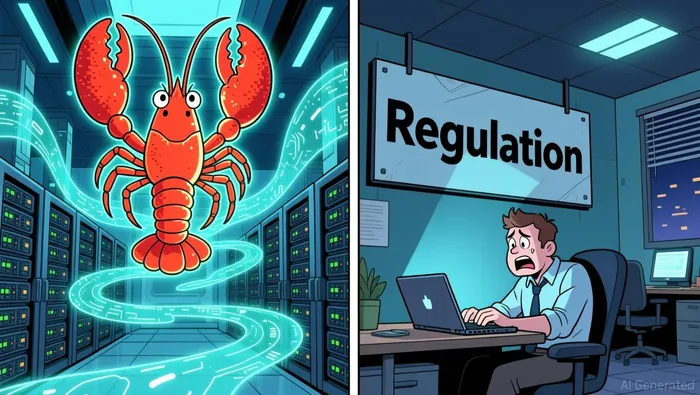
European regulator: We need to ensure AI is developed responsibly, with proper guardrails and worker protections. Founder: Great, but I'm going to California where they'll let me work seven days a week. Chinese cloud provider: We'll give you cheap power, a ready‑made developer ecosystem, and maybe a government grant. Market:buys Chinese AI stocks
The point isn't that one approach is right and the others are wrong. The point is that each jurisdiction is running a different experiment in how to commercialize AI. Europe emphasizes precaution; the U.S. leans into permissionless innovation; China combines cheap inputs, industrial policy, and fierce domestic competition. OpenClaw happened to land in the place where those ingredients produced a viral adoption curve.
There's an older finance analogy here. This looks like regulatory arbitrage-the same basic asset (the software) gets valued and utilized differently depending on which legal and economic system it sits inside. In traditional finance, you'd see this with derivatives booked in different jurisdictions, or with banks structuring deals to optimize capital requirements. With OpenClaw, the "asset" is an open‑source repo, but the commercialization path depends entirely on the surrounding infrastructure: electricity prices, cloud‑provider incentives, subsidy programs, and labor rules.
None of this means the underlying technology is unimportant. OpenClaw seems to have struck a nerve because it moves AI from talking to doing-from chatbots to agents that can execute multi‑step tasks. That's a real shift. But the craze part, the stock‑market part, the "West needs to keep up" part-that's mostly about how different market structures amplify or dampen adoption.
So yes, China has a viral AI phenomenon on its hands. It also has cheap power, cloud wars, and local governments writing checks. The creator, meanwhile, is moving to the U.S. because he thinks he can build faster there. And European regulators are, presumably, still thinking about guardrails. Everyone is playing a different game with the same software. The interesting question isn't who's "winning"; it's what each game reveals about how technology commercializes when the plumbing isn't the same.