

EV charging valuations are resetting even as usage stays strong
The market is cutting EV charging multiples, but not because demand has disappeared. Usage remains firm, while investors are less willing to pay growth-stock prices for companies tied to a messy hardware cycle. That reassessment matters because the next round of commentary should separate businesses that simply sell chargers from those that can capture more value from charging usage. OPmobility stands out in that setting because it is not a pure-play charging story.
Demand still looks tighter than supply
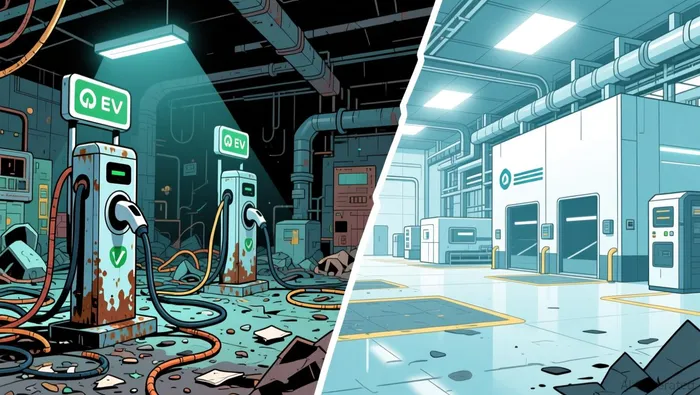
ChargePoint's latest network data shows ChargePoint-enabled sessions were up 34% year over year, while new ports grew 16%. That gap suggests the bottleneck is less about EV adoption and more about whether the installed base can serve drivers efficiently. Even after the US buyer-incentive reset, charging activity remained stable in the US and Europe in 2025. Bears can argue that reflects policy support or a short-term lag, but the practical takeaway is that utilization pressure persists. That favors operators with better site access, stronger execution, and a broader revenue base than charger sales alone.
Why OPmobility is easier to underwrite now
OPmobility's 2025 operating margin was 4.8%. That is not the valuation setup of a hypergrowth pure play. It is, however, a more disciplined starting point for a company exposed to electrification without depending on the market to reward charging narrative alone. If the sector keeps getting de-rated while demand stays firm, diversified operators may attract fresh attention.
OPmobility's edge comes from breadth and execution
The real question is no longer whether electrification is real. It is which businesses can keep compounding when charging economics stop rewarding story and start rewarding discipline.
Breadth matters when charging economics get harder
OPmobility's advantage is its ability to absorb shocks across product, geography, and customer mix. That matters more now because the charging business is getting harder to monetize cleanly. U.S. public-charging satisfaction has already slipped as costs, payment friction, and lack of price transparency weigh on the driver experience. In that kind of market, breadth is not just a strategy slide. It can help cushion pressure on margins.
A diversified operator does not have to lean on one hot product line to grow. It can rely more on site access, installation, energy management, and adjacent offerings. ChargePoint is a useful contrast. It produced full fiscal 2025 revenue of $417 million and 26% non-GAAP gross margin for the full fiscal year. That leaves room for the business to improve, but it also shows how difficult it can be to turn charging scale into durable profitability.
Financial resilience gives OPmobility more room to act
OPmobility also has the financial base to keep executing. In 2025, it delivered EUR 11.5 billion in revenue, €490 million of operating income, and €297 million of free cash flow. It also reduced net debt by €167 million to €1,409 million. That does not create the same balance-sheet pressure that narrower peers may face if financing conditions or demand stay tight.
Recent operational steps point in the same direction. A new Midwest plant brings production closer to a key market. An Executive Committee reshuffle is meant to sharpen customer focus and competitiveness. Management has also confirmed acceleration of diversification in North America and Asia, while exploring a potential lighting acquisition. That last point matters because it could deepen customer relationships beyond the EV stack and broaden wallet share per site.
Solid-state should be framed as optionality
The same discipline should apply to batteries. OPmobility and ProLogium have signed an MoU to develop next-generation solid-state battery packs. That is strategically interesting, but an MoU is not revenue, volume, or a near-term earnings pillar. The more balanced framing is optionality: if solid-state commercialization advances, it could strengthen the long-term story; if it slips, the core business should still be able to stand on its own.
Valuation depends on whether the market is being too slow
The valuation question is practical: is OPmobility cheap because its earning power is fading, or because the market is still applying a discount for EV-linked exposure after a crowded reset in the sector?
The earnings base still looks intact
The evidence still points to a resilient base, not a broken one. OPmobility reported stable Q1 2026 economic sales despite a global automotive production decline, and 2025 delivered EBITDA up +7.7% to €1,001 million. That matters because investors do not need a dramatic new story here. They need proof that the near-€1 billion EBITDA base holds while the market keeps punishing EV-infrastructure names on sentiment rather than fundamentals. The broader backdrop still supports that view: ChargePoint recently showed ChargePoint-enabled sessions were up 34% while new ports grew 16%, suggesting demand remains firm even as valuation multiples cool.
What could drive a rerating
If OPmobility is no longer valued like a pure-play charging narrative, but still has the operational base to support roughly current EBITDA, even a modest rerating could matter. The setup is not about heroic assumptions. It is about the market paying a higher price for a business that is still compounding through diversification, execution, and a better geographic mix.
What would weaken the case
Bears are right to demand discipline. Automotive suppliers can stay cheap if OEM pressure rises, if diversification remains more rhetoric than results, or if the market keeps using OPmobility as a proxy for weaker pure-play charging stocks. The clearest warning signs would be:
- margin erosion that breadth fails to offset
- diversification in North America and Asia that fails to show up in results
- rising customer concentration or weaker project conversion despite broader offerings
- execution missteps in new facilities or adjacent categories such as lighting
That is the decision frame now. The next few quarters need to show that the earnings base is durable, not temporary. If they do, the market's shorthand may be lagging.