

Oracle's Pentagon entry matters because it came late and stayed separate
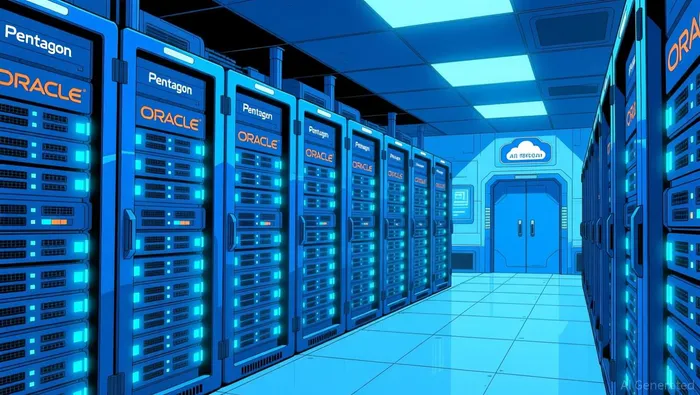
Oracle's recent defense AI development is mainly a timing story. It was added after the initial list to deploy AI on classified networks at IL6 and IL7. That matters because Oracle is still often viewed as a broad government cloud vendor rather than a company with access to highly sensitive DoD AI workflows. If that access translates into recurring usage, the opportunity is less about one pilot and more about becoming part of the infrastructure layer agencies use as AI adoption expands. The adoption signal is not abstract: the Pentagon says 1.3 million personnel have already used GenAI.mil, with tens of millions of prompts and hundreds of thousands of agents deployed in five months.
There is a credible bear case, though. Oracle was not on the original lineup, and the department says it is building architecture to prevent AI vendor lock-in. That frames the deal as non-exclusive access, not a monopoly grant. Even so, the stake is bigger than a symbolic seat at the table. Oracle already has an $88 million Air Force Cloud One task order, which gives it an active foothold in defense cloud modernization. If investors still treat that foothold as ordinary contract work, they may understate how quickly government AI spending could deepen Oracle's role.
Oracle's federal AI stack targets the data-and-workflow layer
Oracle's federal AI stack is built around OCI, Oracle Autonomous AI Database, Oracle Analytics, and OCI Enterprise AI, delivered through the Oracle AI Data Platform for US federal agencies. The platform's stated job is to securely connect industry-leading generative AI models with agency data, applications, and workflows. That is different from simply distributing a frontier model. The value sits in the layer that makes agency data usable inside AI workflows.
Why the stack matters more than the model
Government buyers do not just need another chatbot. They need AI that can work with existing systems, reduce silos, and feed outputs back into decision-making. Oracle is positioning at that integration point. Its federal platform is designed to unify critical information, support agentic applications, and deliver automated workflows. In practical terms, the product is secure data connectivity plus workflow integration. Once Oracle sits between agency data and AI execution, switching becomes more complex because the investment is not only in prompts but also in data pipelines, permissions, governance, and embedded processes.
Classification access shows how far the security boundary extends
That security boundary is where defense matters. Oracle's federal platform runs in a FedRAMP High-authorized Government Cloud with IL4/IL5 support, and it also offers sovereign air-gapped regions plus Exadata Cloud@Customer. More important, defense can use Oracle in classified environments, with DoD saying Oracle can help build, deploy, and scale models while the agency keeps control over its data and architecture. That is a meaningful proof point. If Oracle can operate inside classified workflows, that validation may reduce procurement hesitation in civilian agencies that care deeply about data sovereignty and auditability.
The real test is whether openness still favors Oracle
Bears will argue that "choice" and "no vendor lock-in" weaken Oracle's wedge. That is fair. But modern AI procurement may still reward the vendor that can keep models, data, and governance inside a single controllable stack. Oracle frames its approach around openness, interoperability, and choice across the entire technology stack while preserving agency control over data and architecture. If that balance holds, defense validation could strengthen demand across the broader federal stack, not just in one classified AI project.
What would validate Oracle as federal AI plumbing
The investing lens is straightforward: watch Oracle less as a periodic contract winner and more as potential infrastructure inside federal AI. That view rests on GSA purchasing lanes, service-wide cloud contracts, and a federal AI stack built on OCI, Autonomous AI Database, and AI services. If investors start treating that combination as plumbing rather than a vendor list, the stock could rerate before the full revenue effect is obvious.
What to watch
- Sustained platform use: the clearest signal is movement beyond pilot access into ongoing use of Oracle's federal AI stack.
- Breadth of deployment: whether Oracle expands from classified AI access into broader cloud and workflow work across defense and civilian agencies.
- Procurement friction: whether GSA and service-wide contracting vehicles actually turn stack exposure into repeatable agency orders.
What would weaken the thesis
- Fragmented usage: Oracle gets access, but agencies adopt tools without building around Oracle's data and workflow layer.
- Lock-in safeguards that limit expansion: if multi-vendor architecture rules materially restrict cross-sell into adjacent AI or cloud work.
- Contract depth that stays shallow: existing cloud and AI wins remain narrow enough that they do not materially change Oracle's long-term government growth profile.