

The popular narrative is that AI is a job killer. The data tells a different story. While fears about automation persist, the job market is showing explosive growth in the very roles AI is supposed to replace. Software engineering job listings on Indeed are up 11% annually, a pace faster than overall postings. More strikingly, listings for software engineers at tech companies have roughly doubled since a trough in mid-2023 and are at the highest level in over three years. This divergence is the first signal we are in the early, accelerating phase of the AI adoption S-curve.
The mechanism is clear. AI tools like Anthropic's Claude and OpenAI's Codex are not eliminating software development; they are supercharging it. They allow companies to produce more code with fewer human hours, which should logically reduce demand. Yet the opposite is happening. Firms are expanding their software budgets and hiring more engineers. Why? Because AI shifts the work, not ends it. The best engineers are now spending their days overseeing swarms of AI-powered code-writing agents, focusing on high-level design and ideation. This creates a chaotic transition, where the demand for seasoned talent is surging even as the nature of the job changes.
This sets up a fundamental split in the AI economy. The real growth engine is not in the application layer, where AI is disrupting traditional software models and causing a "SaaSpocalypse" that has erased about $2 trillion in market capitalization from software stocks this year. The true growth is in the underlying infrastructure layer-the compute power, data centers, and specialized chips needed to build and run these AI agents. The surge in engineering jobs is a direct result of companies investing heavily in this infrastructure to fuel their AI ambitions. The market is signaling that we are not at the peak of AI adoption, but deep in the steep, accelerating part of the S-curve, where the rails for the next paradigm are being laid.
The Infrastructure vs. Application Dichotomy: Oracle vs. Salesforce
The divergence between Oracle and Salesforce is a perfect case study in the AI S-curve. One company is building the fundamental rails; the other is selling the next-generation train. The market is rewarding the former while punishing the latter, but the underlying fundamentals tell a more nuanced story.
Oracle is squarely in the infrastructure layer. Its growth is powered by locked-in demand for AI compute. The company's remaining performance obligations for its cloud infrastructure, which includes AI data centers, grew 325% year-over-year to $553 billion. This isn't just future revenue-it's a multi-year contract backlog that has allowed Oracle to raise its FY2027 revenue guidance to $90 billion. This is the exponential adoption curve in action: massive, upfront capital expenditure is being paid for by enterprise customers betting on AI's long-term trajectory. The stock has rewarded this bet, with a 10-year total return of 386% versus the S&P 500's 234%.
Salesforce, by contrast, is selling an AI application platform. Its Agentforce AI tool has shown early commercial traction, closing 29,000 deals and generating $800 million in annual recurring revenue (ARR) that is growing at a rapid 169% rate. Yet this early promise has not translated to top-line growth for the company. Salesforce's stock has been under severe pressure, down roughly 24.5% year-to-date, as investors wait for this AI momentum to accelerate the broader revenue stream. The market is pricing Salesforce as a company whose core software business is being disrupted, not one that is building new infrastructure.
This creates a market dissonance. As noted in recent analysis, investors have been punishing software and data stocks on worries about AI disruption, yet the fundamentals of many of these "AI-disrupted" companies show surprising resilience. Profits are holding up, suggesting the feared existential replacement is not yet here. A more probable outcome is a shift to paying for efficiency tools, not existential replacement. Oracle's model is built on that shift, selling the compute power to run those tools. Salesforce's model is trying to be the tool itself, and the market is skeptical that it can convert early ARR growth into durable enterprise revenue acceleration.
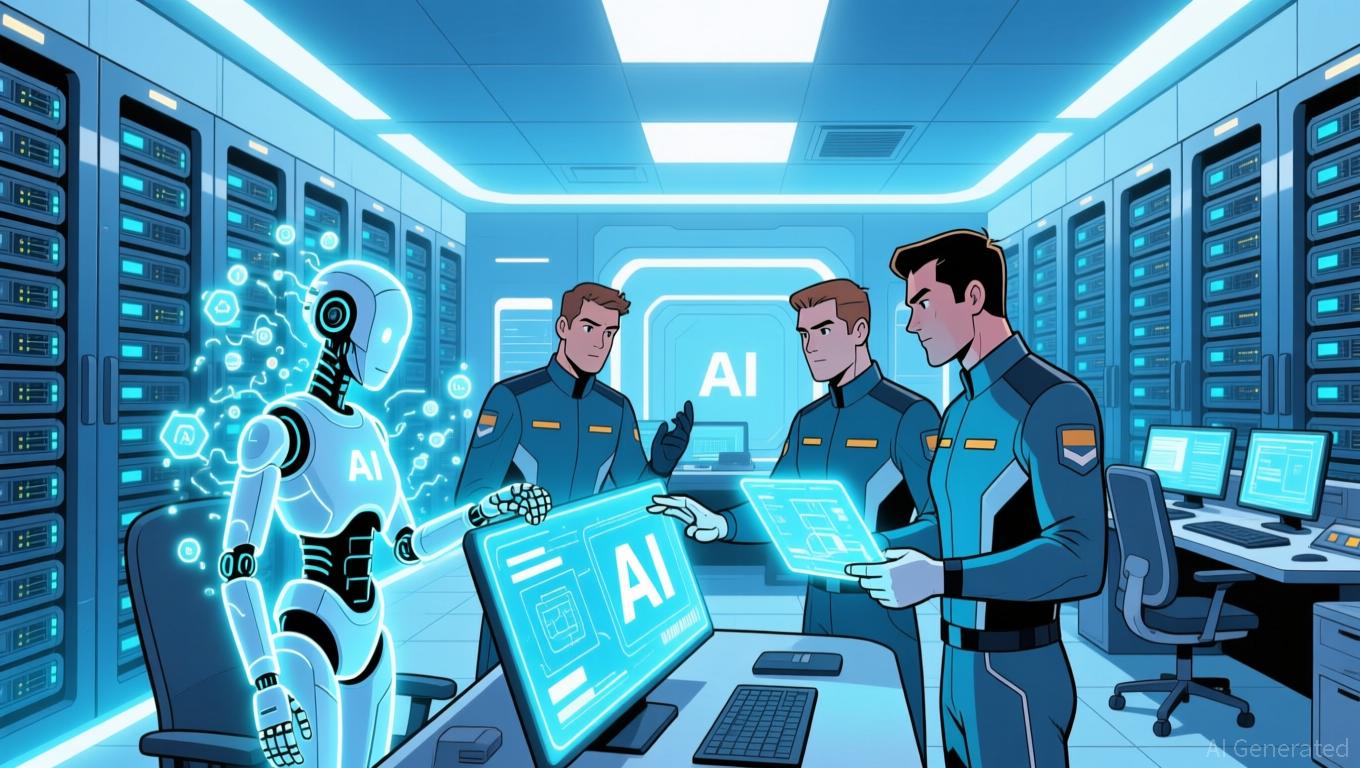
The bottom line is that we are in the chaotic middle of the adoption S-curve. The rails are being laid, and the companies building them are seeing their contracts multiply. The applications are being tested, but the market is demanding proof of exponential adoption before it rewards them. For now, the infrastructure layer is winning the race.
The Chaotic Transition: Shifting Developer Roles and Skills Gaps
The job market is completely changing in 2026. While overall tech hiring rebounds, the transition is creating a sharp divide. Fresh graduates are facing a tougher reality, with an unemployment rate of 5.8%-higher than the general rate. More critically, data shows the employment rate for early career workers aged 22 to 25 in AI-exposed occupations declined by 13%. This isn't a broad job loss; it's a skills mismatch in a chaotic shift.
AI is acting as a force multiplier, but only for the right kind of talent. The best engineers are now spending their days overseeing swarms of AI-powered code-writing agents, focusing on high-level design and ideation. This creates a demand for a new breed of talent: seasoned professionals who can guide these tools and ensure the output meets rigorous engineering standards. As one expert notes, everything that sheds light on how to make better use of LLMs... has to do with good software engineering practices. The problem is that these practices are not as common as they should be. AI tools surface widespread deficiencies in code quality and design, creating a gap between what the tools can generate and what enterprise systems require.
This sets up an intense competition for top, AI-literate talent. Companies are ramping up AI spending, as seen in Oracle's massive contract backlog, while simultaneously cutting costs elsewhere. The result is a market where demand for skilled engineers is surging, but the supply of workers with the right hybrid skills-both deep technical knowledge and AI fluency-is lagging. The bottom line is a period of intense friction. The infrastructure layer is winning, but the human capital needed to build and maintain it is in flux, creating both opportunity and vulnerability for those navigating the S-curve.
Investment Thesis: Betting on the Rails
The investment thesis is clear. In the chaotic middle of the AI adoption S-curve, the winner is the company building the fundamental rails. This means focusing on the infrastructure layer-cloud providers, data center equipment, and networking-rather than those selling AI applications that face higher disruption risk. The evidence points to a steepening S-curve, where locked-in demand for compute power is the primary growth engine.
The strategy is to invest in companies like Oracle, which are selling the essential real estate for AI. Its remaining performance obligations for AI infrastructure grew 325% year-over-year to $553 billion, a multi-year contract backlog that has allowed it to raise its revenue guidance. This is the hallmark of exponential adoption: massive, upfront capital expenditure is being paid for by enterprise customers betting on AI's long-term trajectory. The market is rewarding this bet, with Oracle's 10-year return of 386% significantly outpacing the S&P 500's 234%.
A key risk is that AI adoption slows. Yet the current trajectory suggests the infrastructure S-curve is steepening, not flattening. The job market data is a leading indicator. Despite fears, software engineering job listings at tech companies have roughly doubled since a trough in mid-2023 and are at the highest level in over three years. This surge in demand for skilled engineers is a direct result of companies ramping up AI spending to build and maintain the infrastructure. If adoption were slowing, we would see this hiring freeze, not accelerate.
The catalysts to watch are the pace of enterprise AI spending commitments and the ability of infrastructure providers to convert those performance obligations into cash flow. The $553 billion backlog is a powerful signal, but the real test is execution. Can these companies deliver the compute power and data center capacity at scale? The market will reward those that can, while punishing those that cannot meet the demand surge.
On the flip side, the risk for application-layer companies is existential. The "SaaSpocalypse" has already erased about $2 trillion in market capitalization from software stocks this year as investors realize AI agents could replace traditional software models. This creates a dangerous feedback loop: higher AI spending pressures margins, while disruption fears crush valuations. The market is demanding proof of exponential adoption before it rewards applications, leaving infrastructure as the safer, more certain bet.
The bottom line is that we are in a period of intense friction, but the direction of the S-curve is clear. The rails are being laid, and the companies building them are seeing their contracts multiply. For investors, the thesis is to bet on the rails, not the train.