

Oracle secured a 2.8 GW energy partnership with Bloom Energy to power its AI data centers. The stock rallied 18% in a week following the deal and a broader software sector rebound. Cloud infrastructure revenue jumped 84% in Q3, offsetting slow growth in legacy software. Investors view the current valuation as a buying opportunity despite a 16% year-to-date decline. Geopolitical stability and AI demand reversal are key catalysts for the recent price action.
Oracle Corporation is rewriting the rules of data center infrastructure by securing its own power supply, a move that has sent shares climbing after months of volatility. The tech giant announced a massive partnership with Bloom Energy to install solid oxide fuel cells, effectively bypassing the sluggish utility grid upgrades that have stalled AI expansion across the sector. This strategic maneuver is being hailed as a critical enabler for Oracle's cloud ambitions, directly addressing the energy constraints that threaten to cap the growth of artificial intelligence workloads. With cloud revenues surging and new financing secured for massive campuses in Michigan and Texas, the company is positioning itself as a dominant player in the AI infrastructure race.
How Does Oracle Plan To Power Its AI Data Centers?
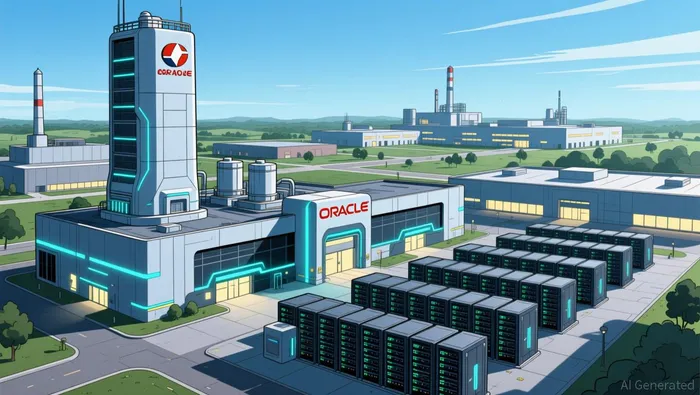
The core of Oracle's recent strategy lies in solving the most immediate bottleneck facing the artificial intelligence industry: electricity. Traditional data center expansion is often held hostage by the pace of utility grid upgrades, which can take years to complete. Oracle is bypassing this delay by deploying Bloom Energy's solid oxide fuel cell systems, which can generate power on-site and bring data centers online within 90 days. The agreement involves procuring up to 2.8 gigawatts of capacity, with an initial 1.2 gigawatts already contracted and actively being deployed across the United States.
This approach represents a fundamental shift in how tech giants approach cloud infrastructure. Instead of waiting for external power providers to catch up with demand, Oracle is taking control of its energy generation through chemical reactions rather than combustion, a process that offers faster execution and reduced execution risks. The company is independently funding the on-site power generation, substations, and battery storage required to support these facilities. This vertical integration ensures that Oracle's cloud operations can scale rapidly to meet the surging demand for AI workloads without being held back by regional power grid limitations.
The financial commitment to this strategy is substantial. Oracle recently finalized $16 billion in financing for a new campus in Michigan, adding to previous debt packages of $38 billion for Texas and Wisconsin, and $18 billion for New Mexico. To further align interests with its energy partner, Oracle received a warrant to purchase nearly $400 million worth of Bloom Energy stock, deepening the relationship beyond a simple vendor-client arrangement. This equity stake signals a long-term commitment to energy security, reinforcing the idea that reliable power is now as critical as computing capacity itself.
Why Is Oracle Stock Rallying After A Difficult Start To 2026?
Oracle shares have staged a remarkable recovery, climbing nearly 18% in a single week to lead the S&P 500. This surge comes after the company reported strong third-quarter fiscal 2026 results and announced its expanded energy partnership. The stock has rebounded from a difficult start to the year, where it was down more than 16% year-to-date and roughly 50% from its September highs. The recent rally is driven by a combination of specific company news and a broader reversal of sentiment in the software sector.
A major catalyst for the recovery was the announcement of the Bloom Energy deal, which alleviated investor fears that Oracle's massive data center buildout would be stalled by power shortages. The market reacted positively to the news that Oracle can now scale its infrastructure rapidly, supported by over $100 billion in debt raised for these expansions. Additionally, the release of new agentic AI products provided further proof of the company's ability to innovate and capture value in the AI space. The stock's performance highlights a shift in investor confidence, moving from concerns about debt loads to optimism about the company's execution capabilities.
Beyond Oracle-specific news, the broader software sector is experiencing a rebound driven by geopolitical stability. Fears of a prolonged conflict in the Middle East had weighed heavily on tech stocks, but hopes for a peace deal between the U.S. and Iran have helped lift sentiment. This geopolitical easing, combined with a realization that AI tools are not immediately displacing traditional software business models, has allowed software stocks to recover significant losses. Companies like Adobe and Salesforce have also seen gains, but Oracle stands out as a top performer due to its tangible progress in building the physical infrastructure required for the AI boom.
What Do The Latest Financial Results Reveal About Oracle Growth?
The financial data from Oracle's third quarter paints a picture of a company in transition, with its growth engine firmly shifted toward cloud and AI infrastructure. Total revenues rose 22% year-over-year to $17.2 billion, a solid figure that masked the diverging fortunes of its different business lines. Cloud revenues surged 44% to $8.9 billion, now representing over 52% of total revenue. More impressively, Cloud Infrastructure (IaaS) revenues grew 84% to $4.9 billion, underscoring the intense demand for the raw compute power needed to train and run large AI models.
However, the company's legacy software business, which has historically been its cash cow, is showing signs of stagnation. Non-GAAP EPS climbed 21% to $1.79, but legacy software revenues grew only 3%. This disparity highlights the reality that Oracle's future valuation depends almost entirely on its ability to execute on its cloud and AI strategies. The remaining performance obligations (RPO) ended the quarter at $553 billion, up 325% year-over-year, providing strong revenue visibility for the coming years.
Despite the strong numbers, the market has been cautious about the heavy debt load required to fund this expansion. Analysts at Seeking Alpha have reiterated a buy rating, arguing that the recent 30% pullback was an overreaction to market noise. They point to the robust AI-driven growth and the fact that the stock is trading at a valuation level not seen in multiple years as key drivers for the bullish thesis. The consensus suggests that while the debt is a risk, the potential for massive revenue growth from the cloud infrastructure business justifies the current valuation, making the stock an attractive entry point for investors who believe in the long-term AI narrative.
What To Watch Next For Oracle Investors
Investors monitoring Oracle stock should keep a close eye on the deployment progress of the Bloom Energy fuel cells and the utilization rates of the new data centers in Michigan and Texas. The ability to monetize the $553 billion in remaining performance obligations will be the next critical test of the company's growth strategy. Additionally, any changes in the geopolitical landscape or shifts in AI adoption rates could impact the sector-wide sentiment that has recently supported the rally. While the current valuation appears attractive to many analysts, the heavy debt load remains a factor that could limit upside if execution falters.