

Sunday night's selloff in U.S. stock futures did not arrive on the back of new supply disruption. It arrived on the back of a headline. Iran reconfirmed Saturday that the Strait of Hormuz remains closed, crude ticked up another 2 percent, and futures sold off as if the market had just learned something it should have absorbed three months ago.
The data says otherwise.
The Strait of Hormuz has been effectively shut since early March. Traffic through the chokepoint - which normally carries roughly one-fifth of the world's oil trade - collapsed to a trickle, with just 191 vessels crossing in all of April. The EIA, in its latest Monthly Energy Outlook on May 12, now assumes the strait will remain closed through the end of May. Iran-related production shut-ins are expected to peak at roughly 10.8 million barrels per day this month. That is more than 10 percent of global supply, wiped out by a blockade that markets have been pricing in since the first strikes landed.
Brent crude is sitting around $111 a barrel. It touched $126 back in late April before pulling back. Oil prices are elevated, yes - but not because of anything that changed this weekend. The Sunday night drop is a fear reflex, not a repricing event.
Where this matters for investors is in the gap between how the market reacts and what the underlying cash flows actually show. The market treats "energy" as a single bucket that gets punished when headlines spike. But there is a massive difference between a company whose revenues move with the commodity price and a company whose revenues are locked into long-term fee-based contracts regardless of what Brent does on a Sunday night.
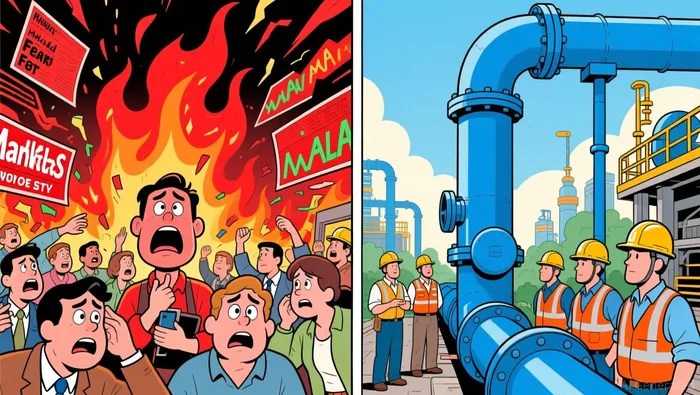
That difference is the entire point.
Take Energy Transfer, one of the largest midstream operators in the U.S. In the first quarter of 2026, its distributable cash flow attributable to partners came in at $2.70 billion, up from $2.31 billion in the same quarter a year earlier. That is a 17 percent jump in cash generated by a business model that does not bet on commodity prices. The company collects fees for moving oil and gas through its pipeline network. Higher throughput from U.S. production growth translates directly into more fee revenue. The war in Iran is a tailwind, not a risk, because it incentivizes domestic production and fills its pipes.
Enterprise Products Partners told the same story. First quarter operating income of $1.9 billion, up 8 percent. Distributable cash flow of $2.3 billion, up 10 percent. The quarterly distribution was raised to $0.55 per unit, a 2.8 percent increase. These are not companies riding the commodity cycle. They are collecting on contracted volumes. The cash flow grew even though nothing structurally changed in their business model other than steady demand for their infrastructure.
Now contrast this with the E&P side of the equation. ConocoPhillips posted $2.3 billion in first-quarter profits, up 84 percent from the pre-war period. BP more than doubled its profits year over year. Those are impressive numbers, but they are commodity-driven. If the Strait of Hormuz reopens and prices fall back to the $70-to-$80 range, those profit multipliers compress fast. The fee-based midstream operators do not face that same cliff. Their contract revenue holds.
The market has not fully recognized this divergence. Energy Transfer's units trade around $20, with an EV-to-EBITDA multiple in the 8.7x to 9.4x range. That is below the historical average for its peer group. The market gave ET a brief run earlier this year, then let it fade as headlines about war and inflation took over the narrative. A company generating $2.70 billion in quarterly distributable cash flow, growing 17 percent year over year, on fee-based contracts that are not exposed to the next oil price headline - at roughly 9 times EV/EBITDA - should not be trading like a commodity play.
There is a reason the midstream sector index kicked off 2026 with strong performance and then stalled. The initial price appreciation priced in higher throughput expectations. Then the broader equity selloff dragged everything down uniformly, including names that had no fundamental reason to participate. The mechanical drag from index funds and risk-off positioning does not distinguish between a pipeline collecting fees and a refinery betting on crack spreads. That mechanical pressure is precisely what creates the mispricing.
From a risk perspective, the worst case for midstream is not a sudden oil price collapse - it is a prolonged drop in U.S. production growth that reduces throughput volumes. That is a real scenario to watch. If the war incentivizes drilling but capital discipline keeps capex restrained, volumes grow slowly and fee revenue follows. But that is a slow-motion risk, not a Sunday-night-headline risk. The EIA's own projections show U.S. production continuing to expand through 2026, just not at breakneck speed. Even 30 percent of surveyed U.S. oil executives expect no production change this year, while the rest see modest gains. That modest growth is still enough to support contracted throughput on existing infrastructure.
What I am arguing is that the current market reaction - lower futures, jittery positioning, the same war-headline cycle repeating - is not creating new risk for fee-based midstream operators. It is creating a buying window for them. The cash flows are growing. The distributions are covered. The valuations are still at a discount to where they should be if the market priced predictable contracted revenue as predictably contracted revenue.
The Strait of Hormuz may stay closed through May, into June, or longer. Iran may reopen it on a whim or after negotiations. Oil prices may swing to $130 or back to $90. None of those outcomes meaningfully changes the quarterly distributable cash flow of a pipeline collecting $2.70 billion on tolls it is contractually entitled to collect.
That is the crack between headline fear and cash-flow reality. It does not appear every quarter. It does not last forever. But right now, it is wide enough to matter.