

Par Pacific delivered a decisive earnings surprise in Q1 2026, posting adjusted EPS of $0.78 per diluted share and swinging to a strong profit from a year-ago loss.net income of $54.5 million marks a dramatic turnaround from the $(30.4) million loss in Q1 2025.
The primary driver was record throughput at the Hawaii refinery, which processed 89.8 thousand barrels per day-the highest quarterly volume on record. This came alongside a massive spike in the Hawaii refining margin index, which averaged $31.11 per barrel in Q1 2026 versus just $8.13 a year prior. The combination of higher volumes and elevated margins propelled the Refining segment's adjusted EBITDA to $69.2 million from a $14.3 million loss year-ago.
That said, the margin picture has a nuance worth noting. The Hawaii refinery's adjusted gross margin of $13.10 per barrel included a net price lag impact of approximately $(125.5) million due to contractual sales structured on prior period pricing. In plain terms, rising product prices meant the company's realized margins lagged current market conditions. The company notes this effect should reverse in a declining price environment.
The other refineries contributed as well. Montana and Washington both posted improved per-barrel margins year-over-year, though Washington's throughput dropped to 23 Mbpd from 39 Mbpd a year ago. The Montana refinery maintained steady volume growth, processing 57 Mbpd versus 52 Mbpd in the prior-year quarter.
The bottom line: this was a high-margin quarter fueled by Hawaii's operational performance and favorable crack spreads. The question for investors is whether this setup is sustainable or if it reflects a temporary margin spike that will normalize as price lags reverse and market conditions shift.
Hawaii Renewables: The Operational Catalyst
The Hawaii renewable fuels facility began commercial operations in April 2026, marking the first major revenue stream from the joint venture with Mitsubishi and ENEOS. This is the operational catalyst the market has been waiting for-but the financial materiality remains modest in the near term. The real value lies in margin optionality and regulatory positioning.
The joint venture structure gives Par Pacific access to Low Carbon Fuel Standard (LCFS) credit revenue streams that traditional refining cannot generate. In California's volatile credit market, those credits can be worth $100+ per metric ton. For a facility of this scale, even modest credit prices translate into meaningful incremental EBITDA over time. That said, the Q1 throughput data shows Hawaii's core refinery still processing 89.8 thousand barrels per day-the renewable facility is not yet a material volume contributor to the system.
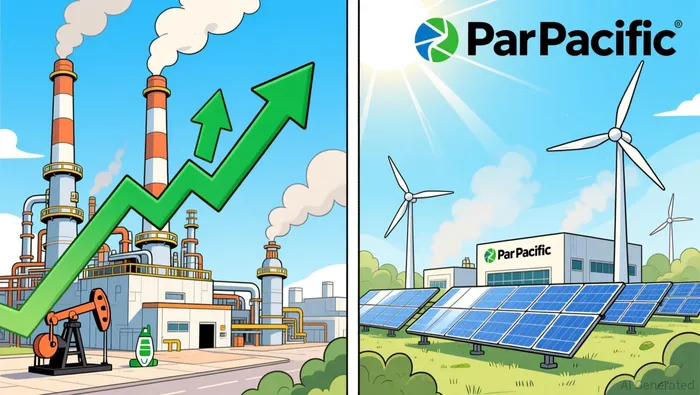
From a business mix perspective, this is a structural shift. The company is no longer purely a refined products player in Hawaii; it now has a foothold in the low-carbon fuel economy. That matters for regulatory tailwinds and potential carbon pricing mechanisms. But investors should temper expectations on near-term earnings contribution. The facility just came online. Ramp-up timelines, credit price volatility, and the joint venture profit-sharing structure all delay meaningful earnings impact.
The tactical read: this is a strategic option, not a quarterly earnings driver. The market may undervalue the LCFS exposure if it focuses solely on near-term throughput and margins. But the setup is clean-Hawaii's core refining engine (89.8 Mbpd, $31.11 per barrel margin index) continues to fund the transition while the renewable facility builds its credit revenue base. The optionality has value. The question is whether the market prices it in or waits for material earnings contribution.
The Setup: Valuation, Short Interest, and Risk/Reward
At ~$62 per share, Par Pacific trades at a compelling discount to its 52-week high of $70.39-despite the earnings turnaround and operational catalysts unveiled in Q1. The valuation math is straightforward: the stock commands a 7.3x PE (TTM) and 7.85x forward PE, multiples that imply stagnation or decline. Yet the company just delivered a dramatic profit swing to $54.5 million in net income and signaled a strong Q2 with the Hawaii refining index at $42/bbl. This disconnect creates a tactical setup.
The short interest at 8.09% of float adds fuel to the re-rating thesis. That's a meaningful short float for a stock of this size, and combined with the recent earnings beat, it sets up potential short-covering momentum if Q2 delivers on guidance. The market has had weeks to digest the Q1 numbers-the price action since the May 5th earnings release has been flat, suggesting the story hasn't fully registered.
Management has been aggressive on buybacks, repurchasing $28.0 million of common stock at an average price of $37.96 per share. That's well below current levels-a signal that insiders view the stock as undervalued. The 2026 CapEx guidance of $190 to $220 million includes $30-45 million in growth investments, showing the company is deploying capital even at these depressed multiples.
The risk/reward setup is clean: downside is cushioned by the buyback floor and asset value (book value per share sits at $30.77), while upside to the analyst target of $72 represents roughly 15% upside from here. The key catalyst will be Q2 execution-if the Hawaii margin environment holds and the renewable facility begins contributing LCFS credits, the market may finally price in the fundamental improvement. At these multiples, the bar isn't high. It's just asking for steady execution.
What to Watch: Catalysts and Guardrails
The stock has already delivered a 276% gain from its 52-week low-yet the setup remains event-driven. Q2 execution will determine whether this becomes a sustained re-rating or a headline-driven bounce that fades.
The company guided to a Hawaii refining index of $42 per barrel for Q2-roughly 35% higher than the $31.11 achieved in Q1. If realized, this lifts the core margin engine into even more profitable territory. Even a modest 10% drawdown from that level would still leave margins well above the Q1 baseline, providing a strong earnings floor.
Second, the Hawaii renewable facility just achieved commercial operations in April. The market will watch for production ramp data and, more importantly, LCFS credit realization. Early credit sales at favorable prices could provide an earnings surprise-the optionality is real, but the timing is uncertain.
The risk/reward has shifted since the earnings beat. The 52-week low of $18.02 versus current levels around $62 reflects a massive re-rating already in progress. That means the bar is higher: the market now expects execution, not just recovery.
Downside risks are concrete. Hawaii regulatory changes could pressure the core refining business, and crude supply constraints-particularly for the Hawaii refinery's feedstock-could throttle throughput. The short float at 8.09% provides cover for a rally, but it also means any disappointment triggers rapid unwinding.
The tactical read: this is now a two-quarter bet. If Q2 margins hold and the renewable facility shows early credit traction, the path to the $72 target opens. If margins compress or operational issues emerge, the 52-week range suggests room to retrace. Watch the Q2 index realization and Hawaii production data closely-those are the triggers that will define the next move.