

Rating: Upgrade to Buy. PayPal trades at a forward P/E near 8.3x while the global chargeback and fraud problem it has tools to solve accelerates to $48 billion in losses. The market has arguably baked in a terminal decline narrative. The numbers don't support it.
What more proof do investors need that payment fraud is becoming unmanageable?
Yesterday, Chargebacks911 - a niche dispute management firm - announced a partnership with AcceptCards, a UK payment processor, to help merchants fight chargebacks. It's a small B2B deal between two private companies. Nobody is going to build a portfolio around it.
But the numbers behind that press release are worth staring at. Friendly fraud - when cardholders make legitimate purchases then falsely dispute them - now represents 45% of all UK chargebacks. And 72% of merchants report an average 18% increase in friendly fraud over the past three years. Globally, chargeback losses hit $48 billion in 2025, a 41% surge. The average merchant now loses $4.61 for every single dollar of actual fraud.
This is the structural tailwind. Nobody talks about it because it's not sexy. But every merchant with an online store is hemorrhaging money, and the ones with built-in fraud prevention infrastructure are sitting on a moat that the market isn't pricing in.
Which brings us to PayPal.
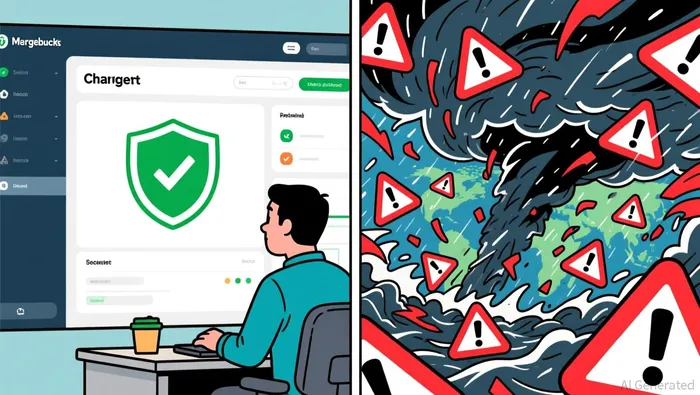
PayPal's Forward P/E of 8.3x Makes Little Sense
PayPal trades at a forward P/E of roughly 8.3x. For context, the S&P 500 trades at roughly 21-23x forward earnings. That means PayPal is priced like a dying railroad, despite being one of the four largest payment processors in the world by merchant volume.
The market's thesis is clear: PayPal is a legacy wallet losing share to Apple Pay, BNPL, and new entrants. The doomsday narrative assumes that fraud prevention is table stakes - a commodity feature that doesn't deserve any valuation premium.
I'm not convinced that's right.
PayPal's fraud prevention tools are not an afterthought. The company has spent years building machine-learning-based risk management systems that evaluate millions of transactions in real time. It offers purchase protection, dispute resolution, and built-in chargeback prevention as standard features for merchants. And with its recently launched "agent ready" platform - which allows merchants to accept payments on AI-driven surfaces with integrated fraud detection - PayPal is positioning itself at the intersection of two trends the market is separately ignoring: the AI commerce wave and the fraud crisis.
The Moat Survives the Stress
Here's the key insight. PayPal doesn't need to be the flashiest payment processor. It needs to be the one merchants trust when a customer disputes a $200 purchase and the processor has to make a call in milliseconds. That trust is built on data - years of transaction history, behavioral patterns, and dispute outcomes that newer entrants simply don't have.
Friendly fraud is the problem that gets harder to solve as volume scales, not easier. A new payment processor with a lean stack can process transactions. But detecting whether a disputed charge is genuine fraud or first-party abuse requires institutional knowledge. PayPal has processed tens of trillions of dollars in payment volume. That dataset is the moat, and it deepens every quarter.
The Valuation Disconnect
PayPal's normalized EPS reached $5.31 in 2025, up 14% year-over-year. The company generated free cash flow at levels that would look healthy for almost any SaaS company, yet it trades at a multiple that suggests investors expect earnings to collapse.
The PEG ratio - which compares the P/E multiple to the earnings growth rate - sits below 0.80 by some measures. A PEG below 1.0 generally signals that a stock's valuation is not keeping pace with its growth. For PayPal, that disconnect is stark.
Market pessimism has compressed PayPal into territory where even modest earnings stability justifies a rerating. If normalized EPS holds around $5.30 and the stock re-rates to a more typical fintech multiple of 12-15x forward earnings, that's a 45-80% upside from current levels. That's not a prediction - it's the math of how compressed the valuation has become.
What Could Break the Case
I'm not blind to the risks. PayPal's top-line growth has slowed. The wallet story is under pressure from Apple Pay's ecosystem dominance. And if merchants continue migrating to lower-cost alternatives, PayPal's take rate could compress further.
These are real headwinds. But they don't explain why a company generating $5.31 in EPS with a fraud infrastructure that serves as a competitive differentiator trades at less than half the market's average multiple. The bears would need to prove that earnings are heading toward zero, not just moderating.
The Action
I don't think investors need to chase PayPal on any single day. The setup is constructive, but the stock's been battered enough that patience is reasonable. Add on weakness. If you're already positioned, this is the kind of valuation compression that justifies doubling down rather than cutting exposure.
I would reassess if PayPal's fraud and risk management revenue shows actual decline - not just slower growth, but contraction. That would signal the moat is genuinely cracking. Until then, the doomsday narrative looks like the kind of consensus panic that creates the best buying opportunities.
Don't let this chance go to waste.
Disclosure: I hold no position in PYPL. This article represents my own analysis of publicly available data and should not be construed as personalized investment advice.