

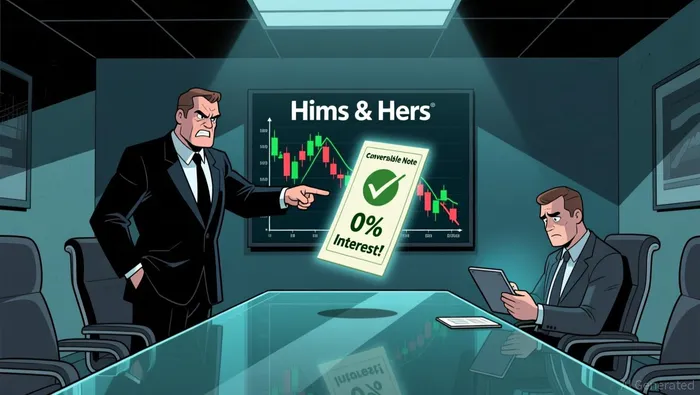
Hims & Hers just raised $350 million by selling debt that pays 0% interest.
Not a rounding error. Not a teaser rate. The coupon on these convertible senior notes due 2032 is literally zero. The company pays nothing in cash interest. If the stock stays above roughly $29.50 for the next six years, the bondholders get converted into equity and the shareholders who hold HIMS today absorb dilution. If the stock stays below that, the company effectively gets a long-term loan that it can call cheap, and the bondholders just collect their principal back at the end.
Either way, Hims & Hers gets $338.5 million in net proceeds today and pushes the cost of money into someone else's problem.
That's how a zero-coupon convertible note works. It's not free money - it's deferred dilution dressed up as debt.
The odd thing is not that Hims is doing this. The odd thing is that they've already done it once at a larger scale, and the pitch is barely different.
In May 2025, the company issued $1 billion of zero-coupon convertible senior notes due 2030. The stated purpose: "accelerate global expansion and utilization of AI in healthcare." This May, the $350 million offering - upsized from the original $300 million plan - uses nearly the same language: "support international expansion and accelerate AI-driven platform investment."
Twelve months apart. Same instrument. Same coupon. Same theme.
The public justification this time is the Eucalyptus deal. In February, Hims & Hers agreed to buy the Australian telehealth company for up to $1.15 billion. The headline number looks large, but the actual cash obligation is smaller than it appears. Approximately $240 million is paid at closing; the rest is structured as earnout - performance-based payments that only come if Eucalyptus hits its targets.
So the $350 million in new convertibles isn't paying for the whole $1.15 billion. It's paying for a fraction of the cash and funding the growth bets that are supposed to make the earnout targets easier to hit. The $350M converts fund the upfront cash and the machinery that's supposed to generate the rest.
Which is to say: Hims is borrowing cheaply at 0% to fund an acquisition where the bulk of the price is contingent on the acquired company performing. The incentives are aligned in theory. If Eucalyptus delivers, the earnout hits, the stock probably goes above $29.50, the convertibles convert, and everyone is happy. If Eucalyptus underperforms, the earnout doesn't hit, the stock probably stays below conversion, and the company still has the cash it raised - but also a struggling acquisition and a balance sheet full of notes it'll eventually have to repay or restructure.
Here's where the story gets more interesting. Q1 2026 just showed the first real stress in the Hims & Hers growth engine.
Revenue was $608 million, up 4% year-over-year. That's down sharply from the 59% growth rate the company posted across all of FY2025. Gross margin contracted to 65%, down from 73% in the prior-year quarter. The company posted a net loss of $92 million, reversing from profitability. Adjusted EBITDA - a rough cash-earnings proxy - was $44 million, a 7% margin.
Free cash flow was still positive at $53 million, and subscriber count grew to roughly 2.6 million, up 9% year-over-year. So the customer base is still expanding. But the economics of each customer appear to be deteriorating, and the revenue growth deceleration is steep.
The contrast with FY2025 is worth sitting with. Last full year, Hims reported $2.35 billion in revenue, $128 million in net income, and $318 million in adjusted EBITDA. In the first three months of this year alone, it lost $92 million. The margin compression is the kind that suggests pricing pressure, higher acquisition costs, or a product mix shift - or all three. The company raised its full-year forecast despite the quarter, which is either a sign of confidence or a sign that management needs the market to believe in acceleration before the dilution from those convertibles kicks in.
Let's step back and look at the capital structure from above.
As of this week, Hims & Hers has roughly $1.35 billion in outstanding zero-coupon convertible notes: the $1 billion from 2025 and the $350 million from this year. These aren't interest-bearing liabilities. They're deferred equity. If the stock reaches or exceeds the conversion prices, those notes become shares and existing shareholders get diluted. If the stock doesn't, they become conventional debt the company eventually has to repay.
The implicit bet management is making is clear enough to state plainly: the company believes its stock will go high enough and fast enough that conversion is the cheaper outcome. That's why the coupon is zero. That's why the purpose keeps sounding the same. The strategy is to use convertibles as growth capital - cash today, equity later - and hope the growth justifies the dilution in retrospect.
It's a familiar trick. Growth companies love zero-coupon convertibles because they push the cost of capital from the present (interest payments that reduce cash flow) to the future (dilution that matters only if shareholders still care by 2030 or 2032). When the thesis is working, no one complains about dilution - the earnings power grows faster than the share count. When it's not, the notes become a quiet overhang that gets repriced all at once.
The market's reaction was fast and unambiguous. Shares fell 7% when the $300 million plan was announced on May 18, before the upsizing to $350 million was priced. That's not a punishment for borrowing. That's a signal that investors are starting to price in the dilution risk - the gap between a stock trading near $22 and a conversion price of $29.53 - and the fact that growth just decelerated into single digits while management raises more money to go bigger.
The simplest model is this: Hims & Hers has $1.35 billion in outstanding zero-coupon convertibles. That's a lot of deferred dilution sitting on top of a business that just went from 59% revenue growth to 4% in a single quarter, with gross margins falling 8 percentage points. The Eucalyptus deal is supposed to change the trajectory, but most of its headline price is contingent. The AI push is supposed to change the trajectory too, but that's been the pitch for both rounds of this offering.
Whether this works depends on a single question: can the company grow its way past dilution before the convertibles mature? If yes, the zero-coupon structure is a stroke of financial engineering that rewards patience. If not, every existing shareholder will wonder why they watched the company borrow $1.35 billion against their future ownership stake while the underlying economics slowed down.
The notes don't care. They sit there at 0%, doing nothing, until someone has to pay the bill.