

A recent headline reported that Trade.xyz's valuation of SpaceX has dropped below $2 trillion for the first time. The phrasing is important because it does the work the story actually needs: it turns a crypto derivative contract into a valuation oracle.
If you read it quickly, you think: Something happened to SpaceX. The market is repricing.
What actually happened is mean reversion in a speculative perpetual swap. Let me explain why the distinction matters - not for SpaceX's stock, but for what's becoming a structural feature of how price discovery now works.
What Trade.xyz actually is
Trade.xyz is a module on Hyperliquid, a decentralized perpetual-futures exchange. On May 17 it launched SPCX-USDC, a cash-settled perpetual futures contract referencing SpaceX's expected IPO price. You don't own SpaceX shares. You get no voting rights. SpaceX didn't authorize it. The contract never expires; instead, long and short positions periodically pay each other a funding rate to keep the synthetic price anchored to whatever reference price Trade.xyz updates.
When it launched, the reference was $150 per share - implying roughly a $1.78 trillion valuation based on SpaceX's fully diluted share count. Within days, the contract spiked above $200. That would put SpaceX at over $2.3 trillion. The $2 trillion threshold was then crossed - and now apparently uncrossed on the way down.
Here's the thing. SpaceX priced its actual IPO on June 3 at $135 per share, for a market capitalization of roughly $1.77 trillion. Shares begin trading on Nasdaq under the ticker SPCX on June 12. That $135 number came from book-building with institutional investors, SEC filings, and months of roadshows. It is the number.
The perpetual contract had been trading as if SpaceX were worth 50 percent more. "Dropping below $2 trillion" is the synthetic market correcting toward reality, not discovering a deterioration in SpaceX's business.
Narrative is not price discovery
I think we need to be clear about what kind of signal these perpetuals are. They are not oracles. They are sentiment instruments. The traders who pushed SPCX above $200 were speculating on IPO-day pop, on Musk premium, on a cultural moment. Their positions were leveraged bets on momentum, not valuations grounded in revenue, cash flow, or satellite subscription projections.
By June 8 - just days before the IPO - Yahoo Finance was reporting that the perpetual was still pricing SpaceX roughly 70 percent higher than the IPO price. The gap between the synthetic contract and the actual offering wasn't a mystery to solve. It was a measure of how much speculative premium crypto traders were willing to carry.
The real story is that this gap existed at all, and that it was visible, tradable, and liquid. HIP-3, the framework Trade.xyz runs under on Hyperliquid, has repeatedly seen open interest top $1.4 billion to $2 billion, with Trade.xyz accounting for over 90 percent of it. That's not a rounding-error side market. That's a parallel price-discovery layer running on crypto rails, operating continuously, accepting anyone with a wallet, and pricing in narratives that institutional book-building deliberately excludes.
Why this matters beyond SpaceX
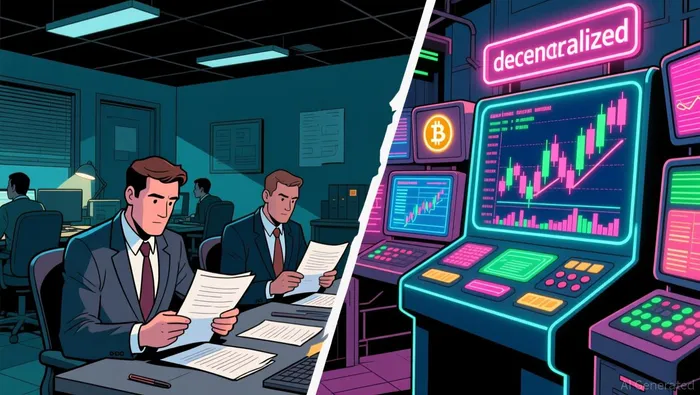
SpaceX isn't the point - or at least it isn't the only point. The point is that pre-IPO price discovery is now split between two systems that don't talk to each other.
On one side: the IPO process. Slow, consent-based, regulated, gatekept by investment banks and the SEC. It produces a number that reflects what large institutions are willing to commit capital to. SpaceX initially targeted a valuation above $2 trillion, then cut that to $1.8 trillion in late May after consultations with advisers, then settled at $1.77 trillion when it priced the deal. That's how the real system moves: through negotiation, pushback, and the hard constraint of institutional conviction.
On the other side: perpetual futures. Fast, permissionless, unregulated, gatekept only by who has access to the platform. They produce a number that reflects what speculative capital is willing to bet on, including retail traders in jurisdictions that can't participate in the IPO at all. The perp price doesn't anchor to fundamentals. It anchors to whatever the deployer sets as the reference - and then drifts on leverage and sentiment.
Neither is "correct." Both are real. And the growing tension between them is the structural shift.
Forbes called the Hyperliquid perpetual "the real regulatory blind spot", and I think they're right. US securities regulators have no framework for a synthetic market that prices a company without that company's consent. Trade.xyz sidestepped securities law by offering perpetual futures instead of tokenized stock. The contracts don't represent ownership. Legally, that's a difference. Functionally, for price discovery, it's a narrowing one.
What to watch when SPCX actually trades
When SpaceX begins trading on June 12, two things will happen simultaneously. The Nasdaq market will open at $135 and move based on real supply and demand. The Hyperliquid perpetual will either converge - if the funding mechanism works as designed - or it won't, if speculative positioning overrides the anchor.
If the perp collapses to the IPO price, the lesson is that synthetic pre-IPO markets are noise: fun to trade, useless as signals.
If the perp stays materially above it, the lesson is harder: there is a persistent arbitrage between institutional conviction and speculative demand, and the gap itself is becoming a tradeable asset. That would be the more revealing outcome. It would mean we're watching the early formation of a shadow pricing layer that doesn't need company consent or regulatory approval to operate.
The headline about Trade.xyz's "valuation" dropping below $2 trillion is not wrong. It's just about the wrong thing. The number that matters isn't where the perp traded. It's that someone built a fully liquid synthetic market for a private company on crypto rails, and the system had no answer for it.