

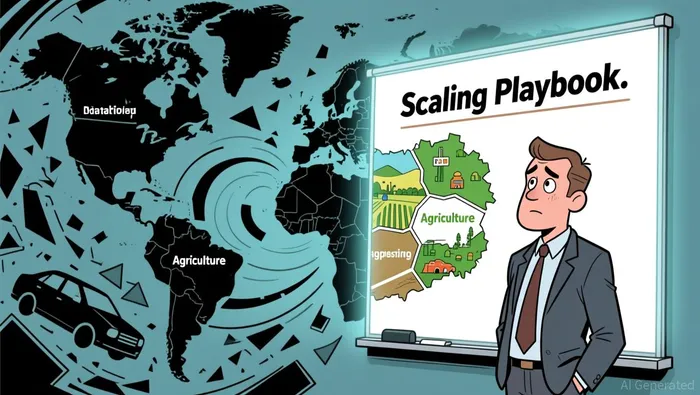
Autonomous Solutions, Inc. just published "A CEO's Playbook for Scaling Autonomous Off-Road Vehicles Across Your Operations". The title is confident. The company behind it is less sure of itself.
That's the tension worth noticing. A private robotics company with a patchwork funding history - some sources put total capital raised at roughly $11.5 million, others at $68 million, and since it's private, nobody can confirm which - is selling other CEOs a guide about scaling. Not a technology brief. A playbook.
The way to evaluate a playbook is not to read it. It's to look at whether the author has done what they're selling.
ASI's own trajectory reads like a company still figuring out which problem is big enough. In 2024, they announced they were exiting the automotive sector entirely - pulling out of OEM proving ground automation - to "focus on scalable automation solutions" in off-road markets. Then in October 2025, they shifted what remained of the automotive team to support agriculture. Then in March 2026, they acquired Scythe Robotics, a maker of autonomous outdoor care equipment - robotic mowers and landscaping machines.
Each pivot makes some sense in isolation. Automotive is crowded and capital-intensive. Off-road environments - mining, agriculture, landscaping - have fewer variables than city streets, which is why the whole category got attention after robotaxies stalled. But string them together and the pattern looks different. This is not a company scaling. This is a company testing categories.
ASI's core product is Mobius, which they describe as an OEM-agnostic fleet management system. "OEM-agnostic" means it works across different vehicle manufacturers rather than being built for one brand. That's actually a smart positioning move. If you lock into Caterpillar or John Deere, you're capped by their roadmap. If you stay vendor-independent, you can sell to anyone who already owns the hardware. But it also means the product has to work everywhere, which is harder than it sounds.
Here's what I couldn't find. ASI doesn't publish revenue. Doesn't disclose how many vehicles are running autonomously in production - not pilots, not demos, actual daily operations. Doesn't share customer names or deployment sizes. For a company whose entire brand pitch is "we know how to scale this," the silence on operational metrics is conspicuous.
That's not a dealbreaker on its own. Private companies don't have to report. But when your marketing strategy is telling other CEOs that you have the proven path, the absence of any measurable path starts to matter.
The playbook itself is a lead-generation vehicle. ASI gates it behind a form on their website. You give them your email and they give you the document. It's not a teaching moment. It's a sales funnel dressed as thought leadership. The more interesting question is why they chose this format.
I suspect the answer reveals something about the category. Off-road autonomy is selling a vision because the numbers aren't there yet. Mining has the deepest deployments - autonomous haul trucks have been running for years at major mines - but that's a handful of large customers with long sales cycles. Agriculture is more fragmented. Landscaping is smaller but has more unit economics to prove. Each subcategory needs a different business model, different pricing, different go-to-market. There is no single playbook that scales across all of them.
Or maybe there is. Maybe Mobius actually does work as a common platform and the playbook is genuine. The way to test that is not to download the whitepaper. It's to ask ASI how many autonomous vehicles they're managing today, which ones make money, and which categories they're still subsidizing. The answers to those three questions would tell you more than any playbook.
Most people in the off-road AV space are repeating the same inherited frame: robotaxis failed, so industrial automation is the logical fallback. That's directionally right. But direction doesn't tell you distance. A company can be on the right road and still be ten years from profitability. ASI might be one of them. Or they might be closer than their public posture suggests.
The test is simple. When a vendor offers you a roadmap, ask to see their own odometer.