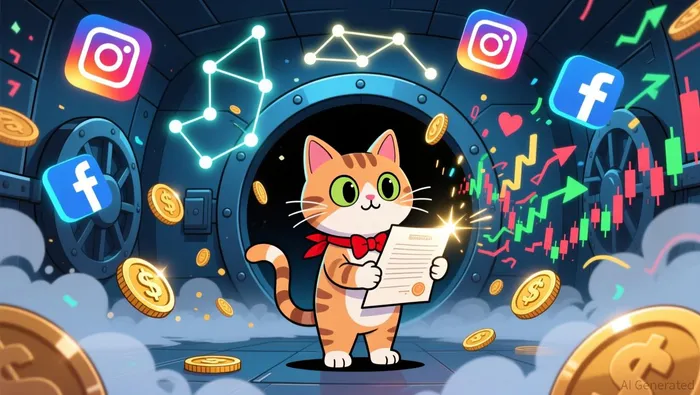
A verified X account posted a Solana Pump.fun token address on Monday after 16 months of silence. The account belongs to Keith Gill, the investor known online as Roaring Kitty. The post featured a cartoon cat wearing a red neckerchief and a contract address for a freshly launched meme coin. Within 30 minutes, the post was deleted. GameStop shares, which had jumped as much as 13% on the initial post, reversed to close down 4.57% at.17. Traders immediately speculated the account had been hacked.
That is weird. The weird part is not that a social media post moved a stock price-that is the Roaring Kitty playbook. The weird part is what sort of financial machine you get when the market treats a social media account as critical market infrastructure, and what happens when that infrastructure either gets compromised or voluntarily disappears.
Start with the signal itself. The post pointed to a Solana meme coin called Red Kitten Crew (RKC) launched on Pump.fun, a platform where 98.6% of tokens carry scam or wash-trading characteristics. This is not Gill's usual material. His history is options trading, value investing themes, and GameStop livestreams. A fresh Pump.fun token is the sort of thing you would expect from a compromised account, not from someone with a $180 million GameStop position to protect.
Yet the market initially treated it as bullish. GameStop climbed, trading volume spiked to 17.9 million shares, and trading was halted nine times in 90 minutes due to volatility. Then the post vanished, and the stock gave back all the gains. The sequence suggests the market was not really pricing the content of the post-a probable scam token-but the fact of the signal itself. The existence of a Roaring Kitty post, any post, became the bullish event. Its deletion became the bearish one.
This is a familiar problem in finance, just wrapped in a new costume. Think of it as a liquidity promise. A bank takes deposits with the promise that you can withdraw them on demand. A money-market fund offers daily liquidity while investing in slightly less liquid assets. The mismatch works until too many people try to exit at once. Here, the social media account functions as a sort of signaling bank. Followers deposit attention and trading capital with the understanding that the account will occasionally emit meaningful signals. When the signal appears-even a suspicious one-it validates the deposit. When it disappears, it triggers a kind of run.
The mechanics look like old-fashioned market plumbing in meme-stock clothing. More than 175 million shares of GameStop changed hands in the frenzy, and short sellers took an estimated billion in losses during the squeeze. Those are numbers you would see in a coordinated options expiry or a index rebalance, not typically in a reaction to a single deleted tweet. The halts, the volume spike, the violent reversal-all of it resembles what happens when a key piece of market infrastructure fails, not when one person changes their mind.
The interesting question is not really whether the account was hacked. It might have been; the pattern matches recent takeovers of high-profile crypto accounts. Or Gill might have posted and deleted it himself, testing something or sending a coded message. The market does not know, and for the plumbing analogy, it does not need to know. What matters is that the account's output is treated as a contractual element of GameStop's price discovery. When the output stops, the contract breaks.
You can see this in how traders reacted. Before the deletion, the dominant theory was bullish: Roaring Kitty is back, maybe the token is a clue, maybe something big is coming. After the deletion, the dominant theory became bearish: the account was hacked, the post was a scam, the rally was fake. The underlying facts did not change-the same questionable token address existed both before and after-but the market's narrative flipped because the continuity of the signal was interrupted.
This is not mainly a story about GameStop's fundamentals or meme-stock mania. It is a story about what happens when price discovery gets outsourced to a social media feed, and what kind of liquidity events you get when that feed goes dark. The Pump.fun address was just the delivery mechanism. The real trade was a bet on the persistence of the signal itself. When the signal disappeared, the bet unwound.
In older finance, you would have a prospectus, a covenant, a disclosure filing. Here, you have a tweet that may or may not be authentic, that may or may not be intentional, that exists for 30 minutes before vanishing. The market still treats it as a contractual input. That is the plumbing. The rest is just price action.