

The Q1 import figure of 0.9% growth sounds unremarkable-but the monthly breakdown tells a more interesting story. Poland's import trajectory in early 2026 was anything than smooth, with a sharp contraction in January followed by a meaningful rebound in February. This volatility suggests the economy is working through transitional pressures rather than facing a sustained demand collapse.
Poland Total Imports fell 7.1% YoY in January, a significant contraction that likely reflected post-holiday pull-forward effects and possibly inventory adjustment. But the picture shifted in February, when imports grew 2.5% YoY-a reversal that signals underlying demand remains intact. Viewed together, these movements frame the Q1 average: not a trend, but a transition.
The baseline matters here. December 2025 imports stood at EUR 372.7 billion, a record high that provides context for the volatility. Against that elevated starting point, the January drop was a sharp correction, while the February recovery represents a partial reassertion of demand. The question for investors is whether this rebound sustains-or whether the January weakness was a warning sign.
The trade balance adds another layer. In February, Poland ran a trade deficit of USD 714.5 million, with imports at USD 35.4 billion and exports at USD 34.6 billion. That deficit is modest relative to the volume of trade, but it does highlight a key dynamic: export growth (1.2% YoY in February) is lagging import recovery. This divergence could pressure domestic producers if it persists, as cheaper imported goods compete with local output.
The consensus view on Poland often centers on growth momentum-either celebrating the economy's resilience or worrying about external headwinds. But the import data suggests a more nuanced reality: the economy is navigating a patchy recovery, with monthly swings reflecting short-term adjustments rather than structural demand weakness. For now, the risk/reward setup hinges on whether the February rebound proves sustainable-or whether it was simply a bounce from an overdone contraction.
GDP Growth Slowdown: What's Driving the Deceleration
The Q1 GDP figure of 3.4% YoY growth-down from 4.1% in Q4 2025-confirms the slowdown many analysts anticipated, but the sectoral breakdown reveals a more important story: this is not a systemic demand collapse. The economy is simply shifting gears, with construction and industry dragging while services hold firm.
Seasonally-adjusted data shows 0.5% QoQ growth in Q1, half the 1.0% pace from the previous quarter. That deceleration is real, but it's largely the result of temporary headwinds hitting specific sectors rather than a broad-based demand failure. Harsh weather conditions weighed on construction in the early months of 2026, producing double-digit output declines, while industry faced its own pressures. The result: a slowdown from a very strong fourth quarter.
Here's where the import data from the previous section becomes instructive. The January import contraction (-7.1% YoY) and February rebound (+2.5% YoY) mirror the sectoral story in the GDP data. Construction and industry-both import-intensive-are the sectors that struggled early in the year. The import volatility reflects their transitional pain, not a collapse in consumer or business demand more broadly.
The key insight is that services remain resilient. Poland's economy is undergoing a structural shift: industry is contributing less to GDP growth than in the past, and the economy is becoming increasingly reliant on services. This is not a vulnerability-it's a different growth model. Services are less exposed to the weather-related disruptions that hit construction, and they're less dependent on the export demand that pressures industry.
That said, the slowdown is not without risk. The surge in fuel prices threatens to undermine income growth and consumption just as the economy is adjusting to weaker industrial output. If higher energy costs compress real wages, the services sector-which has been the growth anchor-could face its own headwinds.
For investors, the question is whether the March rebound in construction and industry (noted in the data) signals a return to more normal growth dynamics, or whether the Q1 slowdown was the beginning of a new, slower trajectory. The 3.4% pace is still solid by European standards, but it's below Poland's recent trend. The risk/reward setup depends on whether you view the current deceleration as a temporary adjustment to sectoral shifts-or a signal that the economy's growth ceiling has fallen.
Sector-Specific Stress Points: Cars and Energy
The aggregate import and GDP figures mask important sectoral fractures. Two categories in particular-used car imports and energy supplies-reveal structural shifts and policy-driven headwinds that could reshape Poland's growth trajectory in 2026.
Used passenger car imports fell 16.7% YoY in January 2026, with just 57.7 thousand units entering the country. That's a meaningful contraction from 69.3 thousand units a year earlier, extending the softer market conditions observed at year-end 2025. But the volume decline is only half the story. The age profile of imported vehicles remains stubbornly skewed toward older cars: 58% of imports were over 10 years old, while vehicles up to 4 years old comprised just 9.4% of the total. This isn't a temporary blip-it's a persistent structural challenge. A fleet that ages slowly has implications for transport efficiency, emissions targets, and ultimately, consumer spending power. When the average car on the road is older, households spend more on maintenance and less on other goods and services.
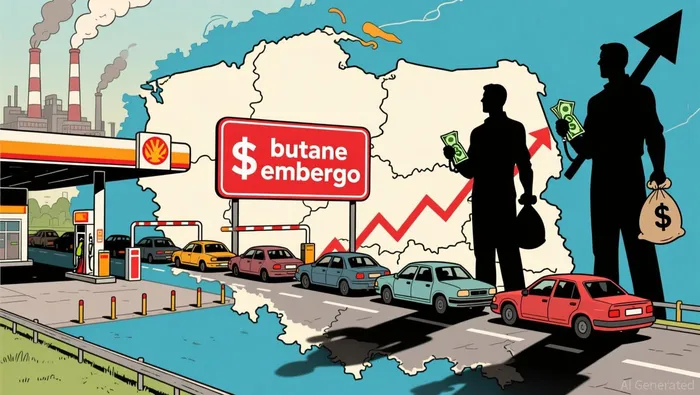
The butane embargo introduces a different kind of pressure. Effective 26 January 2026, the EU banned imports of n-butane and isobutane with purity above 95% from Russia-a tightening of the December 2024 LPG embargo. The market had already adjusted to the first round of sanctions, but the loophole closure created a sharp supply shock. In 2025, imports of these specific butanes from Russia nearly tripled compared to 2024, as traders exploited the exemption that had been granted. By January-October 2025, Russia still accounted for 69% of Poland's butane imports. The embargo forces a complete reorientation of supply chains.
This matters because Poland is the EU's largest LPG importer, and the transport sector consumes the vast majority of it-74.9% of domestic LPG sales in 2024. With 12% of all passenger cars in Poland powered by LPG, any disruption to butane supplies directly affects fuel costs for a significant portion of the vehicle fleet. The shift away from Russian supplies has already begun-Sweden, Norway, and the US now supply 54.1% of LPG-but infrastructure constraints and higher procurement costs are inevitable. Poland's refineries produce only about 20% of domestic LPG demand, leaving the country structurally dependent on imports.
The intersection of these two sectors is where the risk compounds. Higher butane prices push up LPG fuel costs, which in turn affects operating expenses for transport-intensive industries and increases the cost of living for households. At the same time, the used car market slowdown reflects weaker consumer demand or tighter credit conditions-both of which could deepen if energy costs rise. The question for investors is whether these are isolated sectoral adjustments or early warning signs of broader demand compression.
The consensus view on Poland often emphasizes resilience and growth momentum. But the used car data and the butane embargo reveal vulnerabilities that the aggregate numbers don't capture. The risk/reward setup depends on whether you view these as manageable transitional pressures-or as indicators of a more challenging environment ahead.
Risk Assessment: What's Priced In vs. Reality
The consensus view of Poland as a resilient growth story is not wrong-but it may be incomplete. The question for investors is whether the current setup reflects the cumulative weight of geopolitical pressures, energy transition costs, and the fading boost from public investment. Or whether, as the data suggests, these risks are being underweighted.
The public investment cycle provides the clearest signal of what's already priced in. Poland's economy is currently being shielded by the implementation of National Recovery Plan (NRP) projects, which formally expire at the end of 2026. The public investment cycle is spilling over into the rest of the economy, providing a tailwind that has helped offset external headwinds. But this is a finite resource. The key question is whether the economy has built sufficient private-sector momentum to sustain growth once the NRP windfall fades. The Q1 slowdown-from 4.1% to 3.4% YoY-suggests the answer is not yet clear.
Fuel prices represent the most immediate risk to the growth trajectory. The surge in energy costs threatens to undermine income growth and consumption just as the economy is adjusting to weaker industrial output. The surge in fuel prices threatens to undermine income growth and consumption. This is not a theoretical risk-it's already factoring into the Q1 data, where the services sector (the current growth anchor) bore the brunt of weather-related disruptions in construction and industry. If higher energy costs compress real wages, the services sector could face its own headwinds, creating a feedback loop that the current 3.4% growth rate doesn't fully capture.
The interest rate baseline adds another layer of assumptions. The current market pricing assumes rates remain unchanged until the end of 2026. But prolonged gridlock in US–Iran talks and the continued blockade of the Strait of Hormuz increase the risk of higher interest rates. Our baseline scenario assumes that interest rates remain unchanged until the end of 2026. This is a fragile assumption. If energy-driven inflation persists, or if geopolitical tensions escalate, the Monetary Policy Council could be forced into a tighter stance sooner than expected-pressuring an economy that's already navigating a sectoral transition.
Here's where the expectations gap becomes visible. The consensus view emphasizes Poland's resilience-solid growth above 3%, a services-led economy less exposed to external shocks, and a strong institutional framework. But the aggregate numbers don't fully capture the cumulative impact of: - The fading public investment tailwind (NRP expires end-2026) - The energy transition costs (butane embargo, fuel price surge) - The sectoral shift that leaves the economy more reliant on services just as those services face income pressure
The risk/reward setup depends on whether you view the current 3.4% growth as the new baseline-or as a ceiling that could prove difficult to sustain. The data suggests the economy is navigating a patchy recovery with meaningful sectoral stresses. For investors, the question is whether the current price reflects that reality-or whether the market is still priced for the Poland of two years ago, when growth was stronger and headwinds were more manageable.
The asymmetry here is worth noting. The downside risks (energy price shocks, public investment fade, rate pressure) are more concrete and imminent than the upside scenarios (private-sector momentum taking over, services acceleration). That creates a cautious setup-one where the current resilience may be pricing in too much optimism about the transition.