

Do you know what most investors miss when they read about China–Greece maritime cooperation at events like Posidonia's China Night? They hear diplomacy. They should hear toll roads.
At the world's most prestigious shipping exhibition in Athens in June 2026, Chinese and Greek officials announced plans to deepen cooperation in maritime affairs, shipping finance, shipbuilding, ports, and green shipping. It was framed as a platform for international exchange. But the underlying reality is simpler and more direct: control of physical infrastructure where global goods move through. Ports. Shipping lanes. Logistics corridors. These are toll roads - and if inflation proves persistent, toll roads with pricing power are among the few assets that can grow income faster than the cost of living.
The Piraeus proof point
The Port of Piraeus is the clearest example of how this works. COSCO's management of the port has been running for years, but the 2025 financials show the compounding effect of controlling a choke point on European trade. Piraeus posted record revenue of €250.8 million in 2025 - an 8.6% increase year over year - and EBITDA rose 2.2% to follow. Revenue grew faster than throughput in parts of the operation, which is exactly what you want to see: it signals pricing power. The port is earning more per container, not just moving more of them.
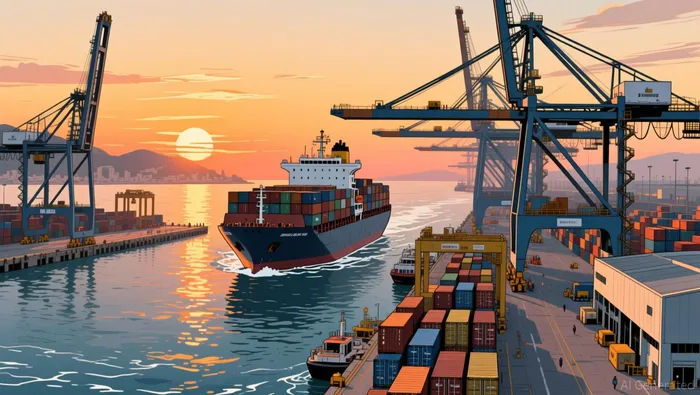
Meanwhile, COSCO SHIPPING Ports as a group moved 153 million TEU in 2025, up 6.2% from 2024. This is a company processing roughly half of all containers that move through the global system. When you own that scale at critical geography, you don't need to chase demand. You collect.
Piraeus is not just a port. It is China's gateway into European markets - the Mediterranean terminus of the 21st Century Maritime Silk Road, one of the core corridors of the Belt and Road Initiative that aims to connect over 150 countries through six land corridors and a sea route. The strategic value compounds when trade reroutes.
The structural disruption nobody has priced out of the model
Here's the thing most investors don't factor into their logistics and infrastructure exposure: the Red Sea crisis is still unresolved. In January 2026, the UN Security Council adopted Resolution 2812, extending reporting on Houthi attacks in the Red Sea for another six months. That means the disruption that began in late 2023 - over 190 Houthi attacks on commercial vessels by late 2024 - has been ongoing for more than two years. Ships that used to transit the Suez Canal in days are still adding weeks by sailing around the Cape of Good Hope.
This matters for three reasons. First, longer routes mean more port calls, more port revenue, and more toll-road earnings for operators at key nodes. Second, the Containerized Freight Index jumped 6% in a single day on June 5, 2026, after sitting in a buyer's market for much of the year where spot rates had fallen over 70% from their peak. Route uncertainty creates volatility, and volatility in shipping rates flows through to consumer prices. Third, and most important for the thesis: the longer these disruptions persist, the more governments invest in alternative corridors and port capacity - which is exactly what the China–Greece cooperation at Posidonia is accelerating.
The 2026 freight environment is contradictory: massive vessel overcapacity and weakening demand have pushed spot rates down, but geopolitical risk keeps a floor under rates and creates sudden spikes. For an infrastructure operator with fixed costs and volume-based revenue, this is an asymmetric setup. The downside is capped by contracts and throughput volume; the upside opens when routes break and rates spike.
What this means for the inflation thesis
I believe the structural inflation picture is changing, and global trade reconfiguration is one of the drivers that doesn't get enough attention. Deglobalization, supply-chain reshoring, energy transition costs, demographic constraints on labor, and now persistent maritime route disruption - these are not temporary shocks. They are the new operating environment. And in this environment, companies that own the physical infrastructure through which goods must pass can raise prices without losing customers. That is the single most important filter for a dividend growth investor.
Shipping and port infrastructure sits between two macro realities. On one side, deglobalization and geopolitical fragmentation are pushing governments to build redundant corridors and invest in friendly-port capacity. On the other side, the energy transition and defense spending are consuming the same industrial resources - shipyards, steel, heavy equipment - creating capacity constraints in the exact sectors that build this infrastructure. The result: supply of new port and shipping capacity is tighter than most investors realize, while demand reroutes and multiplies.
Where the opportunity lives
This is not a stock-picking article, because the framework matters more than any single ticker. But the mental model is the same one I apply across sectors: find the toll roads of global trade.
The criteria are narrow:
Pricing power. Can the company raise rates without losing volume? Port operators at strategic choke points can. Pure shipping carriers with excess capacity cannot - that is why the sector is split between infrastructure winners and cyclical commodity plays.
Balance sheet strength. COSCO's model works because it leverages state backing and long-term port concessions. Private equivalents need investment-grade credit and low debt-to-equity. A dividend in this sector depends on the ability to fund capex without betting the payout on one macro cycle.
Dividend growth, not current yield. The equity yield curve still applies here. The sweet spot is moderate yield with structural growth - ports and logistics operators whose payout grows because throughput and rates grow, not because management cuts costs to the bone.
Volume-based revenue. The best toll-road models earn on throughput, not on commodity prices. A port that charges per container handled doesn't care whether the container carries chips or textiles. This is what separates durable income from cyclical speculation.
The role this plays in a portfolio
Maritime infrastructure and logistics belong in the inflation-hedge sleeve of a dividend growth portfolio. Not as a yield chase - the sector has enough distressed operators to make chasing yield a fast way to lose capital. But as a structural position in the reorganization of global trade. I don't think investors are being paid to chase the highest shipping yield today. The better setup is a port operator or logistics infrastructure company that can turn a modest yield into years of compounding because the world reroutes around it rather than through it.
This may not fit every investor, but from an income and risk/reward point of view, the logic is clean: own a piece of the toll road, collect as traffic moves, and let the geopolitical fragmentation that worries most people work in your favor.
The Posidonia China Night was a ceremony. The reality is a structural shift in who controls the arteries of global commerce. The question is whether your portfolio has exposure to the companies that collect the toll - or whether you're just watching from the shore.