

The Federal Reserve held rates steady at 3.5%-3.75% last week, maintaining its median forecast for a single rate cut in 2026-exactly where it stood in December. That's the official guidance. But look at what traders are actually pricing in, and the picture becomes more hawkish still.
Polymarket markets assign a 79% probability to three consecutive pauses through July 2026, with only 11% pricing in a single cut by mid-year. The market is essentially betting the Fed won't cut at all this spring and summer, despite the dot plot's one-cut signal. That's the expectations gap: the Fed's median projection suggests accommodation is coming, but traders are pricing in something closer to a full pause.
Powell himself acknowledged the forecasts are "a shot in the dark" given Iran war uncertainties, calling it one of the most uncertain Summary of Economic Projections in recent memory. The oil shock from the Middle East conflict has complicated the inflation picture significantly, with energy prices spiking 10.9% and CPI reaching 3.3% year-over-year in March.
So is the one-cut expectation already priced in? In a sense, yes-but perhaps too hawkishly. The market has effectively discounted the Fed's own median projection, pricing in zero cuts through the first three meetings with near-certainty. That creates an interesting asymmetry: if the Fed delivers on its dot plot and cuts once, the market could be surprised to the upside. But if oil prices stay elevated or inflation re-accelerates, the Fed's single-cut forecast could look optimistic too. The uncertainty Powell named is working both ways.
What's Already Priced In vs. What Could Break the Consensus
The market's reaction last Wednesday and Thursday told the story: stocks fell after Powell emphasized the limited progress on inflation and the uncertainty surrounding the oil shock as widely expected. That drop reveals what was already baked in-a pricing for perfection that leaves little room for downside surprises.
The FOMC remains visibly split on the pace and steepness of rate cuts-if at all the FOMC has been split. That internal divergence is something the market may be overlooking in its current positioning.
On the Polymarket timeline through July, the market assigns just 3.1% probability to two cuts and a mere 1% to three cuts. That's the asymmetry: the market has discounted the Fed's own median projection of one cut, but it has not discounted the possibility of zero cuts or even the upside inflation risk from sustained oil price spikes.
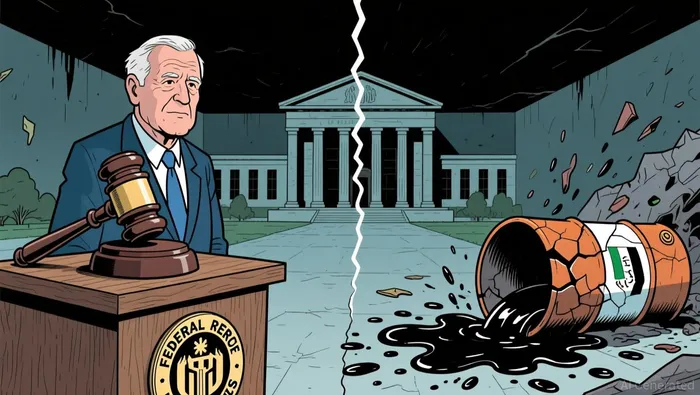
Here's what could break the consensus: if oil prices remain elevated or accelerate further, the Fed's single-cut forecast could look optimistic. The market is pricing in a specific path-three pauses with near-certainty-but it's not pricing in the volatility that could push the Fed toward more than one cut, or toward a full re-acceleration of inflation expectations.
The risk/reward here is interesting. If the Fed delivers on its dot plot and cuts once, the market could be surprised to the upside. But if the oil shock persists, the Fed's one-cut forecast could be the thing that looks wrong. The market has priced in a lot of certainty where Powell himself sees a "shot in the dark."
The Powell Legacy and Warsh Transition
Jerome Powell's term as Federal Reserve chairman ends in May, likely giving way to Trump nominee Kevin Warsh following the meeting of its rate-setting committee. This impending transition fundamentally shapes Powell's incentives in his final policy decisions. With a new administration and a potentially more hawkish successor in the wings, Powell has limited political cover for aggressive tightening-but also less to lose by signaling caution.
Inflation remains above the 2% target, and oil-driven cost pressures are emerging as the Fed also published its first Summary of Economic Projections. Powell faces a clear choice: deliver on the Fed's single-cut path and risk looking optimistic if inflation re-accelerates, or signal enough caution to preserve credibility if the oil shock persists. His press conference tone last week suggested the latter-he emphasized the uncertainty surrounding the oil shock and acknowledged the US had not made as much progress on inflation as hoped during his press conference.
The key watchpoint for investors is whether Powell signals willingness to skip the anticipated cut if oil-driven inflation persists. That would represent a deviation from the already-conservative one-cut baseline the Fed has projected. Given the FOMC's visible split on the pace and steepness of rate cuts the FOMC has been split, Powell could plausibly build a coalition for a hold if inflation data deteriorate in the coming weeks.
For the market, this creates an interesting dynamic. The consensus has priced in near-certainty of three consecutive pauses through July. But Powell's final decisions carry a different weight-he's not building a legacy for the next decade, he's setting up the transition for Warsh. That could make him more willing to signal flexibility, or conversely, more cautious about committing to a path that could go wrong. The asymmetry remains: the market has discounted the Fed's one-cut forecast, but it hasn't fully priced in the possibility that Powell himself might signal a deviation if the oil shock persists.