

The S&P 500 was screaming to new all-time highs as oil prices soared, with investors fully positioned for a soft landing narrative. But beneath the surface, a classic expectation arbitrage setup was forming-one where the market's whisper number bore almost no resemblance to what Powell was about to print.
Markets had priced in a 100% probability of no change to the benchmark funds rate at the current 3.5%-3.75% range. That part was never in doubt. The real bet was on what came next: at least one rate cut in 2026, with high confidence. The Fed's quarterly projections were the real story, and that's where Powell delivered a 100% expectation collapse.
The FOMC vote split 8-4 in an unusually divided meeting-the last time four members dissented was October 1992. Four officials-Stephen Miran, Beth Hammack, Neel Kashkari, and Lorie Logan-forced a dramatic divergence from the path investors had priced in. Miran wanted a quarter-point cut. The other three opposed any easing bias in the statement. The phrasing "additional adjustments" became a battleground, signaling to the market that the next move might be lower-but Powell's projections told a different story.
The shift was stark: from one cut to zero cuts in the Fed's 2026 outlook. That's not a course correction. That's a complete reset of the narrative that had been building over 18 months of on-again, off-again rate cuts. With inflation already jumping 90 basis points to 3.3% in a single month and the Fed's own forecast pushing toward 3% by late 2026, the math became brutal. The market had priced in easing. Powell delivered tightening logic without the tightening.
The result? A complete expectation gap. The S&P 500's all-time high context made the reversal even more jarring-investors weren't just adjusting to a rate decision; they were recalibrating an entire growth narrative in real time.
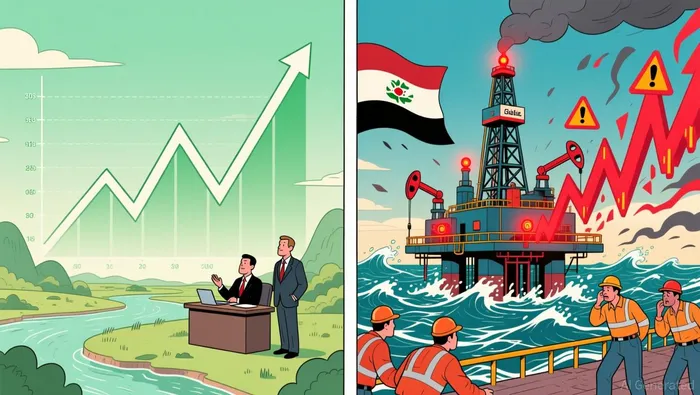
Why the Hawkish Pivot? Oil, Inflation, and the Warsh Factor
The Iran war didn't just shake the Middle East-it delivered a direct blow to the Fed's inflation outlook, forcing Powell's hand in what may be his final act as chair.
Before the conflict, U.S. trailing 12-month inflation sat at 2.4% in February. One month after U.S. forces attacked Iran and Tehran shut down the Strait of Hormuz, inflation had jumped 90 basis points to 3.3% a one-month surge of 90 basis points. That's not a drift-it's a shock. The Strait closure halted roughly 20 million barrels of oil per day, 20% of global crude demand, triggering the largest energy supply disruption in the modern era 20 million barrels per day through the Strait. Gas prices rose at their fastest pace in more than three decades, with diesel even steeper fastest pace in more than three decades.
The Fed's own nowcasting tool was already signaling things were "about to get even uglier" Cleveland Fed inflation nowcast. The December projection had inflation falling to 2.6% by year-end. The new reality? Economists now expect the Fed to forecast inflation stuck at 3% well into late 2026 inflation at 3% by late 2026. That's a 40-basis-point revision in a single quarter-and it directly contradicts the easing narrative investors had priced in.
This is the context that produced Powell's 8-4 split and the expectation collapse. The four dissenters-Miran on the cut side, Hammack, Kashkari and Logan on the no-easing side-were all signaling that the data no longer supported a dovish tilt 8-4 split with four dissents. The phrasing battle over "additional adjustments" was a proxy fight over whether the Fed was still on a downward path or standing at a crossroads.
For Powell, this was a last-stand moment. With a hawkish Warsh nomination on the horizon and the Fed's credibility on the line, the math was brutal: you cannot cut rates into 3%+ inflation with oil at multi-decade highs. The policy reset wasn't ideological-it was reactive. The market had priced in easing. Powell delivered tightening logic without the tightening. That's the expectation arbitrage in action: the whisper number was one cut. The print was zero. And the oil shock made it inevitable.
The Expectation Arbitrage Play: Market Reaction and Sector Implications
The market's reaction to Powell's hawkish shock reveals a classic expectation arbitrage in motion-where the gap between whisper number and print creates both risk and opportunity.
The S&P 500 had been screaming to new all-time highs with the benchmark index at record levels, but that rally was built on a foundation of priced-in easing. When the Fed's projections shifted from one cut to zero, the bond market immediately recalibrated. The 10-year Treasury yield, already elevated, now faces a decisive test at the 4.5% level-a break above that threshold would signal the market has fully priced in the hawkish reset.
Here's the dynamic: investors had bought the rumor of easing. The print delivered tightening logic without the tightening. That's the expectation gap in action, and it's punishing rate-sensitive sectors first.
Real estate, utilities, and high-growth tech-sectors that rallied on the prospect of cheaper capital-are now facing a fundamental reset. The logic is straightforward: if the Fed sees zero cuts in 2026 and inflation stuck at 3% well into late 2026 inflation at 3% by late 2026, then the discount rate supporting those valuations isn't coming down. That's a direct headwind to sectors that priced in the easing narrative.
But here's where the arbitrage gets interesting. The 8-4 split with four FOMC members dissenting signals something critical: the Fed is more divided than it has been in decades, and the next chair-potentially a hawkish Warsh-could push policy even further in the tightening direction. That uncertainty is creating rotation out of rate-sensitive names and into sectors less dependent on the Fed's trajectory.
Energy, of course, is in a different position entirely. The oil shock that forced Powell's hand is a direct tailwind for energy producers and related infrastructure. The same dynamics that pushed inflation up 90 basis points in a single month a one-month surge of 90 basis points are creating a fundamentally different outlook for energy cash flows.
The key question for investors: is this a temporary dislocation or a structural reset? The Fed's own projection of inflation at 3% by late 2026 inflation at 3% by late 2026 suggests the latter. Rate cuts fading from the 2026 outlook interest-rate cuts may fade for 2026 isn't a pause-it's a narrative collapse.
The expectation arbitrage has played out. The market now faces a choice: adjust to the new hawkish reality or get caught on the wrong side of the next Fed surprise.
What Comes Next: Timeline, Catalysts, and the Investor Playbook
The hawkish reset is just beginning. What investors experienced last week was not a one-off policy correction-it was the opening move in a longer game of expectation arbitrage, where the Fed's new consensus will be tested by concrete catalysts over the coming months.
The first major test arrives with the Warsh confirmation. Once confirmed, a hawkish chair will have direct influence over Fed messaging and potentially the pace of any future policy shifts. The market has already priced in zero cuts for 2026 interest-rate cuts may fade for 2026-but a confirmed Warsh could push expectations even further, toward actual tightening language in future projections.
The June FOMC meeting represents the next real-time stress test. That's when the Fed releases its updated economic projections, and the question on everyone's mind: will the dot plot still show zero cuts, or has the market overshot? The 8-4 split with four FOMC members dissenting signals deep division that hasn't been resolved-only postponed.