

Trump Mobile said this week it has begun shipping its long-delayed $499 T1 smartphones to customers, several months after the gold-colored device was originally slated for release. That is the headline. The more interesting part is what happened before the shipping started.
Back in April, Trump Mobile updated its pre-order terms. The new language said a $100 deposit "provides only a conditional opportunity if Trump Mobile later elects, in its sole discretion, to offer the Device for sale." The terms continue: "A deposit is not a purchase, does not constitute acceptance of an order, does not create a contract for sale, does not transfer ownership or title interest, does not allocate or reserve specific inventory, and does not guarantee that a Device will be produced or made available for purchase."
That is weird. You are giving a company $100 for the chance to maybe give them more money later, if they decide to make the thing you are paying for. It is sort of like buying an option on a phone that may not exist. The option premium is $100, and if the company exercises the option to make phones, you get to pay $399 more for one. If they don't, you get your $100 back. Probably.
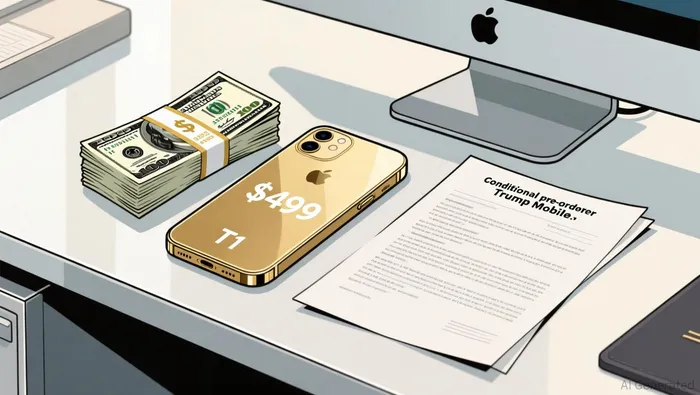
The phone itself is a gold-colored Android device that Trump Mobile says is "assembled in the U.S." though it initially promoted the T1 as "designed and built in the United States." The company is a mobile virtual network operator (MVNO) that uses the Trump brand under a licensing arrangement, with the actual service managed by Florida-based Liberty Mobile Wireless, which uses T-Mobile's network. The monthly plan costs $47.45, a reference to Donald Trump serving as both the 45th and 47th U.S. president.
So the structure is: Trump Organization licenses its name to T1 Mobile LLC, which runs the MVNO business. Customers pay $100 deposits that don't guarantee phones. The phones, when they come, are produced largely overseas with only limited final assembly expected to take place in the US, despite earlier marketing. And now, after pushing back the T1 phone's release first to October and later to this week, phones are shipping.
You can think about this in terms of who bears what risk. The Trump Organization gets licensing fees for the use of its brand. T1 Mobile LLC bears the operational risk of actually making and selling phones. And customers who put down $100 deposits are providing zero-interest financing that comes with no guarantee of product delivery. It is a neat separation of functions: brand owners get paid for the brand, operators take the business risk, and customers provide working capital through non-refundable-but-refundable deposits.
The pre-order terms are the key to understanding what sort of machine this is. They turn what looks like a simple purchase into something more complicated: a conditional option where the company has all the discretion. Customer: "I want to buy your phone." Company: "Great, give us $100 for the chance to maybe sell you one later, if we feel like it." That is not really a pre-order in the normal sense. It is more like a non-binding expression of interest with a refundable fee attached.
Now phones are shipping, so the system "worked" in the sense that customers who put down deposits will get phones. But the structure remains what it was: a licensing deal wrapped around an MVNO business, funded in part by customer deposits that didn't guarantee anything. The fact that phones eventually shipped doesn't change the contractual reality that they didn't have to.