

The Australian economy grew 0.8% in the final quarter of 2025. That was above expectations. The headline about growth slowing more than expected last quarter is, as written, wrong.
But here's the odd thing. Everyone knows the slowdown is coming. The Q1 2026 data hasn't landed yet - the ABS releases it next week - but Westpac's nowcast, which assembles the partial indicators before the full national accounts, is pointing to about 0.4% growth. That's a material collapse from 0.8%, basically in half. Household spending, the engine that kept the whole thing moving, has fallen for three consecutive months. February was the first decline since September 2024. March was down 1.1%. April was down another 1.2%, with six of nine spending categories in the red.
So the slowdown isn't coming. It's already here. The question is what anyone is going to do about it.
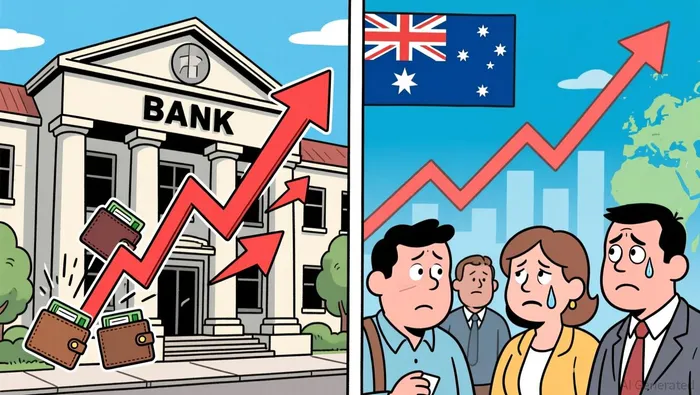
The Reserve Bank of Australia is raising interest rates. Three times in 2026. February: up to 3.85%. March: up to 4.1%. May: up to 4.35%, where it sits now - back at the peak from the prior tightening cycle in early 2024. That makes the RBA the clear outlier among major central banks. The Fed and ECB are holding or cutting. The RBA is hiking, and hiking into the very slowdown its policy is causing.
That was weird, at least to anyone who hasn't been watching Australian macro plumbing all year. But it's not actually that strange once you understand the machine.
The basic point is this: the RBA has an inflation problem it cannot escape. Core inflation - trimmed mean CPI, which strips out the extremes to get at underlying price pressure - is running at 3.4% as of April 2026. The target band is 2–3%. The RBA's own projection, from its May monetary policy statement, is that inflation will spike to around 4.2% by mid-2026. Wage growth is feeding into price-setting as workers try to protect real incomes. Capacity pressures are building - the RBA explicitly flagged that in its March statement. The terms of trade, the thing that normally makes Australian economists cheerful, are rising on commodity prices.
So the RBA is in the classic central bank bind: inflation is sticky and trending higher, so it has to keep tightening. But tightening kills demand. And it is killing demand. The household spending data is the proof. More than 65,000 Australians have called the National Debt Helpline this year, mostly about mortgage stress. APRA, the prudential regulator, activated debt-to-income lending caps in February as a guardrail against highly indebted borrowers. The machinery is working exactly as designed - higher rates push households to spend less - and also exactly as the RBA didn't want it to.
This is basically the same trap the UK Monetary Policy Committee ran into when they hiked into a recession in 2023. You hike to kill inflation. Hiking kills demand. Killing demand kills inflation - eventually. But if inflation has its own momentum from wages, supply, and capacity, you have to hike more before the inflation comes down, which kills even more demand, and by then you're asking whether the economy can absorb the hit. The RBA is about 12 months into this loop.
The funny structural detail is household spending. It was the thing that kept the whole Australian growth story alive through 2025. Australians kept spending despite rising rates, partly because migration-driven population growth was pulling up the aggregates and partly because wage growth was catching up to inflation. But now spending has turned negative for three months running. That's the transmission mechanism finally doing its job. Higher mortgage service costs plus two years of cumulative rate hikes plus a labour market that's starting to soften - the household balance sheet is hitting the wall.
The question that matters is whether the RBA can pause now. They signaled as much after the May hike - eight to one vote, the standard "we've done enough for now" posture. But if the June inflation print comes in near that 4.2% projection, the pause becomes politically and economically fragile. The whole mechanism only works if the RBA's credibility holds: the market has to believe they'll keep hiking if needed, which keeps inflation expectations anchored. If they pause and inflation surges, expectations unanchor, and then the hiking has to be even more aggressive later.
That's the machine. The RBA is borrowing economic growth from future quarters to kill inflation in the present. Household spending is the collateral. The slowdown isn't a surprise; it's the price.
The structural implication is straightforward. Australia is running one of the steepest rate cycles in G20 history while most of the world has pivoted away from tightening. That's a drag on the AUD, on equities, and on the property market - which is already showing stress signals. If the slowdown holds and inflation cools, the RBA gets to play the hero who tamed inflation with minimal scarring. If the slowdown holds and inflation doesn't, they're in the UK 2023 box: stuck, with demand destroyed and prices still rising, and no clean path forward until one or the other breaks.
The Q1 GDP number next week will tell us how deep the demand destruction goes. The June CPI will tell us whether the RBA can stop hiking. Between those two data points, the whole Australian economy is held in the tension between what the RBA needs to do and what it can afford to do.
That's not really a growth story. It's a central bank solvency story disguised as macro data.