

Summary
- Red Cat trades at a $2.24 billion market cap on $40.7 million in annual revenue - 55x sales for a company that has never posted a profitable quarter.
- The Army's key SRR contract, management's flagship deal, had an initial production order of only $12.9 million. FOIA filings revealed this was at least 60% smaller than what management told investors.
- Free cash flow burn reached $95.8 million in 2025. The company is financing growth through equity dilution, not cash generation.
- Revenue growth is real and accelerating - Q1 2026 revenue jumped 849% year-over-year - but the stock is pricing in a decade of flawless execution, zero competitive disruption, and margin expansion that hasn't happened yet.
- I rate Red Cat as a Sell. The valuation front-runs the thesis by years, and the false narrative of Pentagon spending inevitability does all the heavy lifting.
I've been very surprised that the market continues to reward Red Cat Holdings (NASDAQ: RCAT) with a $2.24 billion market cap despite the company having never generated a quarter of free cash flow. The popular narrative is straightforward: the Pentagon is pouring billions into drone procurement, Red Cat won the U.S. Army's Short Range Reconnaissance program, and Section 1709 of the FY25 National Defense Authorization Act - which bans foreign-made small drones for military use - locks in domestic winners. The logic seems airtight. The problem is that none of it justifies the price.
Let's start with the headline number everyone cites. Claims that the Pentagon is spending $1.1 billion on drone dominance are a mix of misattributed classified program budgets and European defense spending figures. The actual U.S. defense budget line for the SRR program - Red Cat's crown jewel - shows approximately $149 million for systems and $100 million for spares in FY26, totaling roughly $248 million annually. That's not nothing. It's also not the multi-billion-dollar revenue base needed to support a $2.24 billion valuation on a company that burned $72.1 million in net losses during all of 2025.
Here is the number that matters: Red Cat's full-year 2025 revenue was $40.7 million. The stock trades at roughly 55 times that figure. For context, most defense contractors - even growth-oriented ones - trade between 4x and 8x revenue. AeroVironment, the established small-UAS manufacturer that Red Cat is trying to displace, trades at a multiple that reflects actual earnings power, not projected market share. At 55x revenue, Red Cat's stock is pricing in that $40.7 million figure grows to something closer to $120 million to $150 million, sustainably, within the next two to three years. That would require revenue to triple while gross margins expand from their current 13% to something approaching profitability. The company has not demonstrated it can do either.
The revenue growth is genuine and worth examining. Q1 2026 revenue hit $15.5 million, up 849% year-over-year, and gross margins finally turned positive at 12.7%. Q4 2025 was even more dramatic on the surface - $26.2 million in quarterly revenue, up 1,985% year-over-year. However, the trajectory tells a different story when you look at the structure of that growth. The Q4 spike appears to have been a concentrated delivery event, and the Q1 2026 pullback to $15.5 million suggests lumpy execution rather than a stable ramp. Defense contracting routinely produces these kinds of quarter-to-quarter whipsaws, especially for companies still working through their first low-rate initial production orders.
That brings me to the false narrative at the center of this trade. In November 2024, Red Cat announced it won the Army's SRR program of record - the contract to supply small rucksack-portable drones to Army platoons. Management framed this as a generational inflection point. The market bought it, sending the stock from the mid-$5 range to over $18 by March 2026. Then FOIA filings in October 2025 revealed the truth: the initial low-rate initial production contract was only $12.9 million. At least 60% smaller than what management implied to investors. A $12.9 million order on a $2.2 billion market cap is not an inflection point. It's a pilot program.
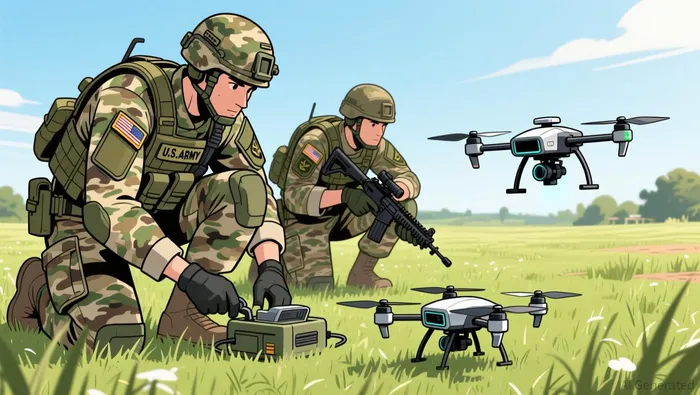
That being the case, the real question becomes: what happens after LRIP? The FY26 budget of roughly $248 million for SRR systems and spares is the annual pool, not the contract value. Even if Red Cat captures a majority of future orders - a big assumption - we're talking about tens of millions per year, not hundreds. The Army will have multiple years of evaluations, competitive reassessments, and budget uncertainty before any full-rate production decision. And that's before considering that Section 1709's anti-import restrictions, while real, don't mean Red Cat faces no competition. AeroVironment, Skydio, and other domestic manufacturers are still in the arena.
The balance sheet compounds the problem. Red Cat ended Q1 2026 with $131.9 million in cash, which management rightly highlights as providing runway. But free cash flow burn hit $95.8 million in 2025, with capital expenditures of $6.7 million on top of operating losses. At that burn rate, the current cash pile lasts approximately 15 to 18 months if revenue growth stalls or slows. When that runway shortens, dilution follows. The company has already demonstrated this pattern - funding growth through equity raises rather than cash generation is the textbook startup playbook, and it works until it doesn't. At a $2.24 billion valuation, there's no room for the equity watering that comes with extended cash burn.
The acquisition of Apium Swarm Robotics in March 2026, adding drone-swarming autonomy capabilities, and the reported $69.7 million sales backlog (up 12%) are real developments. But they don't change the structural math. A $70 million backlog on $41 million in trailing revenue is a strong number for a company trading at 5x sales. At 55x, it's a number the stock already reflects. The Apium deal is a strategic bet on swarm technology that is years from revenue contribution - and that's if the Army actually adopts it at scale.
I recognize the bull case. Revenue is growing faster than almost any defense company in the market. Section 1709 is a structural tailwind that removes the cheapest foreign competition. The SRR program of Record status means Red Cat is the incumbent, and incumbents in defense have enormous staying power. If this company reaches even $80 million in revenue with 30%+ gross margins - which would require three years of flawless execution - the current valuation might look defensible. That's the thesis. It's also a thesis that requires assuming the Army ramps SRR orders aggressively, Red Cat never loses ground to competitors, margins expand as projected, and cash burn reverses within 18 months without further dilution. All of it.
In my opinion, asking investors to accept all of those assumptions simultaneously, at 55x revenue, for a company that has never posted a profitable quarter, is a false narrative dressed up as inevitability. The Pentagon's drone spending is real. Red Cat's role in it is real. The valuation is not.
I rate Red Cat Holdings as a Sell. The stock has front-run its own thesis by years, and the gap between the $2.24 billion market cap and the $40.7 million in actual revenue will close one way or the other. For investors who want exposure to defense drone growth, AeroVironment offers the same structural theme with actual earnings, a dividend, and a valuation that doesn't require you to believe in flawless execution for the next five years.