

Rigetti's first-quarter results lay bare the classic infrastructure bet: explosive top-line growth is being fueled by massive, sustained spending. The company reported revenue of $4.4 million, a figure that represents a 193% year-over-year jump from $1.5 million. This acceleration is driven by tangible product deployments, primarily the delivery of on-premises Novera systems and related government contracts. Yet this growth is occurring against a backdrop of widening losses, as Rigetti invests deeply to scale its hardware production.
The financials show a clear trade-off. While revenue surged, operating losses widened to $26.0 million from $21.6 million a year ago. This expansion is directly tied to increased capital intensity, with spending concentrated in R&D, engineering, fabrication, and system integration. The company is building the fundamental rails for the next paradigm, and that requires pouring capital into its own fabrication line (Fab-1) and dilution refrigerators. This is the cost of vertically integrating to control the quality and pace of its quantum processors.
Crucially, this aggressive spending is funded by a substantial war chest. Rigetti ended the quarter with cash, cash equivalents, and available-for-sale investments totaling $569.0 million and no debt. This provides a multi-year runway to absorb the high costs of scaling production, even as it continues to report a non-GAAP net loss of $14.7 million. The thesis hinges on this capital buffer allowing Rigetti to outlast competitors in the race to build the first commercially viable, large-scale quantum computer. The current burn rate is the price of admission for a position on the steep part of the adoption S-curve.
The Scaling Architecture: Chiplets and the 1,000-Qubit Target
Rigetti's path to a commercially viable quantum computer is defined by a fundamental engineering challenge: scaling physical qubits while maintaining control. The company's answer is a deliberate architectural bet. It manufactures its chips in-house at Fab-1, the industry's first dedicated quantum device manufacturing facility. This vertical integration is the first step in building the infrastructure layer for the next paradigm, giving Rigetti direct control over its core hardware.
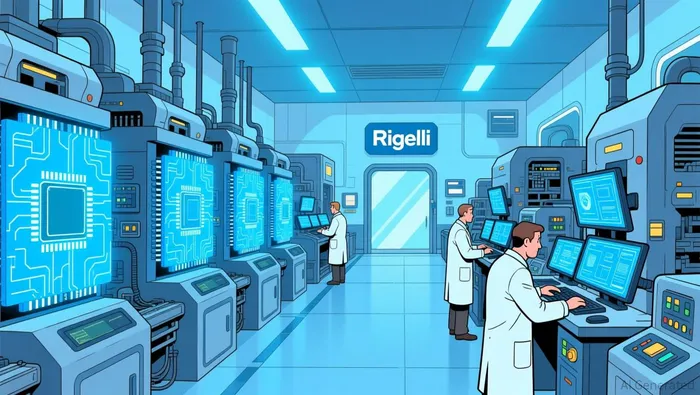
The key to overcoming the physical limits of scaling lies in its chiplet-based architecture. Instead of trying to cram all qubits onto a single, unwieldy chip, Rigetti connects smaller, specialized chiplets. This modular approach is explicitly designed to enable its target of 1,000+ physical qubits by 2027. The company is already demonstrating this strategy with its current Cepheus 36-qubit to 108-qubit systems. The chiplet design allows for more efficient fabrication, easier testing, and a clearer path to integration at the scale needed for quantum advantage.
This strategy contrasts sharply with competitors like IonQ, which is targeting 256 physical qubits by late 2026. IonQ's approach focuses more on maximizing qubit count within a trapped-ion system, often prioritizing high fidelity per qubit. Rigetti's chiplet architecture represents a different scaling paradigm-one that trades some of the pure qubit-count race for a potentially more manufacturable and integrable foundation. The goal is not just more qubits, but a system that can reliably deliver them.
Viewed through the lens of the technological S-curve, Rigetti is investing heavily in the infrastructure layer that will eventually support exponential growth. The chiplet design and in-house fab are bets on a scalable, cost-effective production method. The company's recent launch of its 108-qubit system is a milestone, but the real investment is in the architecture that will carry it to 1,000 qubits. This is the long game of building the rails, where today's capital intensity is the price paid for securing a position on the steep part of the adoption curve.
The Security Catalyst: A Compressed Timeline for Adoption
The investment thesis for quantum infrastructure is being turbocharged by a powerful, non-technical catalyst: the accelerating threat of quantum decryption. This isn't a distant future concern; it's compressing the timeline for adoption and creating urgent demand for both post-quantum cryptography and, paradoxically, the quantum hardware needed to develop and test it.
The core driver is a dramatic shift in technical estimates. Research published in early 2026 suggests that breaking widely used cryptographic systems could require as few as 100,000 physical qubits. This is a staggering drop from the 20 million qubits estimated just a few years ago. For elliptic-curve cryptography, which secures Bitcoin and digital signatures, the estimate is under 500,000 qubits. While these are still theoretical, the narrowing gap between today's capabilities and a potential attack vector is forcing a strategic rethink. The past 18 months represent one of the more notable changes in quantum threat assessment in recent years.
This compression fuels the "harvest now, decrypt later" threat model, where adversaries are already collecting encrypted data today, knowing they can crack it once powerful quantum computers exist. This creates immediate, high-stakes pressure for organizations to migrate to post-quantum cryptography. The urgency is being amplified by governments. The UK's recent $100 million investment initiative in quantum technology is a clear signal of strategic backing for the infrastructure layer. It signals that national security and economic competitiveness are now tied to quantum readiness, potentially boosting investment in the entire ecosystem.
For a company like Rigetti, this catalyst is a double-edged sword with profound implications. On one hand, it validates the long-term infrastructure bet. The push for post-quantum standards and migration will likely increase demand for quantum hardware, not just for attacks, but for research, testing, and potentially even the development of new quantum-resistant algorithms. On the other hand, it raises the stakes for the race to scale. The compressed timeline means the window for building a commercially viable, large-scale quantum computer is now tighter. The company's chiplet architecture and in-house fab are no longer just about efficiency; they are about securing a position on the steep part of the adoption S-curve before the security-driven demand surge becomes overwhelming. The catalyst has arrived, and it is accelerating the entire paradigm shift.
Valuation and Scenarios: The Dilution Risk vs. Paradigm Payoff
The market's verdict on Rigetti's infrastructure bet is clear in the stock price. Despite meeting adjusted earnings expectations, the shares dipped on the news, with the stock falling 7% to $19.07 in recent trading. This reaction captures the core tension: the company is executing on its roadmap, but the valuation is pricing in the vast gap between today's $4.4 million in quarterly revenue and the exponential adoption that will eventually justify its massive capital intensity.
The primary risk is a technological lag. The security-driven demand surge is compressing timelines, but the industry remains in the NISQ era, where systems are still far from commercial advantage. If Rigetti's chiplet architecture and in-house fab cannot scale to its 1,000+ physical qubit target by 2027 at a competitive cost and fidelity, it risks falling behind. The upside, however, is a dominant position in the quantum infrastructure layer. By building the rails-its dedicated fab, its chiplet design, and its cloud-accessible systems-it aims to capture leading share as the paradigm shift accelerates.
Key watchpoints are the 2027 target and the company's ability to manage dilution. The recent cash balance of $569 million provides a multi-year runway, but funding the continued expansion of Fab-1 and R&D will require disciplined capital allocation. The market's skepticism, reflected in the stock's dip, is a reminder that every dollar spent is a dollar not yet generating revenue. The scenario that plays out will determine if this is a strategic investment in the future or a costly bet on a timeline that may not materialize.
Viewed through the S-curve lens, Rigetti is on the steep part of the adoption curve, but it must climb it alone. The security catalyst validates the long-term thesis, but the immediate path is paved with high costs and dilution. The company's ability to translate its architectural bets into tangible scaling milestones will decide whether the current valuation gap closes or widens.