

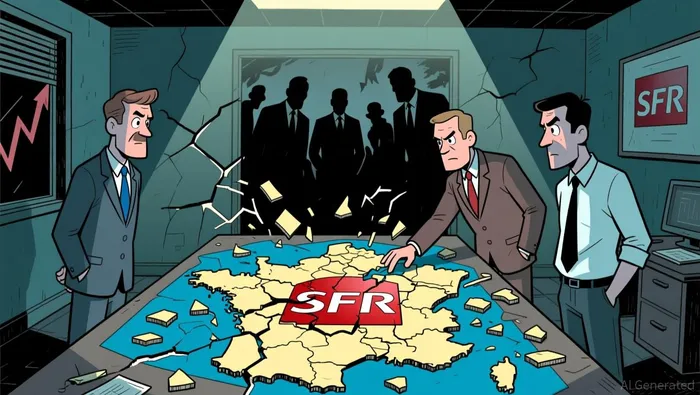
Three companies that compete with each other every day formed a consortium to buy a fourth company that also competes with them, then immediately agreed to tear it apart and split the pieces.
Bouygues Telecom, Free-iliad, and Orange signed a deal on Saturday to acquire Patrick Drahi's SFR - France's second-largest telecom operator - for €20.35 billion, which works out to roughly $23.4 billion at current rates. Bouygues gets 42 percent of SFR's assets, Free gets 31 percent, and Orange gets 27 percent. No one is merging. No one is creating a champion. They're running a coordinated liquidation and calling it strategic investment.
That was weird. But not the weirdest part.
The basic point is not that French competitors are teaming up. That happens. The basic point is that Patrick Drahi has spent the last several years systematically bleeding his lenders dry, and this sale is the final exit from a company he built with borrowed money and has been dismantling with borrowed time.
To understand what sort of machine SFR actually is right now, you have to start with the debt, not the towers.
Altice France - Drahi's holding company, and SFR's parent - was loaded with roughly €23 billion in debt heading into its restructuring. That debt grew from €2.2 billion in 2013 to around €50 billion across the wider Altice empire by 2017, fueled by a feverish acquisition spree when rates were low and investors weren't paying attention to the plumbing. Drahi owns just 55 percent of Altice France now, after creditors were coerced into swapping €8.6 billion of debt for equity in a February 2025 deal that the FT described as having "weakened the position of lenders." In June 2025, Altice France filed for Chapter 15 protection in the Southern District of New York - a move that lets a foreign entity enforce its French restructuring plans on US-based creditors who might otherwise try to seize assets. New filings in February 2026 showed Drahi shifting assets worth billions away from creditors even as he talked to them.
In plain English: this is a serial liability management operation. The company has been surviving not by growing SFR but by convincing its lenders at each stage that the alternative is worse. And at some point during that process, SFR itself became the remaining asset everyone still wanted.
Now, back to the buyers.
The consortium structure solves a regulatory problem. France has four national telecom operators: Orange, SFR, Bouygues, and Free. If any single company bought SFR outright, ARCEP - France's telecom regulator - and the European Commission would have blocked it as an obvious concentration. By forming a consortium that carves SFR into three chunks and distributes them to its three existing rivals, the deal shrinks the market from four operators to three, but does so in a way that no single company looks dominant.
The math suggests this is about margin, not market power. Telecom in France is a low-growth, cash-flow business where network infrastructure costs are enormous and price competition keeps margins thin. Adding SFR's customer base to existing operations should reduce the per-customer cost of network maintenance and spectrum licensing. Bouygues gets the biggest slice because it's the smallest of the three - it needs the most incremental scale. Free gets the second-largest because its parent Iliad has been the disruptive underpricer in the market for a decade and could use more coverage density. Orange, the largest and most profitable, takes the smallest slice because it doesn't need the scale the same way.
That's the story the buyers tell themselves. The real question is the price.
€20.35 billion "including debt" is the language here. We don't have the clean equity price broken out yet, and that gap is telling. In leveraged buyouts and restructuring exits, the total enterprise value is always bigger than the cash changing hands because the buyers assume the liabilities. The equity price could be significantly smaller than the headline number. We should expect that clarification in coming days.
Here's the structural judgment.
This deal is not really a story about French telecom competition. It's a story about what happens when a leveraged roll-up strategy runs out of runway and the only remaining valuable asset is the one the market still understands. SFR is a phone company. Everyone knows what a phone company does. It's the rest of Altice - the cable operations, the European diversification, the opaque corporate layers - that became the problem.
Drahi built Altice as a leveraged aggregator: buy infrastructure-heavy assets, load the subsidiary with debt, use the parent's credit to bridge gaps, and repeat. The model works beautifully until rates rise or a major subsidiary can't service its own borrowings. Then it becomes a liability management game where the owner's only leverage is the fact that he holds the last remaining asset buyers actually want.
The creditors are the real losers here, not the competitors. Over the past three years, they've been forced through equity swaps, Chapter 15 coercion, and asset shifts. Now the crown jewel is being sold, and the recovery math on what's left of Altice France outside SFR looks like the sort of puzzle that keeps distressed fund analysts awake at night. Drahi has been "besting his lenders yet again," as The Economist put it in December, and this sale is the final move in that pattern.
As for the buyers, they're doing something that looks competitive on paper but is really a margin play wrapped in consortium clothing. France goes from four operators to three, and the EU regulators will have to decide whether that's acceptable because no single company owns more than 42 percent of the combined entity. The formal antitrust test hasn't happened yet, and it will be interesting to see whether Brussels accepts the argument that a carved-up SFR is no different from the four-operator market it replaces.
The structural implication is simpler than any of that. When a leveraged empire finally liquidates, the asset that sells cleanest is the one you can explain in a sentence. SFR is a phone company. The rest of Altice is a debt problem with a brand name.