

Rivian's Q1 results delivered a mixed picture that neither confirms nor contradicts the path to profitability-it simply establishes the baseline from which that path must be built. Revenue of $1.4 billion edged past estimates of $1.37 billion, with 11% year-over-year growth driven by a 49% surge in software and services revenue to $473 million. That segment now contributes $181 million in gross profit, a meaningful offset to the core automotive business that continues to bleed.Automotive gross profit loss of $62 million underscores the fundamental challenge: Rivian still loses money on every vehicle it delivers.
The gross margin improvement to 9% reflects both the software mix shift and early cost discipline, but it remains far from the threshold needed to offset fixed costs. The adjusted EBITDA loss of $472 million sets the stage for a full-year guidance range of $1.8 billion to $2.1 billion in losses-roughly where Wall Street expects, but still requiring substantial capital to fund. Cash equivalents of $4.8 billion provide approximately three quarters of runway at current burn rates, making the timing of external capital inflection points critical.
Here's where the portfolio logic tightens: the $2.55 billion in expected strategic partner capital in 2026 and the potential $4.5 billion DOE loan for Georgia expansion are not optional-they are prerequisites for reaching the R2 ramp without a funding gap. The R2 itself, with a starting price of $59,485 and a bill of materials expected at roughly half the R1 platform, represents the primary lever for turning automotive gross profit positive. Without R2 scaling as planned, the math doesn't work.
The Q1 beat on revenue and EPS (adjusted loss of $0.54 versus $0.60 expected) provides some tactical breathing room, but it doesn't change the strategic imperative. Rivian's path to profitability is binary: R2 execution succeeds, and the cost trajectory turns positive in 2027; R2 stalls, and the cash position becomes a countdown clock. For now, the numbers support a hold stance-no evidence of near-term profitability, but no funding crisis imminent either. The burden of proof rests entirely on R2 delivery numbers in the coming quarters.
R2 Launch: The Make-or-Break Product Cycle
The R2 represents Rivian's clearest path to scale economics-and its greatest execution risk. Unveiled at SXSW on March 12, 2026, the production-spec midsize SUV carries a starting price of $59,485 that positions it directly against the Tesla Model Y, the segment benchmark. That's a competitive position, but it leaves minimal margin buffer once production costs are accounted for.
The initial trim lineup targets the premium end of the segment: a 450hp AWD Premium and a 656hp Performance variant, both sharing an 87.9-kWh battery pack rated at 330 miles of driving range. Rivian has indicated a more affordable $48,500 trim arrives in 2027, which will be critical for volume penetration-but that also means the 2026 delivery mix will be skewed toward higher-priced configurations, potentially constraining unit growth in the near term.
Here's where the portfolio logic tightens: analysts expect 17,200 R2 deliveries in 2026, while Rivian has implied a target of 20,000-25,000 units. That gap matters. The company's full-year guidance of 62,000-67,000 vehicles assumes R2 contributes meaningfully to the mix-but if production ramp stalls or demand softens at the $59,485 price point, the entire profitability timeline shifts. The R1 platform loses money on every unit delivered; the R2 must turn automotive gross profit positive to change the equation.
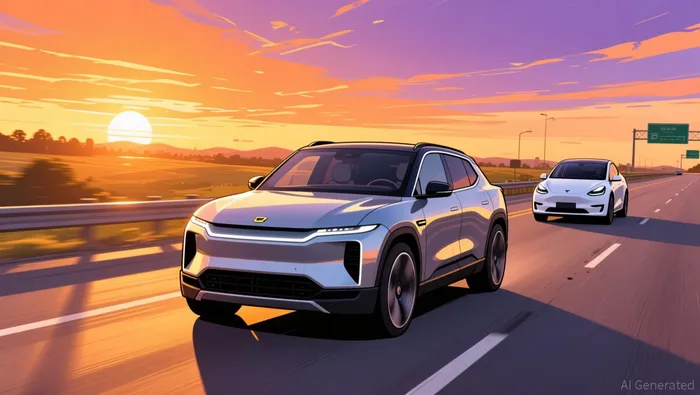
The Uber robotaxi partnership adds a potential demand buffer. Under the agreement, Uber will deploy 10,000 R2 vehicles for autonomous ride-sharing starting in 2028, with potential to buy 40,000 more by 2031. That's a committed offtake agreement at a time when Rivian has no other guaranteed volume. But it's also years away from contributing to revenue, and the technology readiness timeline remains uncertain.
For now, the investment case rests on a simple binary: R2 execution succeeds, and Rivian reaches scale economics in 2027; R2 stalls, and the cash position becomes a countdown clock. The pricing is competitive, the specifications are competitive, but the margin structure is the constraint. At $59,485 starting price, Rivian is betting that volume will drive costs down fast enough to avoid another round of painful price cuts. That's a reasonable bet-but it's still a bet.
Autonomous Partnership with Uber: Strategic Optionality or Distraction?
The Uber robotaxi deal injects $300 million in near-term capital with a potential $1.25 billion follow-on through 2031-but the revenue timeline extends three years out, creating a meaningful gap between cash receipt and earnings contribution.
Uber will deploy 10,000 R2 vehicles in Miami and San Francisco by 2028, with an option to expand to 50,000 vehicles across 25 cities by 2031. The initial investment provides tangible balance sheet relief at a time when Rivian is burning roughly $472 million per quarter on adjusted EBITDA. That's approximately six months of runway added without diluting existing shareholders or triggering a financing round at potentially unfavorable terms.
The strategic logic extends beyond cash. Rivian's third-generation autonomy platform, unveiled in December 2025 and scheduled to debut in the R2 model in late 2026, gains a committed deployment partner. The partnership accelerates Level 4 autonomy development by providing real-world data from a scaled fleet operating in diverse urban environments-exactly the kind of mileage accumulation that drives down perception and decision-making costs in autonomous systems.
But the competitive positioning is problematic. By embedding Rivian's autonomy stack in Uber's platform, the company places itself in direct competition with Waymo, which already operates driverless ride services in Atlanta, Austin, and multiple other cities. Waymo has a head start of several years and has demonstrated operational scale that Rivian cannot yet match. The partnership essentially bets that Rivian's hardware and software integration can close that gap within a three-year window-a non-trivial proposition.
Here's where the portfolio logic tightens: the $1.25 billion in contingent capital is tied to autonomy milestones, not vehicle deliveries. If Rivian misses those technology benchmarks, the follow-on funding evaporates. The initial $300 million is secured, but the bulk of the deal remains conditional on execution in an area where Rivian has no proven track record.
The vehicle delivery schedule creates a second layer of risk. Even if the technology works as intended, meaningful revenue recognition doesn't begin until 2028 when the first 10,000 vehicles enter service. That's a two-year gap from current production timelines, and the R2 itself is still ramping toward volume in 2026-2027. The partnership doesn't solve the near-term profitability problem-it defers the question.
For a hedge fund managing risk-adjusted returns, the Uber deal is a classic optionality play: limited downside (the $300 million cash infusion), asymmetric upside (if autonomy scales as envisioned, Rivian captures a meaningful share of the robotaxi market), but significant execution risk in the intermediate years. The key question isn't whether the deal is valuable-it clearly is-but whether Rivian can survive the gap between capital receipt and revenue contribution without additional funding.
The answer depends entirely on R2 production scaling. If Rivian can hit its 62,000-67,000 vehicle delivery target in 2026 and begin turning automotive gross profit positive, the Uber partnership becomes a strategic accelerant. If R2 stalls, the $300 million becomes a bridge that extends the countdown clock rather than a foundation for profitability.
From a portfolio construction standpoint, the Uber partnership adds a controlled bet on autonomy execution without materially altering the core investment thesis. It's a hedge against the possibility that Rivian's hardware platform becomes the preferred chassis for autonomous deployment-but it's not a substitute for the fundamental requirement: delivering vehicles at scale while holding costs down. The partnership is optionality, not a solution.
Investment Implications: Risk-Reward at Current Levels
Rivian presents a binary investment case where execution on R2 production scaling and autonomy deployment determines whether the stock delivers meaningful returns or faces severe dilution. The Q1 results establish a clear baseline: $4.8 billion in cash against roughly $2 billion in annual adjusted EBITDA losses provides approximately two years of runway-but only if R2 ramps as planned. That conditional timeline is where portfolio risk concentrates.
The catalyst sequence is straightforward. R2 production ramp begins in Q2 2026, with initial deliveries targeting 20,000 to 25,000 units annually-significantly above analyst expectations of 17,200. Success here matters because the R2's bill of materials is approximately half of the R1 platform, creating a path to turning automotive gross profit positive. If Rivian hits its full-year delivery guidance of 62,000-67,000 vehicles and achieves structural cost reductions, the adjusted EBITDA loss could narrow meaningfully in 2027. The Uber robotaxi partnership adds a secondary catalyst: 10,000 R2 vehicles deployed in Miami and San Francisco by 2028 would generate revenue recognition and validate the autonomy stack, while the potential $1.25 billion in contingent capital provides a funding backstop if milestones are met.
The DOE loan for Georgia expansion remains a critical third catalyst. At up to $4.5 billion, it would materially extend runway and fund capacity needed for R2 scaling-but closing is contingent on meeting federal requirements and maintaining production timelines.
The risk profile is equally structured. R2 demand shortfall represents the primary downside: if the $59,485 starting price proves too high for mass-market adoption, or if production complexity delays the ramp, Rivian faces a volume gap that strains the cash position. Automotive gross margin deterioration remains a concern-the business still loses $62 million on every vehicle delivered, and the software segment's $181 million gross profit contribution isn't yet large enough to offset that bleed. Autonomy development carries technology risk: Waymo already operates driverless ride services in multiple cities, and Rivian's third-generation platform must close a multi-year gap to compete effectively in the Uber partnership timeline. Competitive pressure from Tesla's Model Y and emerging Chinese EV makers adds pricing headwinds in the exact segment where R2 needs to gain traction.
From a portfolio construction standpoint, the capital structure creates a hard constraint. At current burn rates, Rivian needs to reach profitability or secure additional financing within roughly two years. If R2 execution stalls or autonomy costs escalate, equity raises become likely-potentially at distressed valuations. The $2.55 billion in expected strategic partner capital in 2026 provides some near-term relief, but it's not a substitute for operational execution.
The investment thesis simplifies to a single question: Can