

Summary
- RocketDNA shareholders approved every AGM resolution on May 28, including a renewed 7.1A mandate that removes the 15% cap on share issuance.
- The headline narrative - "shareholder backing" - is a false narrative. The mandate authorizes the board to issue unlimited new shares without asking shareholders again.
- Q1 2026 results are the real story: revenue up 49% year-over-year and the company achieving its first positive operating cash flow.
- Cash generation is encouraging but still tiny. At roughly A$27 million in market cap and around A$0.025 per share, the math is unforgiving.
- In my opinion, RocketDNA remains a speculative hold. The operating inflection is real, but the dilution key is now unlocked.
The press release language is standard corporate optimism: RocketDNA shareholders backed all resolutions at the May 28 AGM, including director re-elections, remuneration, and the 7.1A mandate. Framing unanimous AGM approval as evidence of shareholder confidence is the false narrative that deserves attention here.
Let me explain what the 7.1A mandate actually does. Under normal ASX rules, a company can issue new shares worth up to 15% of its existing equity without going back to shareholders. The 7.1A mandate removes that ceiling. It gives the board authority to issue new shares with no meaningful cap, for the next 15 months, without another shareholder vote. That isn't confidence. It's a dilution key.
That being the case, the question isn't whether shareholders showed up and clicked the right button at a virtual meeting. The question is what happens when a company that raised A$4 million by issuing shares at A$0.015 in November 2025 - and now trades around A$0.024 to A$0.025 - has unlimited authority to do it again.
Here is what the market is not discussing: RocketDNA reported its March 2026 quarterly results showing revenue growth of 49% year-over-year and the company's first positive operating cash flow. For a company that has burned cash for years, this is a genuine operating inflection. Revenue for FY2025 sat at A$7.68 million. A 49% acceleration in a single quarter is the kind of step change that turns cash-burn companies into self-funding ones - if it holds.
However, the scale matters. Even with the improvement, we are talking about a company generating cash in the hundreds of thousands per quarter, not the millions. The A$4 million placement in November was roughly equal to four to five quarters of positive operating cash flow at this new run rate. One more dilutive raise at or below the current price wipes out the progress.
The 7.1A mandate makes that scenario easier, not harder. The board no longer needs to convince shareholders it deserves more capital. It simply needs to justify the raise in an ASX announcement. That is a lower bar, and it works against existing shareholders every time the share price is weak.
There is also the question of who held the votes that approved the mandate. Sadietilly Capital, a substantial holder at approximately 13.6% of the company, sits in a position where dilution works differently for a long-term insider than for a retail holder who bought at a higher price. That structural misalignment doesn't mean the mandate was a bad vote - it means the vote wasn't as uniformly in all shareholders' interest as the headline implies.
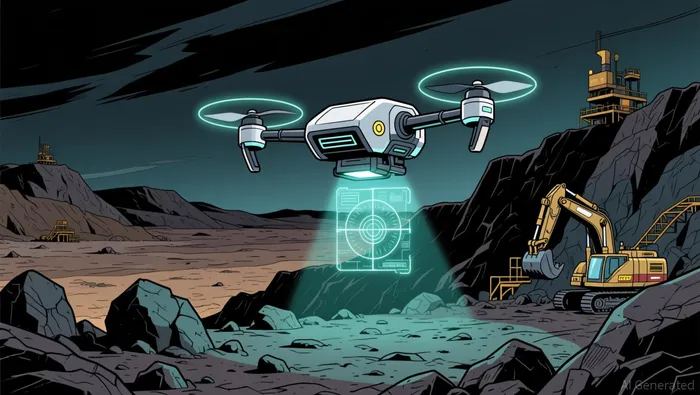
RocketDNA's business model - autonomous drones-as-a-service with its Skylink software platform deployed at mining sites - is worth examining on its own merits. The company is testing with tier-1 mining customers and building monthly recurring revenue. The drone monitoring market for mining, agriculture, and infrastructure inspection has real secular tailwinds. If the Q1 cash flow improvement represents a durable shift rather than a one-quarter blip, the company crosses a line that separates funded startups from operating businesses.
But I evaluate companies on the mechanics of how they fund the gap between revenue and scale. RocketDNA's answer to that gap has been issuing shares. The 7.1A mandate formalizes that playbook. There is no dividend. There is no free cash flow yield to anchor the valuation. There is no balance sheet that stands on its own. What there is is a mandate to raise more capital by printing more shares, whenever management decides the runway needs extending.
Comparisons with profitable, cash-generating small caps are not only unjustifiable and irrational; in my opinion, they are irresponsible. RocketDNA is a pre-scale operator that has now authorized its own dilution mechanism. That is neither bullish nor bearish on its own - it's a fact of the capital structure. Investors should treat it as one.
For investors who can tolerate the dilution risk and believe the 49% revenue acceleration is the start of a sustained cash-flow inflection, RocketDNA remains a speculative hold at these levels. The operating data from Q1 gives the thesis a chance to prove itself. But the 7.1A mandate means the company's ability to extend that runway comes at your expense, not the board's. That is the structural reality behind the AGM headline, and it changes how you should think about every share you own.